THE OLIGARCHY THIS TIME By Eva von Redecker *** The Montréal Review, September 2026 |
|||
“We have no words to waste on you. When you reach out your vaunted strong hands for our palaces and purpled ease, we will show you what strength is. In roar of shell and shrapnel and in whine of machine-guns will our answer be couched. We will grind you revolutionists down under our heel, and we shall walk upon your faces. The world is ours, we are its lords, and ours it shall remain.”[1] This threat, eerily contemporary in an era of unhinged neo-imperialism and suppression of domestic dissent in the US, hails from a nearly forgotten novel by Jack London. The Iron Heel was published in 1908. Its characters are familiar from political novels of the time: a strong but utterly devoted bourgeois woman, the narrator, eulogizes her husband, a martyr to the workers’ revolution. Ernest Everhard is at once a science-loving Russian nihilist and a shining light of expressionist humanism. His Franko-Germanic name literally translates as “Hard-as-a-Boar.” But the revolution Everhard lives and dies for has anything but the standard plot of the early twentieth century. At a time when belief in proletarian-led progress was firm, union organizing at an all-time high, and the slaughter of World War I unimaginable, Jack London painted the bleakest picture of world history. It’s still unsettling today, which says a lot. London’s novel is framed as if the report were edited from the archives, annotated by scholars in a future of socialism finally victorious. Their perplexed footnotes are some of the highlights of the text, musing about the mystifying distinctions between native- and foreign-born people, the outrage of having to pay for things, and men’s long-overcome habit of breaking furniture when quarreling with their wives. However, actually defeating such quaint social absurdities, according to this account at least, requires nothing short of 300 years of bloodshed. The last third of the book contains little else. Dispersed revolutionaries pride themselves on targeted assassinations, while the oligarchy, which has taken over state power, is committing mass slaughter in the streets of Chicago. The narrative is presented as a love story, but by far the most physical contact reported by the narrator is the sensation of subproletarian corpses piling up on top of her. The threat I quoted above (“we have no words to waste on you…”) marks the turning point towards that grim trajectory. Ernest, the professional revolutionary, has just given a lecture to a room filled with notables of society. He has proved to them that the course of history inevitably runs towards socialism. His arrogant account reads a bit like a caricature of scientific Marxism, but it is also an impressive document of the will to popularize radical ideas. Ernest recounts how capitalist laws of development lead to the formation of ever greater associations. Factories take over from artisans, then trusts take over from factories and destroy the middle classes. “Amidst the crashing of the middle men, the small business men and manufacturers, the trusts stood firm. Nay, the trusts did more than stand firm. They were active. They sowed wind, and wind, and ever more wind; for they alone knew how to reap the whirlwind and make a profit out of it. And such profits! Colossal profits!”[2] At this point his account is still confident. There exists an association larger than the trusts, the supreme association, that of all working people: socialism. However, that one angry listener to Ernest Everhard leaps up and predicts that even the vastest number of humans would be powerless against those who control the profits, should the latter decide to pool their resources in class warfare. And that’s exactly what they do. The oligarchs’ association, the Iron Heel, buys secret agents and militias – modeled on the Pinkerton brigades, who acted as hired strike-breakers during the gilded age – and unleashes preemptive combat. Facing this, Everhard, who can never not be right, now excels in pessimistic prophesies. The Iron Heel will win elections by manipulating farmers. They do. The Iron Heel will buy the press and slander working class leaders. They do. The Iron Heel will infiltrate the movement and provoke premature uprisings, which can only fail. They do. It’s rather disquieting that the only positive prospect in all this is tied up with eugenic beliefs, which Jack London is known to have held. He has his hero predict the successful division of the working people via a caste system between privileged professionals and unskilled workers (note the glaring absence of race in London’s account, though he is exceptionally clear-sighted about intra-class splits). Allegedly, however, the upper castes of labor will be weakened by degeneration and comfort, and only then can the revolution finally prevail. To quote once more from the jarring original, in which Everhard lectures his spouse and biographer: “Under the oligarchs will flourish, not a priest class, but an artist class. And in place of the merchant class of bourgeoisie will be the labor castes. And beneath will be the abyss, wherein will fester and starve and rot, and ever renew itself, the common people, the great bulk of the population. And in the end, who knows in what day, the common people will rise up out of the abyss; the labor castes and the Oligarchy will crumble away; and then, at last, after the travail of the centuries, will it be the day of the common man. I had thought to see that day; but now I know that I shall never see it.”[3] He paused and looked at me, and added: “Social evolution is exasperatingly slow, isn’t it, sweetheart?”[4] The details are hard to bear. But the thing about Jack London’s take is that he was right about one crucial point. Theodor W. Adorno himself, the intellectual center of the first generation of Frankfurt School philosophers, credits Jack London with having “accurately predicted”[5] fascism. Max Horkheimer, the director of the Frankfurt Institute, concurred. In 1939 he ended his first substantial attempt to theorize Hitler’s rule by calling the old continent “the Europe of the Iron Heel.”[6] This text, an essay entitled “The Jews and Europe,” also contains a line recently trending on social media: “But whoever is not willing to talk about capitalism should also keep quiet about fascism.”[7] To contemporary ears, this might sound like a punchline, but in Horkheimer’s context it is an admission of despair. Speaking of two things in conjunction, after all, is a far cry from actually theorizing them. They were Marxists. Of course they thought that fascism and capitalism were somehow connected. But their belief in the forces that could overcome capitalism had just collapsed. Radical philosophy would have to be rebuilt from ground zero. The Marxist-Leninist party line in the early 20th century understood fascism as a conspiracy of sorts, a reign of terror consciously set up by the bourgeoisie to crush proletarian resistance. In actual historical fact, though, there was no real danger to private ownership of the means of production in Italy or Germany in the 1930s.[8] Some communists integrated this situation into their views. Clara Zetkin, for instance, claimed that fascism was the “punishment”[9] for a working class that had failed to fulfil its world-historic mission. But what if world history was on a different course altogether? That is the staggering lesson which the early Frankfurt School scholars contemplated vis-à-vis the reality of fascism. After all, the working masses were not just “punished” by a cabal of business magnates. Large numbers of them partook in a state project aimed at cleansing Jews and other “heterogenous” elements from society, and in conquering Western Europe and colonizing the East. If one reduces this to a top-down conspiracy, “the true horror of fascism is conjured away,”[10] as Adorno puts it.[11] Curiously, however, Jack London with his “we-will-walk-upon-your-faces”-bosses is singled out for praise. This is because, according to Adorno, he saw the butchery not as a mere cabal, but as “a slow end-product of the concentration of social power.”[12] Used to Cold War explanations of fascism as totalitarian collectivism, we might find that the nuances between London’s Iron Heel and the Comintern’s account of bourgeois terror elude us. Both feature evil bosses colluding to crush the workers. But it matters whether one sees this as a mishap, a deviation from the correct revolutionary path of history, or as a new insight into history’s much more sinister trajectory. In the Dialectic of Enlightenment, Adorno and Horkheimer attempt to reconstruct the latter. They reach back into pre-history, even natural history, to trace an instrumental form of reason which would eventually tip from enlightenment into barbarism. It’s capitalism that makes it tip, but only because capitalism has internally collapsed into something else already, a rule no longer of the invisible hand of the market but of the very visible heel of the monopolies. Monopolies embody what Adorno and Horkheimer call the loss of mediation. They skip the detour via the market, and with it even that one-sided form of “[t]hinking, which had developed though transactions, as a result of egoism’s need to negotiate.”[13] The effect is “direct rule” aimed at “violent appropriation.”[14] We might want to pause here and recall Donald Trump’s recent paean to property. With Greenland in mind, he stated in Davos as well as in a lengthy NYT interview: “Ownership is very important. Because that’s what I feel is psychologically needed for success. I think that ownership gives you a thing that you can’t do, whether you’re talking about a lease or a treaty.”[15] Contract turns into grabbing right in front of our eyes. The Dialectic of Enlightenment, however, does not ascribe this move to the propensities of boasting leaders, but to an inner logic of monopolization. Once monopolies are established, the loss of the mediating detour via free contracts leads to a loss of any rule of law. Civil law ceases to be an instrument of regulation and becomes “a mere instrument of terror.”[16] And private law, the very basis of the liberal social contract formed around the protection of property, evaporates too. “Monopoly, as the consummation of private property, is annihilating the latter’s concept,” write Adorno and Horkheimer.[17] We might read this as an exaggerated delight in negative dialectics (the turning of something into its opposite without a revolutionary breakthrough). But it is also a pretty good description of something that is unfolding in front of our own eyes. Recall Trump’s “argument” for why he deserved Greenland: because Denmark allegedly was unable to protect it. That’s the logic of grabbing, not the logic of property, which would secure the title against the thief. It is the same logic which Curtis Yarvin, in his so-called “formalist manifesto,” recommends to settle all disputes over things: Let the most powerful have them straight away.[18] And having things and ruling them, according to Yarvin, should coincide. This is not a relapse back into a feudal world where rule over land and rule over people were undifferentiated. The rule recommended here is not a matter of feudal privileges and protection. It is modelled on the very modern form of absolute dominion, sovereignty over things, which has intensified while ruling over people – imperium – became tied to contractual consent. This crude control of the owner is the common denominator of the CEO and the monarch which neo-reactionaries interchangeably extol as the appropriate leader figure. Hardly any real king, with the exception of Leopold II’s horrendous colonial rule over Congo,[19] actually ruled as an owner. The world’s leading CEOs, however, do exactly that. As Katharina Pistor puts it, “Facebook, Google, and Amazon all have chosen governance structures that perpetuate the founders or owners in office, irrespective of any change in the future composition of shareholders or their desire to put new management in their place.”[20] For Elon Musk’s empire of firms and the new generation of AI companies, this is even more firmly the case. It is worth noting that Franz Neumann, the great political scientist of the early Frankfurt School, described the same trend in his day. In spite of all its propaganda targeting farmers, tradesmen and the petty bourgeoisie, the Third Reich actually promoted a small number of big industrial syndicates. Neumann recounts this economic organization in detail and also describes how the prevalent management model reverted from shareholder democracy into full authority of the board alongside the political collapse of parliamentarianism. Just as Pistor puts it for the present, Neumann concluded in 1942: “The structure of the cartels […] is autocratic.”[21] But it wasn’t so much their inner structure as their role in the overall economy which made Horkheimer and Adorno consider the monopolies trailblazers of fascism. We already saw that they skip the mediation of the market. “Competition is for losers,”[22] as tech entrepreneur, venture capitalist and apocalyptic thinker Peter Thiel infamously put it. But monopolies also demonstrate how to deal with losers. Use them as fair game. Frenzied, possessive rule is characteristic of fascism, and also of fascist individuals. According to Adorno and Horkheimer, the latter seek dominion rather than negotiation, because their souls are marked by a loss of mediation, or reflection, too.[23] Instead of oscillating between imagination and receptiveness, instrumental reason hardens into an inescapable shell, unable to distinguish between reality and its own demonizing projections. Instead of balancing between the conflicting drives to preserve and to transcend the self, authoritarian desire tips into violent assault, “since even hatred leads to union with the object – in destruction.”[24] This, then, is “the true horror,” the aspect even Jack London underestimated: The Iron Heel doesn’t just rule over, but from within its subjects. The theoretical edifice is fascinating. And yet I don’t think Adorno and Horkheimer really found a lever to link the psychology of lost mediation to its counterpart in the economy. Why does fascism from above meet a corresponding fascism from below? Why, in other words, do the tech bros co-occur with MAGA? The connection might be psychologically plausible as the slow brewing of resentment under brutalized economic laws. But neither the formation of monopolies nor the fixation on certain victim groups follows strict laws of so-called social evolution. And yet I cannot help thinking that the early Frankfurt School’s enriched Jack-Londonism is almost more plausible today than it was in the last century. Compare the switch from negotiation to usurpation with Melinda Cooper’s recent summary of the economy of our day: “Just as Epstein wanted to close off all escape routes to his female victims, Trump and his tech reactionaries want to shut down all alternatives to the household economy and turn the presidency into a founder-controlled family firm. Attacks on the administrative state, the public sector and unions, and the transformation of border control agents into a personal militia can be understood as parts of a broader programme to extend the rule of master and servant to the entire economy.”[25] Doesn’t it read like an echo of: “The world is ours, we are its lords, and ours it shall remain”? The monopolies of old, which Neumann describes, were part of a somewhat real economy. They concerned oil and grain. It is reserved for our day alone to have allowed the rise of trusts which trade nothing but AI slop after enclosing the linguistic commons. Perhaps this aspect helps to build the theoretical bridge only conjectured earlier, between the loss of mediation in the economy and in psychology. What the latest monopolies capture and commodify is, after all, the very material of reflection itself: language. Adorno and Horkheimer already worried that contact with advertising
would destroy language as a democratic tool: “The blind and rapidly spreading
repetition of designated words links advertising to the totalitarian slogan.
The layer of experience which made words human like those who spoke them has
been stripped away.”[26]
Little did they know how far that stripping would go. Rather than the “rule of
master and servant,” fascism aims for the rule of master and mute object. Maybe
the crucial lesson from London is provided not by the hero theorist, but by the
heroine narrator: Whatever they take from us, we cannot let them have the last
word!
[1] Jack London: The Iron Heel, New York: Macmillan Company 1908, p. 96 f. [2] London: The Iron Heel, p. 174. [3] London: The Iron Heel, p. 227 f. [4] London: The Iron Heel, p. 228. [5] Theodor W. Adorno: “Commitment,” pp. 177–195, in: Aesthetics and Politics, London/New York: Verso 2007, p. 184. [6] Max Horkheimer: “The Jews and Europe,” pp. 77–94, in: Stephen Eric Bronner and Douglas MacKay Kellner (eds.) Critical Theory and Society. A Reader, New York/London: Routledge, p. 94. [7] Horkheimer: “The Jews and Europe,” p. 78. [8] Michael Mann: The Sources of Social Power. Vol. 3: Global Empires and Revolution, 1890–1945. Cambridge: Cambridge University Press, p. 328. [9] Clara Zetkin: “The Struggle Against Fascism,” in: Mike Taber and John Riddell (eds.) Fighting Fascism. How to Struggle and How to Win. Chicago: Haymarket Books 2017. [10] Adorno: “Commitment,” p. 184. [11] While Adorno’s criticism here is directed at Bertolt Brecht, it also pushes back against Horkheimer’s intermittent attempt to reformulate world history as a sequence of usurping cliques, which he called rackets. Cf. Max Horkheimer: “Die Rackets und der Geist,” pp 287-291 in: Gesammelte Schriften. Vol. 12 (eds. Alfred Schmidt / Gunzelin Schmid Noerr). Frankfurt a.M: S.Fischer 1985. [12] Adorno: “Commitment,” p. 184. [13] Adorno and Horkheimer: Dialectic of Enlightenment, p. 189. [14] Adorno and Horkheimer: Dialectic of Enlightenment, p. 189. [15] David E. Sanger u.a., “Trump Lays Out a Vision of Power Restrained Only by ‘My Own Morality’,” in: The New York Times, Jan. 10, 2026. [16] Adorno and Horkheimer: Dialectic of Enlightenment, p. 189. [17] Ibid., p. 190. [18] Mencius Moldbug: “A Formalist Manifesto,” in: Unqualified Reservations, Apr. 04, 2007. [19] Thanks to Amira Möding for this point. [20] Katharina Pistor: “Rule by Data: The End of Markets?” pp. 101–124, in: Law and Contemporary Problems, Vol 83:101 (2020), p. 121. [21] Franz Neumann: Behemoth. The Structure and Practice of National Socialism. 1933–1944, Chicago: Ivan R. Dee 2009, p. 274. [22] Peter Thiel: “Competition Is for Losers,” in: The Wall Street Journal, Sep. 12, 2014. [23] Adorno/ Horkheimer: Dialectic of Enlightenment, p. 156. [24] Theodor W. Adorno and Max Horkheimer: Dialectic of Enlightenment. Philosophical Fragments. Stanford: Stanford University Press 2002, p. 165. [25] Melinda Cooper: “Epstein Family Values,” in: equator (14.02.2026). [26] Adorno and Horkheimer: Dialectic of Enlightenment, p. 135. CONTENTS
Onkel Rudi (Uncle Rudi), Gerhard Richter, 1965.
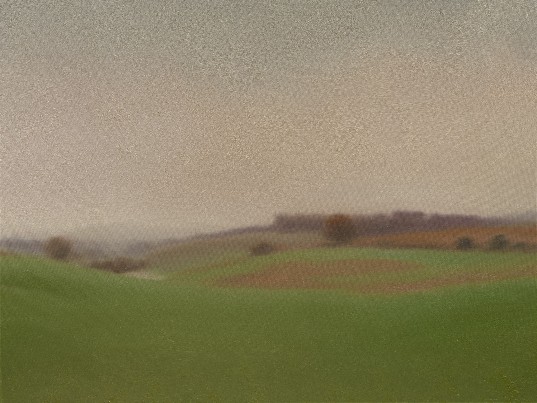
Grünes Feld (Green Field), Gerhard Richter, 1969.

A still from My Undesirable Friends: Part II — Exile (2026)
THE SKY IS BLUE: A CONVERSATION WITH JULIA LOKTEV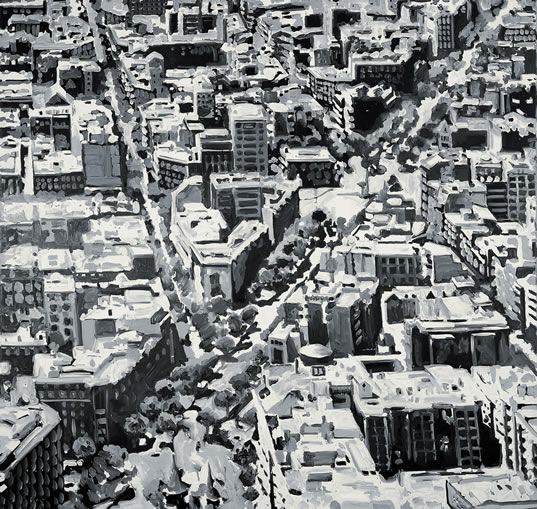
Stadtbild Madrid (Cityscape Madrid), Gerhard Richter, 1968.
INTRODUCTION: SYMPOSIUM ON CRITICAL THEORY
Relativity, M.C. Escher, 1953.
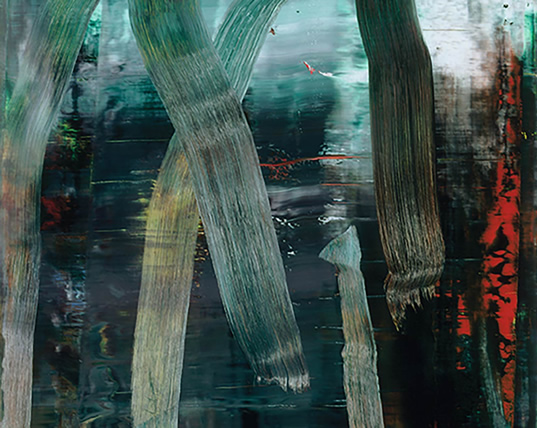
Cage 6, Gerhard Richter, 2006.
5. Jan. 98, Gerhard Richter.
|

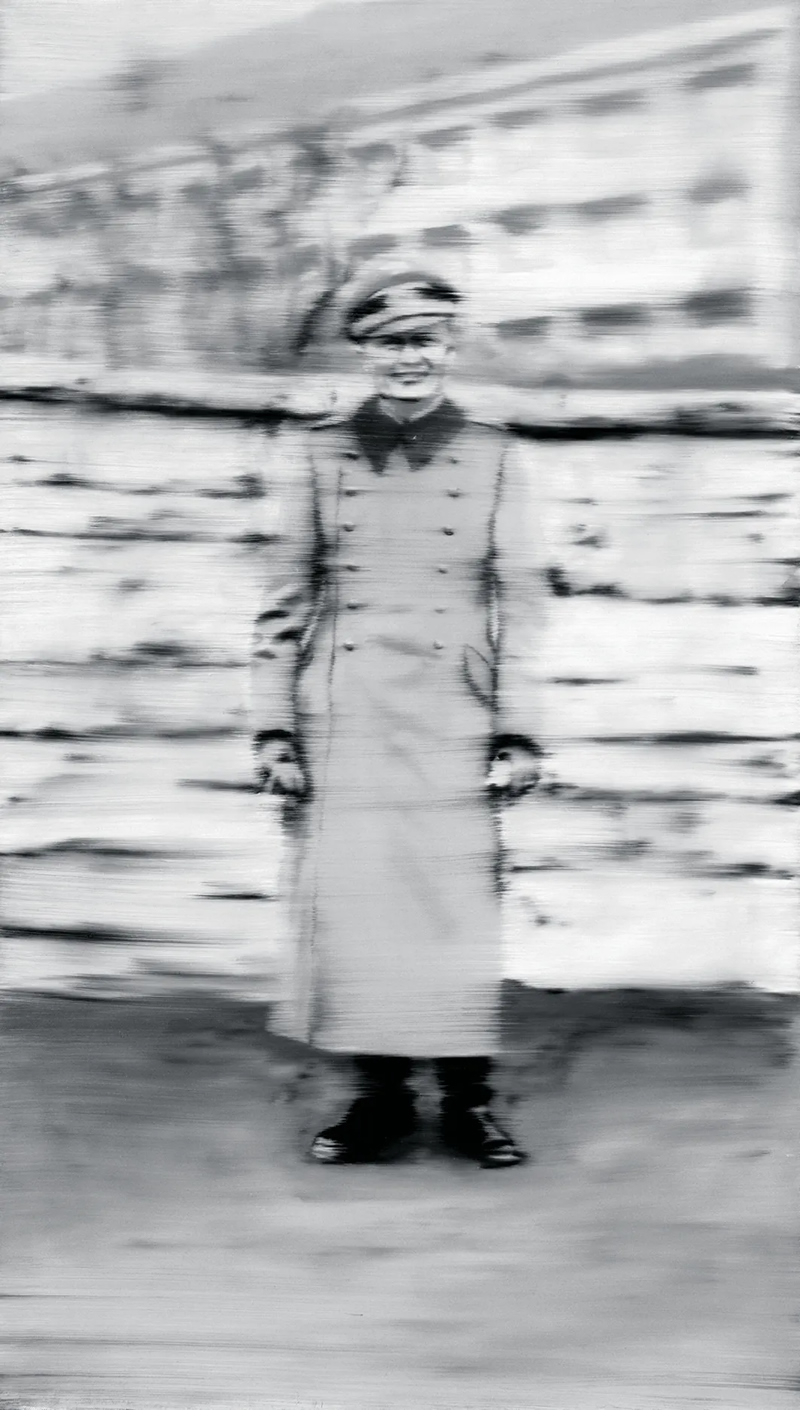
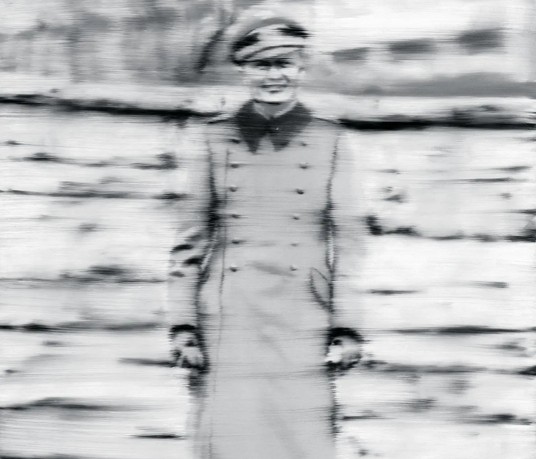
Art Note: Onkel Rudi (Uncle Rudi), Gerhard Richter, 1965. A smiling young man in Wehrmacht uniform, painted from a family snapshot and deliberately blurred, as if memory itself were trying to look away. Richter first showed the canvas at a Berlin exhibition in homage to Lidice, the Czech village the SS erased in reprisal, then gave it to Lidice outright — the perpetrator's face surrendered into the keeping of those he helped destroy. Domestic, smiling, kin: this is fascism painted not as a monster arriving from outside, but as the uncle already at the table. Oil on canvas, 87 × 50 cm. Collection Památník Lidice / Lidice Memorial, Czech Republic. Image via David Zwirner; further reference at AAEPortal. © Gerhard Richter, courtesy of the artist and Gerhard Richter Archive.