THE SKY IS BLUE: A CONVERSATION WITH JULIA LOKTEV By Martin Shuster *** The Montréal Review, September 2026 |
|||
Julia Loktev is a film director, screenwriter, and video artist. Two years ago, she released the critically-acclaimed documentary My Undesirable Friends: Part I—Last Air in Moscow (2024), a five-and-a-half-hour immersion in the daily lives of a group of Russian journalists. The second part, My Undesirable Friends: Part II—Exile, is slated to premier at the Venice film festival on September 4, 2026, and is six hours in length. The films are remarkable and incredibly timely, taking place first in Moscow in the weeks before Russia’s full-scale invasion of Ukraine and then in twelve countries, following the same characters into exile. Because of their length, the films are at the same time both intimate and sweeping, capturing the everyday lives of these journalists as they deal with the most extraordinary circumstances. I do not think it is too much to say that the films are each a kind of critical theory in action and motion. I am very grateful for the opportunity to have had a conversation with Julia on August 20, 2026. Below you will find a transcript of our conversation, which ranges across both films, and also across topics like the ordinary and the everyday; revolution and history; journalism, documentary, and film; what it means to have and screen a world; fascism; shame, necessity, and guilt; and love. And, of course, we also discuss Russia and the USA and the contemporary world. While the interview speaks for itself, I have added annotations in case any readers want to delve deeper into any of the topics we discuss.[1]
Conversation Between Julia Loktev and Martin Shuster
Martin Shuster: First of all, let me say: the films are fantastic. I had a chance to watch My Undesirable Friends: Part II—Exile, so thank you for sharing that. In a way, it brings everything full circle, because the characters are now here, in the States. And so, in a way, you’re also commenting on the USA. So, I am curious to start there, just to get a small sense of what motivated you, because my reaction when watching, especially My Undesirable Friends: Part I—Last Air in Moscow, was: “Oh man, if we stay on the course that we're on, in 20 or 30 years, this is what things look like for us.” And I don't know if you had that feeling while you were making it, or while you were sort of documenting these characters, if something like that was in the background. Because that does seem to come to the fore in Part II, when some characters are explicitly reflecting on the USA and Trump. So, I am curious to get a sense of how you position what you’ve accomplished. Julia Loktev: I don't know if it's up to me to position what I've accomplished. But in terms of how I was thinking of it, as I was making it: the world was changing around the film and what the world was fundamentally transformed. When I started out in 2021, in the fall, nobody had any idea that a full-scale war was four months away. Obviously, a low-scale war had been happening since 2014, but it was at a level that the world seemed to think was acceptable … so that it was OK to let Russia host a World Cup. But the kind of war that we've seen, now going on the fifth year, nobody could imagine. I thought I was making a film about these journalists in Russia who had been just recently—like a few weeks before—declared “foreign agents.” And they were trying to figure out: how do we live with that? I was making what was really the first chapter of this whole project. And I remember Anna Nemzer, who is the protagonist we start with and she's also a co-director on the film because we kind of conceived it together and she brought all the other characters together. At some point in the fall of 2021, she said: “Well, what are we doing here? Why are people going to be interested in this?” And we had this conversation with a couple of the characters and they were like: “Why would people be interested in this?” The film is about these, you know, very nice people that seem very funny and charming. They're living in this very weird country that does very weird things. These things seem very unpleasant, you know? And it’s all very alien, but why would this be relevant to anybody outside of Russia? And really outside of a small part of Russia, in the sense of a small part of Russian society to which this was happening? And we were making it for an international audience. All the characters were really thinking: who cares?
And then, of course, it came so full circle. First, I walked into capturing history, so, on February 24th, 2022, it became clear that this was actually something quite important, because the film was in fact about a historic moment right before Russia starts a full-scale war. It’s that small moment of transition, this little crack in the window, between—where it’s still possible to work in Russia and be the opposition to an increasingly authoritarian society, to still do some good—and between that little crack in the window slamming completely shut. And everyone I knew, all the people I was filming—and not only all the people I was filming, but literally everyone I knew in Russia—left in the course of a week. Then it became relevant because: the war, because Russia, because this historic moment, etc. This was still Biden times, you know? Were we thinking: “Oh, wow, it's so relevant, you know, for the US?” Nothing like that. And then, you know, as I was filming Part II—Exile, and following these characters as they fled their country, going from country to country to country, then, of course, Trump 2.0 happened, and it did come full circle suddenly when we released. Even then, there was a difference between when Last Air in Moscow first premiered at the New York Film Festival in the fall of 2024: it still felt very far away from people—like: “Oh, there it is looming, but we're not going to get there.” Then to last year, when it was out theatrically, and all the American critics were like: it's about us, it's about us. In response, you know, Ksyusha [Ksenia Mironova] said: “Wait, can it be about us first and then about you?” But that's definitely a reaction, you know, where unfortunately the world keeps catching up to the film, and it becomes about bigger and bigger things, through, you know, certainly no doing—and no desire—on my part. I liked it better when it was about something less, when there was no war, and no historic moment, and no relevance for anywhere else. I liked it better then. Martin: Well, I doubt you're alone there. Julia: I'm aware that I walked into telling a much bigger story. Martin: The next question I wanted to ask you is about the form of the film, because I think it's remarkable: both the length—obviously, it's long. You really follow these characters. But also the way you shoot it: it's so intimate, so close. There are very few shots that pan out. Especially for a documentary that about the topic that it is about, it’s sort of unique. I feel that often filmmakers want to zoom out, to sort of “show” you all the people that aren't present. And this film, it doubles down on its method. And in a way—at least I was struck by how with so many of the characters, their lives revolve around their phones and screens—so that’s obviously somehow in the background. Julia: Yeah, I mean, but whose lives don't right now? Martin: Right, right. But this film runs counter to that in a deep way, because it really requires a sort of attention that I think most people nowadays are not used to having. People nowadays interact with things algorithmically and piecemeal. And with this like, you’ve got to sit here for six hours and watch this. Julia: You can watch it in pieces! I think if you make one five and a half hour and one six-hour film, it is a different experience to see it in a movie theater, with a marathon, with a group of people. But I'm not going to be precious: like, oh, you have to watch it this way. If you want to watch it in your pajamas, like over the course of a day. Martin: Yes, of course. But I wonder: was there something behind it, where you were pulled to this form especially? Because I could imagine telling this story in a different way, but I think it would feel very different. It would have different sort of claim on viewers. And so: what was at stake for you there? Julia: I mean, the two words that people keep bringing up, or that keep coming up as people talk about it, are: “epic” and “intimate,” which are kind of generally thought of as a little bit in contrast with each other. Telling this historic epic, but on the most intimate kind of kitchen-table scale, like you're right there with the characters living through it. It's about lived experience. I guess with My Undesirable Friends—Part II: Exile, this is my third documentary. I've now, it seems, made more documentaries than fiction. But I really think of myself as a fiction filmmaker. That was always my intention. I've made two fiction features.[2] I'm interested in characters and stories. I approach this the way that I would a fiction film. I'm interested in the lives of people, in their emotions, in their movements, in their expressions, in their jokes, in the contradictions. It's a film about journalists, but I'm not a journalist. I'm not interested in information. I mean, you learn a lot about what the hell happened to Russia by watching this film. But you kind of learn it by osmosis, by just hanging out with people the way you would if you go somewhere. Like if you go to Brazil and you have a Brazilian friend and you're hanging out with them and you learn a lot about Brazilian politics just by hanging out. And this is kind of like that, I think. For me, it's the only thing I know: to focus on emotion and on character. And that's how the film is told. And I think that's what makes it a fairly “easy” long watch, I've been told. And because it's so immersive. Again, I'm just kind of reporting what I've been told by viewers. I don't know what it's like to watch it. I've watched it a million times. But people tell me it's quite bingeable. Because, you know, we all watch things in part to combat loneliness. You get attached to a character and you want to see them again and live through them. There were people that walked out of Last Air in Moscow, after five and a half hours, going: “I can't wait to see the next one.” And it is that sense of attachment, I think, that you have to these characters. That's what drives it. Martin: Yes. You know, I intentionally have not read any criticism of the film. So, I'm sort of surprised to hear people call it epic because I somehow actually would reject that if I was to characterize it. I think your film is really, to me, about the ordinary and the everyday. And that's what makes it so powerful. And so, I also wanted to ask you about this. And this is a sort of two-part question. On one hand, I take it that these films are about the everyday and the ordinary. To me, it seems like all the characters, prior to the [full-scale] war breaking out, are, in a way, invested in the ordinary and the everyday as a means or site or way where you can radically transform society.[3] They’re doing things on the ground, involved with NGOs, doing reporting, and so forth. The gamble seems to be that if we somehow transform our ordinary, everyday lives, then, eventually, that'll filter out to broader society and its structures. Then, [on the other hand], especially in Part II, a few of the characters—I think explicitly of Lera [Valeria Ratnikova]—have a sort of breakdown, where they’re explicitly reflecting on this gamble. And there is an especially remarkable moment. I can't remember exactly who says this. I think Anna [Nemzer] says this. She says: look, somebody told me this … that we did everything right, but we did it all in the wrong order. Julia: Yes, she says Yana told her this. Martin: And it's a really remarkable line, because in a way, having just recently taught a class on the very concept or idea of revolution, I thought a bit about this and I came to the conclusion that some grandiose idea of revolution, where you have a complete break, a big event that just changes everything suddenly—I feel that this never in fact works out. It strikes me as overly masculine, tied to some heroic sense of things. I increasingly felt drawn to an idea that the sense of revolution that we need is a kind of transformation of the ordinary, that slowly filters out to society.[4] But, watching your documentaries, it seems that, well, that doesn’t work either. So, I wonder how you think about this. I mean, this isn’t a question so much about the film, but I’m curious because this seems to be in the background here; I’m curious if you have any thoughts about this. Julia: Well, I think all of them … everyone was trying to do something in Russia to make their society better. Whether it was reporting on Russia's increasing turn to fascism, as Lena [Elena Kostyuchenko] describes it, or whether it was people who were creating, let's say, NGOs for people to help people with disabilities who are often institutionalized in Russia, it’s standard to be institutionalized [for this] in Russia. And after Russia invaded Ukraine, everyone started to ask themselves: were we wrong to do what we did? You know, were we wrong to do this? Is everything other than overthrowing the government wrong … when you can't overthrow the government? Martin: Right. It's not like there is some way to do that easily. Julia: Right. You don't know how many characters said to me: well, what I really should have done was assassinated Putin. But I'm like: were you really equipped for the job? Everything short of the assassinating [of] Putin and preventing the war felt meaningless to people, I think, because they felt such a tremendous sense of guilt and responsibility for not having stopped this atrocious war. So, they started to question everything they did because Russia still invaded Ukraine. But I don't know … if you live under a government where you cannot fundamentally overthrow that government, is it a mistake then to advocate for a law against domestic violence, for example, which does not exist in Russia to this day? Is it, as an example, a mistake to report the truth to what is a minority of the people, knowing that the majority of the people will still watch state propaganda? I don't have a clear answer. I don't know if my answer to this is as clear as: we were doing everything in the wrong order. Because I think these were people’s real frustrations. And yet all these war crimes happened. And yet we weren't able to prevent this. So, how do we think of everything we did before? As to the ordinary and extraordinary: of course, I mean, yes, the extraordinary is made up of ordinary moments, and the film is on some levels about the ordinary. But there's nothing ordinary about the fact that when we meet these characters, you walk into someone's house, and she’s like: “Oh, here's some muffins I baked.” “Oh, and by the way, this is the apartment which was searched.” And, “Oh, when masked men came in, they asked me to turn on the air conditioning.” And I said: “No, I'm not going to turn on the AC for you.” And when they were looking for like whatever in my maxi pads. So, it's this constant. This is Ksyusha, whose fiancé was arrested when she was twenty-two. He's a journalist and is now serving twenty-two years in a Siberian prison. Ivan Safronov. It's this constant collision between the ordinary and the extraordinary. In Part I, you have other characters and they're like: “Oh, yeah, our office is bugged. But you know we keep coming here every day anyways. We just don’t discuss important things here.” The film is this constant relationship between how the ordinary collides with the extraordinary.
If you just look at it visually, Part II—Exile is filmed in twelve countries, but it all looks like the same anonymous Airbnb, because people are constantly moving. It looks like: oh, there's some girls with a suitcase. They're arriving at an airport. They're looking for a hotel. How ordinary. But there's nothing ordinary at all about the fact that they left their country in four hours. That they went home, packed their suitcases and left their country for, I don't know, forever, but certainly for a very, very long time and can't go back. If somebody's parents die, they can't go back. There's nothing really ordinary about that. And yet on the surface, it all looks very ordinary.
Martin: Yes, I think philosophers, the way that some philosophers think about this is that humans have an amazing capacity to allow anything to become ordinary over time. And it’s us as the viewer that sees these moments—as you note—as extraordinary, because, fortunately, we live a different way. But if we had to, perhaps we would get used to the same things. Julia: I think it's also about something else. It's like as you're going through an extraordinary moment, you still have to feed your daughter, and you still have all the basics, the banalities. The texture of life is still there. It doesn’t disappear. You’re not just living that moment in history as: here is the big moment. I mean, of course, there is that aspect where we get used to anything, but also as it's going on—and as we're not used to it at all—it’s still made up of so many details. Here was something that really stuck with me. And this is years ago; this is 9/11 [World Trade Center Attacks in 2001]. I remember some woman describing it, how she was running from the World Trade Center. And she was like: then I lost my shoe and I had to walk home in one shoe. And that’s what everything is made up of: the lost shoe, I think. Martin: Oh, that's great. So, let me ask you also, since it came up already a little bit, how do you conceive of the relationship between documentary filmmaking and journalism? Because another way to view this film, at least what struck me—I don't know if you would agree or if critics have said this—but the film is a kind of love letter to journalism in many ways. What's fascinating about all these characters is that commonly we think of journalism as: oh, it's about facts, it's about information, but it's very obvious for these characters that it’s also about dreams. It’s about a love of the world, of their country. Journalism is driven by these emotional things. Of course, they're interested in facts and truth and things of that sort, but what's really underwriting things for them, it seems, are these strong, idealistic, emotional commitments. I wonder also then, again, what's at stake for you in making a documentary about journalism? And especially, again, in this moment. How do you think about all these issues? Having spent so much time around journalists, has that affected the way you think about documentaries and what they can do and what journalism can do? And vice versa? Julia: It's a good question. Let me think on that. I mean, obviously, and there are different kinds of journalists. Like some of the more sophisticated ones, they love digging into facts; they love digging up and finding out things. And then other people, you know, focus much more on characters. And they love that aspect of it. And then, you know, one of them works much more with political analysis. So, they do different kinds of work, of course. I’m not a journalist. I’m just friends with journalists. So, it's not something I have ever aspired to myself, nor do I ever really think of “the truth.” I come from cinema. I'm not, I don't think a lot of journalists … a lot of documentary filmmakers see themselves as much closer to journalism. I just think of myself as a filmmaker. I don't spend a lot of time thinking about the distinctions between fiction and documentary. To me, that's where the world that I come from is cinema and not really journalism. I appreciate their passion for it. And I have to say that the most instructive thing for me in making this film came from a journalist, accidentally. A few years before [making the film], I had seen Bob Woodward speak at some event and he was speaking and he told some story and then he said: “The most important thing as a journalist is to shut up.” I think that completely transformed what I thought. I think if it wasn't for that, I would have maybe been tempted to be like: oh, I'm filming these people—I should ask them questions. I should, because of some idea that that's what one does. The only other documentary I've made about before this was about my mom and dad.[5] And so, I hadn't really filmed people in this way before. I think my instinct would have been to kind of do what you think you're supposed to do. But that [Bob’s statement] stayed with me. And I realized: oh, the best things happen if I just shut up. Martin: Well, it's very palpable. I was really impressed by how restrained you are, because I think that does really allow the world to arise in a certain way. And I think this is where I would say it is very much cinema and not reporting, because what you're screening for people is a world. And I think—I don't know whether you agree—but, to me, that's the power of film: you have a world before you that you cannot enter. You're entirely divorced from it, but it's a full-fledged world.[6] That's what you accomplish here. And the few times you insert yourself, or you have these amazingly well-placed editorial frames or lines, like: “Oh, and our characters don't know that a week from now, X will happen.” They really are perfectly placed and contribute towards that. Julia: Yes. For me, honestly, the power of film is getting to feel other people's emotions. It's empathy. It's feeling what it feels like to be someone else in a very intimate way. I mean, when you watch a movie and especially the way that I film: I film really in closeup and I film faces, like there's almost no wide shots. It's really just faces and characters. You see people at a proximity that you only usually see your lover, or someone up close. It's the reason that when sometimes you see a famous person on the street, you're like: “Oh, I know that person.” Because you have a sense of familiarity. And then you're like: “Oh, no. No, no, no. I don't know that that person.” I once had that with Sigourney Weaver. I was like: where do I know this woman from? Then: I do not know Sigourney Weaver. It's that power. I was very lucky that I had these incredible people. I wouldn’t have wanted to film … there were other people that I filmed that just weren’t really compelling characters, so I stopped filming them. Or, they weren’t as compelling. And I have to really love a character to film them and feel them and to try to convey that to someone through the camera. Martin: I wanted to ask you one more thing. This is in a quite different vein, but you brought it up earlier. And I want to I want to hear your thoughts about it, because I was struck by it. I was struck by how many of the characters, especially in the first part, but also in the second: they frequently invoke a notion of shame. “I’m ashamed of my country.” It's this notion of it being a “pozor” (позор) or “stidno” (стыдно). A few moments ago, you invoked guilt. And Americans, yes, sometimes, they’ll say they feel guilty about something. But this notion of shame is completely absent from our vocabulary. I wonder—were you struck by that? How do you think about it? Because I think shame and guilt are quite different. And it was very really forceful to see shame invoked in this context, because you never hear that in the American context at all. It's just not an emotion that Americans invoke, as far as I can tell, ever to think about our political lives. Julia: Obviously it's an emotion people feel: all people feel shame. They don't talk about it often. But yeah, I think in terms of a sense of accountability and shame for the actions of your government, that is very unusual, I think, as an American to hear. Now, I was born in Russia. I was born in the Soviet Union. I left when I was nine. Martin: Yes, I have a very similar story, except with Ukraine and the Soviet Union. Julia: Exactly, I think we’re around the same. Obviously, my entire acculturation as an adult is very American that way. But I don't recall, like during the Iraq war or other times, people talking, having a sense that this is my country doing this and it is so atrocious. It was: this is someone else doing this. Abu Ghraib was, you know, someone else, these rogue soldiers doing this, and a system.[7] But it wasn't the sense that, for example, when the news about Bucha [massacre] came out, that everyone felt a sense of: “My God, I'm so perfectly ashamed. And I am part of the fabric of this country that is doing this.” That's a kind of way of speaking that is, I think, very unusual for an American to hear, because we're so used to saying: not my president, not my country. It's somebody else doing this. In fact, there’s whole controversy that they get into. When [TV] Rain is in exile in Riga, in Latvia, where they use the words “our army.” “Our army,” which some perceive its meaning as patriotic. But they’re like: No. No, no—we're saying our army is committing war crimes. Our army is killing children in Ukraine, meaning we don't want you to think—we don't want our viewers to think—it's somebody else, something that has nothing to do with them. We want to understand that this is what we as Russian citizens [are doing], what our country is doing. And that's incredibly startling to see. Martin: Yes. It reminds me of a book by a philosopher named Bernard Williams called Shame and Necessity.[8] He basically has this argument where he says: look, ancient Greece, it had a culture of shame; that was the primary way they thought about guilt. Moderns have sort of just forgotten all of that because we have this heightened sense of individuality, so everything is about personal responsibility.[9] We’ve moved away from notions of shame to notions of guilt. So that’s how I thought about it. But it is so fascinating to see it on the screen because it's almost like conversation with his thesis [in a different context], how [modern] Americans never invoke notions of shame. Julia: So glad you've zeroed in on this, because it's something I think about all the time with the film. Yeah, absolutely. Now, of course, there's a kind of shame that is paralyzing. And most of us think shame causes paralysis, where you want to disappear. And in this case, it hasn't made all the people do that. They speak their shame, they share it, and they continue—and what else is really startling to me—they continue to work. They all continue to work without much reward, for the benefit of this country to which they may not return to for decades. I think all of them question: why the hell am I doing this? My country does not love me back. It's been a thankless task. But they all have this sense of tremendous necessity to keep doing it now. Martin: Yes. I think that in a way answers it. This is not unrelated to Williams's point in that book because he says what happens is moderns have this myth of: we're autonomous. We have control over things, whereas the Greeks had no illusions, they knew that fate existed, and they were fated to do things. But nonetheless, they could feel shame in the face of such circumstances because shame is always intersubjective. This struck me, especially how you have Edik [Eduard Burmistrov] at the very end of the film invoking the myth of Sisyphus. So, it’s this sense of necessity. I heard it from my [Soviet] parents all the time; it’s a constant feature of Soviet and post-Soviet life. Of course, we're subject to forces outside our control. Julia: I’m going to argue with that, because that's very different. Because when you say forces beyond your control, then you're kind of talking about—what is it?—learned helplessness. That’s about saying: these are forces beyond my control. But this is: okay, there are forces beyond my control, the war will go on, but I must still do something to attempt to change things. Martin: I think all I meant was not a sort of helplessness, but simply the fact that human lives are bounded by contexts that are out of our control.[10] Julia: Yes, absolutely. But I think, you know, there's one point where Lera, who is this very young news anchor—she was twenty-two when we started following her. And this is after [Alexei] Navalny is killed. And she says: “I have absolutely no idea, you know, what to do next. What is the purpose in I'm doing?” And yet she’s clear: I'm not ready to stop doing it, not ready to think otherwise. Maybe this thing we're working for will never exist, this beautiful Russia of the future. And yet, I'm not ready to give up. I don't know how to do otherwise. Martin: Yes. You show how they [Edik and Lera] have this amazing moment discussing this, where Edik is like, “Well, sometimes maybe it is about support and fostering community.” And it is such a robust and remarkable discussion. There's a line by a philosopher that I love very much, Walter Benjamin, where he says, hope is for the hopeless. That line definitely came to mind during that scene. Continuing, I wanted to ask you, and then we can wrap up: the film is called, My Undesirable Friends. In a way, another big theme of the film is friendship. Again, going to these very ordinary moments. There are so many ordinary moments where the characters are—for example, the police station, whether it's bailing someone out, or when Ksyusha sends the package to Ivan. It’s really remarkable. In a way, the movie is very much about friendship: your friendship with them, their friendship with each other, and just the sorts of things that become possible when you have this sort of camaraderie. But then the film ends with Edik’s invocation of the Myth of Sisyphus,[11] which is very individual, singular, almost at cross-purposes to that sentiment. So, I wonder, why end it there? What was your thought process in the way you edited it together?
Julia: Well, it’s very linear, first of all. My thought process is: this is kind of the march of history, and we can’t go … we’re not mixing things up. But I think you're right in terms of friendship. I think somebody said—because people were coming up with all kinds of genres of what it was—responding to Last Air in Moscow. And it was ranging from a hangout comedy to a horror film. And everything in between and imaginable. And then someone said: “it's a love story.” And I said: “Well, that's quite beautiful, because I think it's about different kinds of love.” And it circles around to what you said. It's about love of your work, love of journalism, love of your sense of purpose. It's about love—there's a lot of romantic love. But there's also like love of your friends. Martin: And of the world.[12] Julia: —Like of the world, love of your country that doesn't really love you back. And maybe you still love it anyways. There is just a lot of love in the film. Our color grader—the colourist, she asked me: “Are Russians just really affectionate? They're constantly hugging.” She noticed this because she was watching it. She's like: they're always just hugging. And there is a lot of affection. I mean, some of it comes from desperation. But there's also just general support. And I think that that's how any of them have gotten through any of this, is through community and a very wide sense of love. Martin: I think, in a way, we’re back to [how] journalism and documentary have these similar capacities in that they can create these communities around what they're doing.[13] And you have a sort of love of the world that animates all these pursuits. I was often struck and Anna says this very frequently, but all of the characters in a way, they’re like: sometimes you just have to say black is black. And this is this. And it's just that I don't actually care about anything else at that moment. This has to be said and done. And why? It's not some personal desire. It's the world demands that we point out that this is the way that things are.[14] Julia: Exactly. Yeah, I think in Russian, I believe it's a constant phrase. They're always: Black is black. White is white. The sky is blue. There's this sky aspect of it—the sky is blue, because when you live in a totalitarian society where you're constantly told that black is white, and the sky is God knows what color. Lena actually says it really beautifully in Last Air in Moscow. She talks about how still—and of course, it changes now after the war—how young people, who even as journalists were being repressed in Russia, were still hoping to go to journalism school because they wanted to restore the image of the world to what they know: the sky is blue. And we have to describe things as they are. And see them. Martin: Exactly. And to inherit the world. I was also struck by how they a few of them spoke about: look—I learned this from Navalny. He was doing this sort of investigation, he showed up showed us how to do it, then we began to do it. And it's this sort of scene of instruction, like almost the same way you have a parent with kids.[15] Julia: And, well, they were kids when they started watching it. That's the whole thing is so many of the characters were around, like twenty-three, when I started filming them, and they were already working professionally. And yet, you know, for them, this was a very transformative moment when they were teenagers. As Lera says, I grew up on his [Navalvny’s] work. Martin: It's a really remarkable film. You should be really proud of it. Julia: Thank you so much. And you're one of the few people to see Part II—Exile, because we're premiering in Venice in a couple weeks. And I'm excited to share this, we have this fantasy that one day we're going to make Part III, but it's not happening. Part III will be if anything ever changes in Russia, and if they're ever able to go back, but I think we know it's not coming out next year. Right? Martin: I mean, I'm hoping—I don't want to say this, but Part III might end up taking place here. Julia: Oh, no, no. That’s kind of a pointless Part III. That's still part of Part II! No, I think if people are ever able to return, that would be remarkable. We kind of accept that we may be very, very old by then. Martin: Well, it's funny, I've been thinking a lot about this, even before your film, but it really struck home. We tend to think and especially I'm sure you had this as being an immigrant from the former Soviet Union: the US won the Cold War. And, of course, obviously materially, we won. But in a deep sense, ideologically, Putinism now is rising and operative as a dominant ideology across the world. Obviously, there’s resistance… Julia: –I think that was generally his gamble with the war: I just have to hold out long enough until everyone else catches up with “our traditional values.” Martin: Exactly. Julia: It's just they're gonna come around, you know? Martin: Yeah, I mean, it's troubling. Julia: I'm a little more optimistic now than I was, you know, six months ago. Martin: I'm glad to hear that. I certainly think that films … at this
moment, really, anything that creates community is really an accomplishment!
CONTENTS
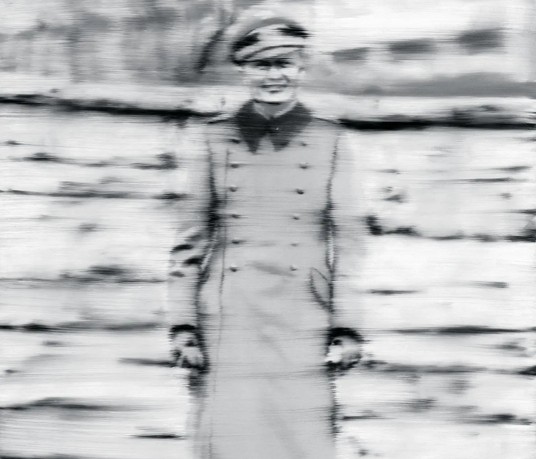
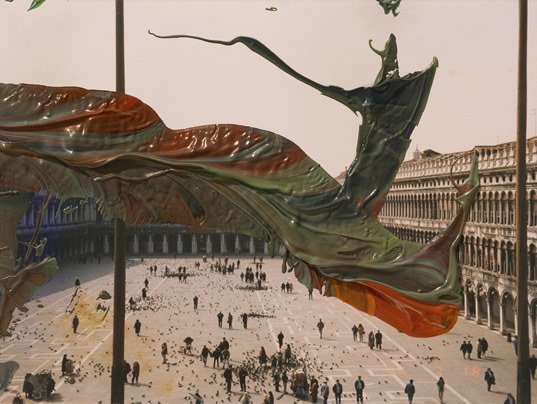
Onkel Rudi (Uncle Rudi), Gerhard Richter, 1965.
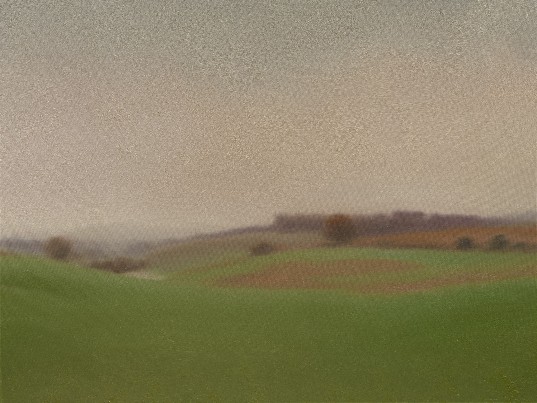
Grünes Feld (Green Field), Gerhard Richter, 1969.
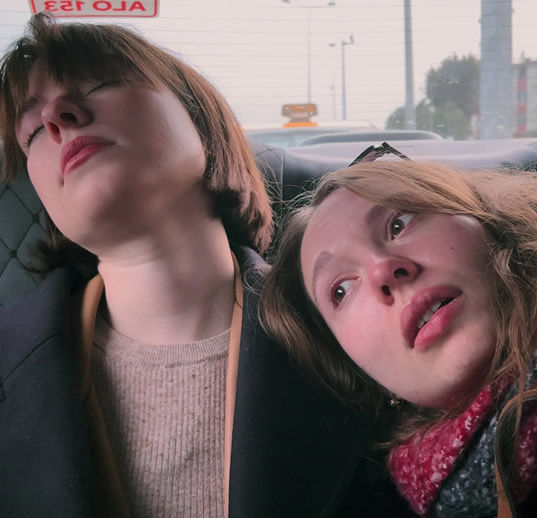
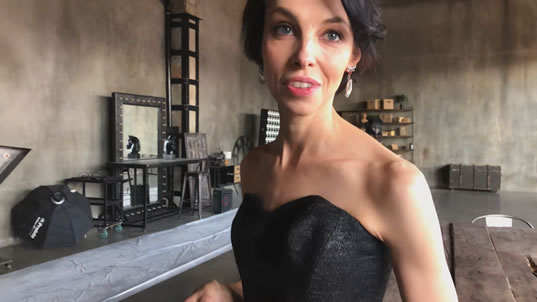
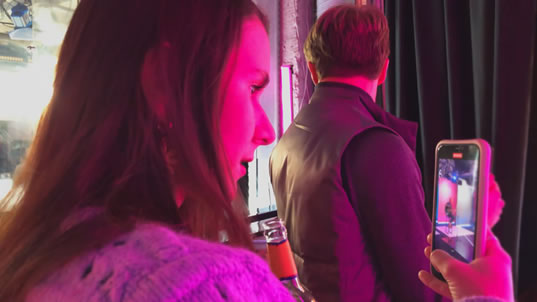
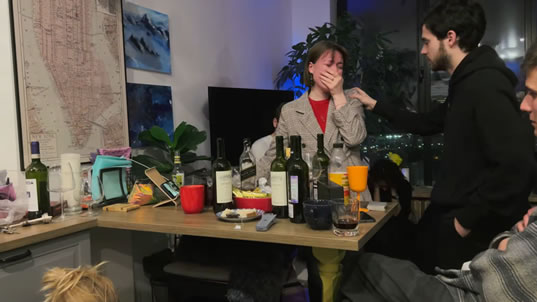
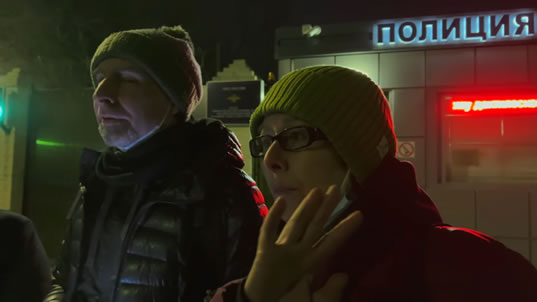
A still from My Undesirable Friends: Part II — Exile (2026)
THE SKY IS BLUE: A CONVERSATION WITH JULIA LOKTEV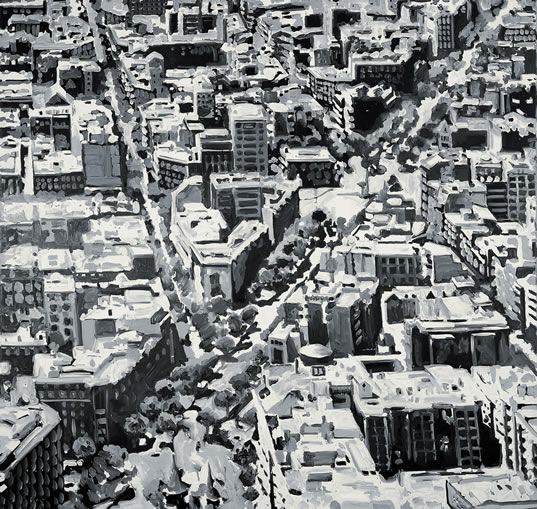
Stadtbild Madrid (Cityscape Madrid), Gerhard Richter, 1968.
INTRODUCTION: SYMPOSIUM ON CRITICAL THEORY
Relativity, M.C. Escher, 1953.
Cage 6, Gerhard Richter, 2006.
5. Jan. 98, Gerhard Richter.
|

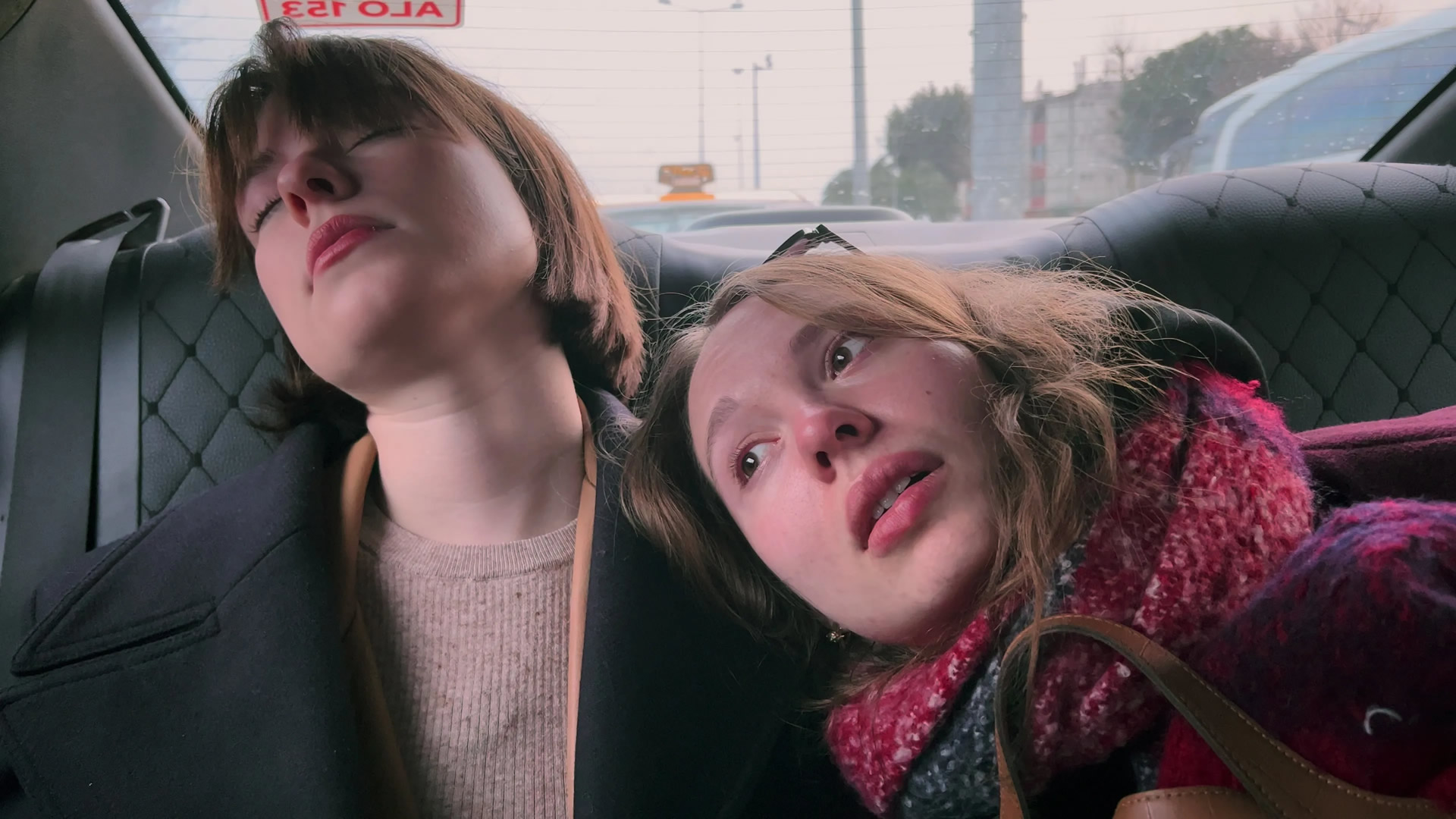
Image Note: Journalists Ksenia "Ksyusha" Mironova (left) and Valeria Ratnikova (right) in the backseat of a car — a still from My Undesirable Friends: Part II — Exile (2026), Julia Loktev's six-hour sequel following TV Rain reporters through twelve countries after fleeing Russia. The shot is the film's whole method in miniature: two faces, close, in transit, the ordinary logistics of exile — a car, a seat, a border ahead — carrying everything the film has to say about what it costs. Film still, My Undesirable Friends: Part II — Exile, directed by Julia Loktev, 2026. Premiered at the Venice Film Festival. © Julia Loktev; see also Wikipedia and Film at Lincoln Center.