INTRODUCTION By Martin Shuster *** The Montréal Review, August 2026 |
|||
I am grateful to Tsoncho Tsonchev for inviting me to collate a special issue of The Montréal Review on critical theory. To my mind, The Montréal Review is a model contemporary magazine of robust discussion, wide-ranging engagement, and powerful contemporary writing. It is also a beautiful literary magazine. Across the board, these are increasingly rare in the contemporary literary landscape. It is a real honor to present this issue. Since its emergence roughly one hundred years ago, critical theory has been a contested term, one that has come to mean many things to many people, and one that has been—and continues to be, especially now—the bogeyman for many regressive forces. In the United States, critical theory is frequently in the news as a foil for all the worst ambitions animating the contemporary forces of regression and/or fascism. For this reason, some of the pieces engage with some of the most pressing contemporary social and political developments (e.g., the rise of authoritarianism and neo-fascism or settler colonialism, as in the pieces by Eva von Redecker or Samuel Brody, respectively). Others, though, touch on more ordinary topics like teaching (Ada Jaarsma), artificial intelligence (Christopher Schaberg), contemporary subjectivity (Oshrat Silberbusch), or borders (Margret Grebowicz). The pieces are unified not by any doctrinal commitments, nor by a particular form (several are experimental in form), but rather by a certain approach to the (contemporary) world, where the aim is both to understand the present state of the world while opening up this world to change, to a movement towards more fruitful and progressive ways of organizing the world and ourselves in it. Writing a little less than a hundred years ago (1937), Max Horkheimer, in a programmatic statement of critical theory (“Traditional and Critical Theory”) wrote, speaking about the humans of his world and time, that: “At the same time their work and its results are alienated from them, and the whole process with all its waste of work-power and human life, and with its wars and all its senseless wretchedness, seems to be an unchangeable force of nature, a fate beyond man's control.” Horkheimer’s description of the world one hundred years ago, seems just as apt now, and equally pressing. The world is riven by war, technological advances are quickly reshaping the landscape and propelling wealth inequalities to stratospheric and catastrophic levels, ecological destruction proceeds, and democracy appears on the wane, whether theoretically or practically. Towards the end of his essay, Horkheimer boldly claimed that “the future of humanity depends on the existence today of the critical attitude.” Again, the same feels true today, especially as billionaires gobble up the various portions of the media ecosystem, subjecting us to their inane and foolish ideas about life and the world (that we are now everywhere constantly bombarded by their blather says more about the necessity of venues like The Montréal Review than it does about the worth of the ideas of billionaire ideas; Elon Musk famously had to buy an entire media platform just to argue otherwise). I mention all of this—and in this way—also to stress a point that critical theory has maintained from its beginnings, which is also on display in Horkheimer’s essay, when he offers the image of the critical theorist as “forming a dynamic unity with the oppressed class, so that his presentation of societal contradictions is not merely an expression of the concrete historical situation but also a force within it to stimulate change.” Our understandings of oppression have become more variegated and complex since his time, so that we are less likely to speak of the oppressed class, but the basic thought remains, again, apt and important. This is one way to register the range of topics covered in this issue. It is also one way to situate the presence in the issue of an “author meets critics” symposium on my recent book, Critical Theory: The Basics. Tsonchev suggested this would be a fruitful item to include since it touches on many core issues in what it means to pursue critical theory in the present moment, especially in both the broad history of critical theory and considering where things stand in the contemporary world. I am especially grateful to my colleagues and the participants of this symposium: Samir Gandesha, Kathy Kiloh, Jordan Daniels, Lorraine Markotic, and Henry Pickford. In conclusion, as a bit of introduction, I hope that this issue serves to give a glimpse—small and modest as it is—into the ways in which critical theory continues to have contemporary relevance for our world, especially for generalist audiences. Charlotte, North
Carolina, USA
CONTENTS
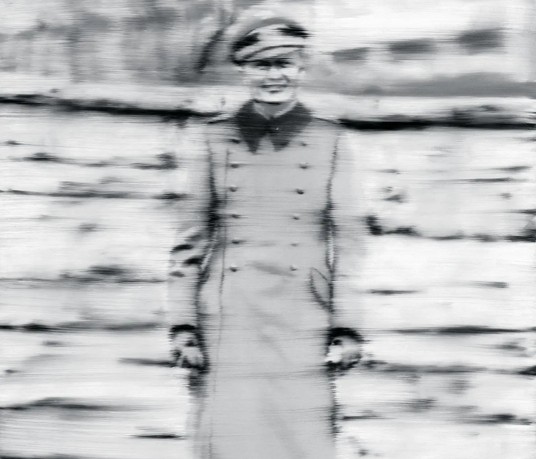
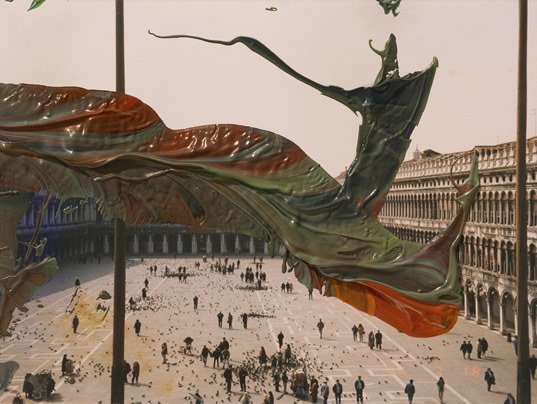
Onkel Rudi (Uncle Rudi), Gerhard Richter, 1965.
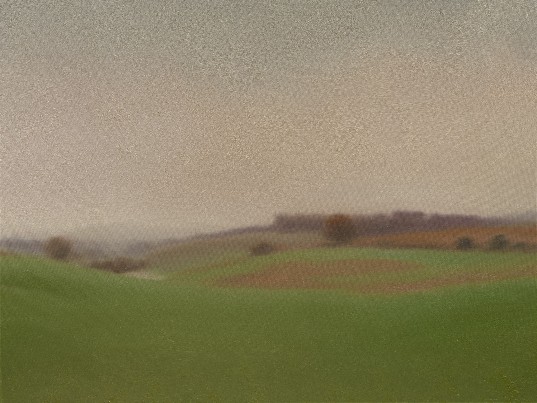
Grünes Feld (Green Field), Gerhard Richter, 1969.
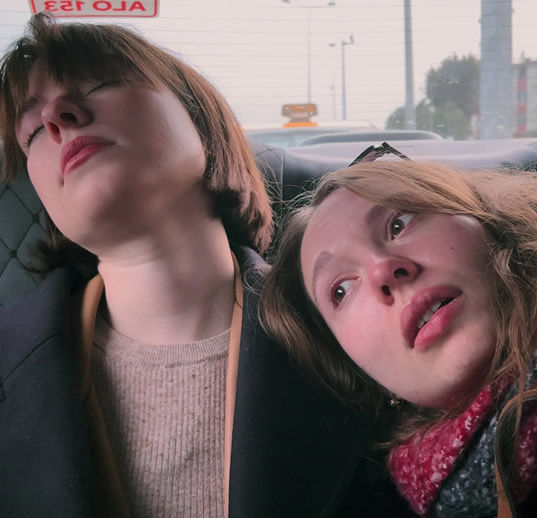
A still from My Undesirable Friends: Part II — Exile (2026)
THE SKY IS BLUE: A CONVERSATION WITH JULIA LOKTEV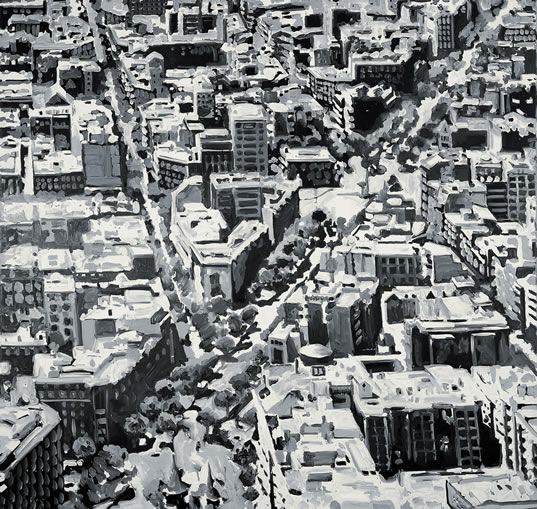
Stadtbild Madrid (Cityscape Madrid), Gerhard Richter, 1968.
INTRODUCTION: SYMPOSIUM ON CRITICAL THEORY
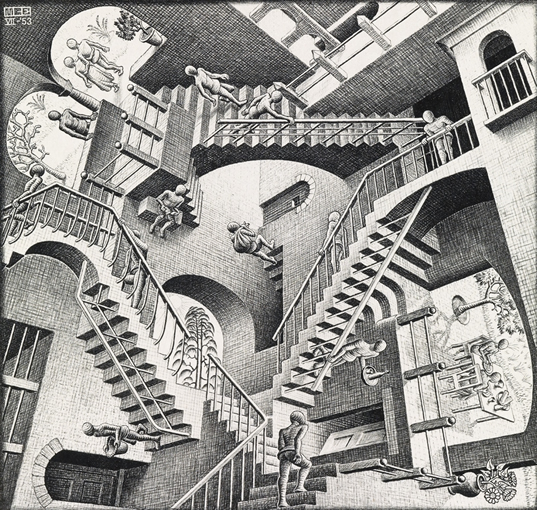
Relativity, M.C. Escher, 1953.
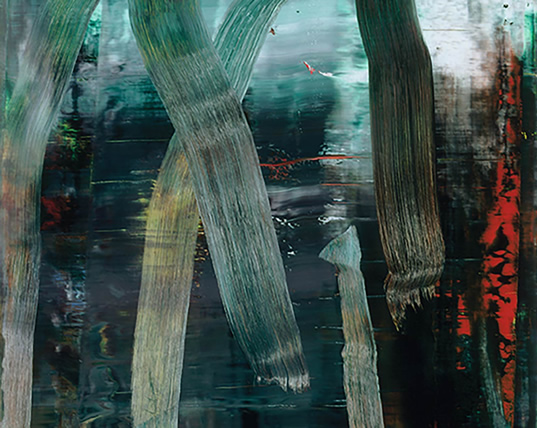
Cage 6, Gerhard Richter, 2006.
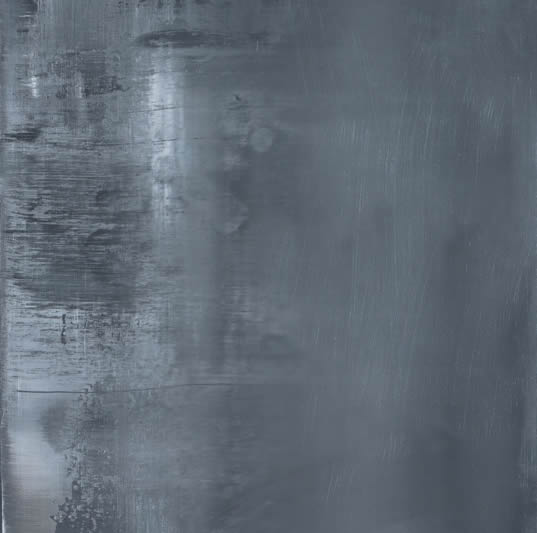
5. Jan. 98, Gerhard Richter.
|


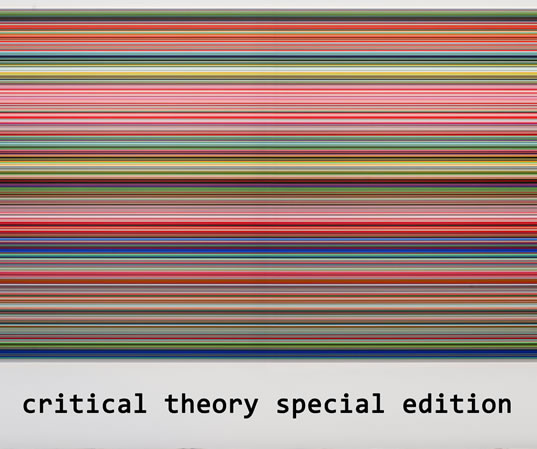
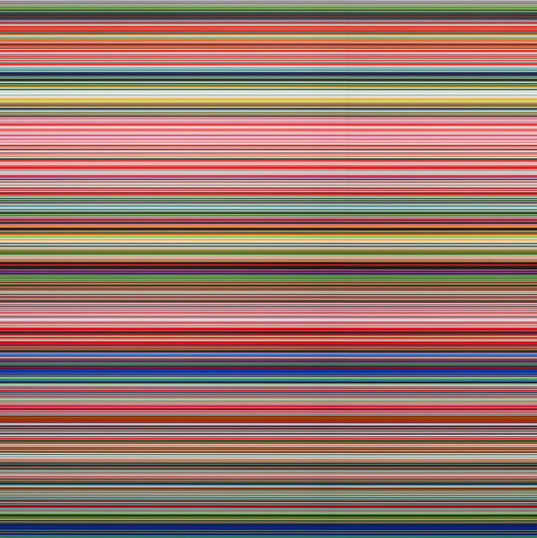
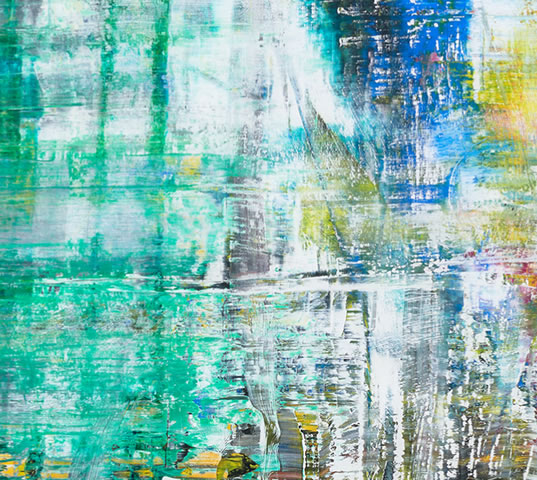
Art Note: Strip, Gerhard Richter, begun 2011. Richter took a single painting of his own and sliced it, digitally, into thousands of vertical strips — mirrored, repeated, recombined — so that one source multiplies into compositions that never quite resolve into a single picture again. It is one way to describe what this issue does with a hundred-year-old tradition: not a single argument applied to the present, but many cuts through it — fascism, AI, borders, teaching, roadkill, exile — each a strip of the same source, reflecting back a slightly different structure of the whole. Digital print on paper between aluminum and Perspex (Diasec), derived from the 1990 painting Abstraktes Bild (Catalogue Raisonné 724-4). From the Strip series, begun 2011 — image and details via Fondation Louis Vuitton and Christie's. © Gerhard Richter, courtesy of the artist and Gerhard Richter Archive.