15 THESES ON WRITING AND ARTIFICIAL INTELLIGENCE By Christopher Schaberg *** The Montréal Review, September 2026 |
|||
1. Fire
College students are usually taught to write as an essential proficiency, foundational to critical thinking and clear presentation. But how essential is writing in the 21st century? Can we prove its unique value in an era that has effectively automated the composition of most text-based communications? Consider fire-making and fire-tending: For millennia these were critical skills for humans to know and be able to practice, for survival as well as for sociality. I have been thinking about how I learned to build a fire out in the woods, at summer camp when I was in my teenage years. I learned how to gather tinder (the thinnest peeled sheets of fallen birch bark), identify dry branches for kindling (“dead and down,” unless it is my favorite kind of kindling, the lower brittle branches on a living cedar tree), which woods burn the best (white ash and ironwood, my go-to), and how to put it all together in a small structure that I could ignite using exactly one match. Or, if absolutely necessary, how to get the fire going without a match, which takes more time and patience but can be done, using friction, precision, and oxygen. Now, no one these days really needs to learn how to build a fire like this. We have lighters, charcoal briquettes, ovens, microwaves, air fryers, furnaces, heating pads, insulation, and so on. Building a fire is a skill still possible to learn, but hardly necessary for human survival or thriving in the 21st century. I personally like building a fire from time to time, just to practice and get the satisfaction of creating and containing a small fire. Sometimes I do this on the beach, in the summers. But it’s not really an essential or existential part of my everyday life. Fire-making and tending have ceased to be considered an essential skill for every person. Could it be that with recent advances in artificial intelligence, writing too might lose its status as the essential skill that we believed it was for many centuries? Writing has of course been taught and understood as something essential to individual self-expression and even to thinking itself. But AI is forcing humans to reconsider it, perhaps as something more thoroughly instrumental in fact. Maybe humans don’t need to learn all about it, to use it. When the first college decides to eliminate the basic college writing course requirement, this will be a sign of something changing for which there is likely no turning back, like humans with fire. Writing may persist, then, not as necessity but as ritual—something practiced for meaning rather than survival.
2. Intelligence
Defenders of the untouchable status of writing will often resort to inviolable if vague job skills, broadly described as intelligence: things like reasoning, creative problem-solving, logic, and keen argumentation. Yet, we can’t rely on advance evidence of the importance of these skills, as if delivered from a known future. Not to mention the present: One need only look closely and be honest about how leadership works in most contemporary organizations and in political hierarchies to see that what matters has more to do with charisma, salesmanship, and power. Clearly, if shocking to admit, one doesn’t even need to be smart. Intelligence turns out to have been an artificially inflated aptitude. The things that supposedly make writing so significant escape like grains of sand through fingers. And AI, meanwhile, presents itself as pallets of cinderblocks, solid and ready for crafting and construction, all the better to hold systems of power in place. What we once called intelligence may dissolve into a set of optional gestures, performed when convenient rather than required.
3. Power
Michel Foucault once wrote about how power works: it isn’t located here or there, he said, but circulates and functions. This is how AI exists: on everyone’s devices and personal screens, shot through businesses and logistics, ever upward expanding like an invisible net that connects and surrounds human life. Ideally, it may not even need human life to sustain itself. It just keeps on functioning. AI is the ideal form of power, from a certain perspective: this is either the scary apocalypse wherein AI kills off humans and proceeds (for some time, at least) without us; or, the utopian wish image in which extractive human labor and food scarcity and energy shortages have all been mitigated by AI, and we repose in leisure while AI hums along in the background, ever satiated and productive. A recent news story in the Wall Street Journal reported on jet turbine engines repurposed, stripped from the wings of aircraft and retooled to run on natural gas to power server farms and data centers. Power no longer to transport humans, but to move data and accelerate AI. Just pure function, no travel required. In such a regime, writing risks becoming less a tool of power than a residue left behind by its operations.
4. Flight
When commercial airliners begin to fly with remote pilots, assisted by AI, this will likewise be a sign that the age of writing is over. Humans, unnecessary for in-person problem solving, will no longer need to practice writing-as-thinking. This moment is probably closer than one might think. When presence itself is no longer required, the written trace of thought may likewise seem superfluous.
5. Future
When I graduated from college in 2000, the commencement speaker was the radio storyteller Paul Harvey. I recall how Harvey spun a utopian narrative of the decades to come, wherein more and more of the tedium of modern life would be automated, and humans would be able to rest and just enjoy; I remember how he described a fantastical image of people staying in their rooms and exercising on stationary machines and having all the information and entertainment they needed piped directly to their personal screens. This would be the future. And in this future people certainly would never need to write, to exert that special kind of effort. The projected scenario seemed downright freaky to me then. But, 26 years on, Harvey’s vision seems close to accurate, if less thrillingly so. And one of the mundane places it snaps into focus is when writing on phones or computers: Increasingly, the platforms and software we use offer to assist us—if not do it for us entirely. Paul Harvey’s future was now, and AI one key actor in this mix. The future, it turns out, does not eliminate writing so much as absorb and automate it into the background of everyday life.
6. Camouflage
AI is sort of like camouflage: You might spot it, but then can’t really know for sure how people are using it. The more you look for it, the more you see it: Wrapped around CyberTrucks, on Gap cargo pants, in airports worn by soldiers in transit, on pajamas donned by college students on their way to exams, but also on ROTC students, as well as on ICE agents in the streets of the United States. Ironically; as a style; for tactics and strategy; with no thought at all, because it’s just there to wear—camo blends in and becomes ubiquitous. The standard, most recognizable form of camouflage is called the “disruptive pattern.” This is the military design that has lasted, and been modified and adapted, over the past nearly 100 years. AI too is disruptive, merging with and disappearing into the fabric of everyday life, perhaps at a greater speed than the spread of camouflage. Writing, too, may become camouflaged—still there, but indistinguishable from the systems that now produce it.
7. Writing
In Spike Jonze’s 2013 film Her, Joaquin Phoenix’s main character Theodore Twombly has an interesting job. He works for a company called handwrittenloveletters.com. He narrates letters in the voice of the customers, addressed to romantic partners and spouses. These letters are then machine-inscribed in “handwritten” script, printed out, and deposited by Theodore in a drop box at the end of the workday—presumably to be mailed out to the recipients, by physical delivery. Her has been in the cultural conversation again because of its prescient depiction of AI chatbots, and their potential to act like actual human friends, even lovers. But the English major will take note of Theodore’s occupation: He is a writer. At one point in the film, his AI companion Samantha (Scarlett Johansson) surprises Theodore by curating and submitting his selected letters for a potential book publication. Theodore is bowled over. But so, what has happened to writing in the contemporaneous world of film? In short, it died. It became a rarefied commodity—a skill, surely, but also something cut off from the mundane. One gets the sense that normal people in the world of the film don’t write anymore. They don’t need to. And if they want a “handwritten love letter,” they can simply dial in for a custom one. Writing survives here as a kind of outsourced intimacy, its human origin increasingly difficult to locate. Not so different from a college student today ordering up an essay for class, utilizing AI. Or a professor, asked for a letter of recommendation or a book endorsement or an essay for a journal, utilizing AI to do the job more efficiently—possibly even better.
8. Empire
When I read about AI policies on higher education campuses, and attempts to patrol students for academic integrity violations involving AI, I am reminded of the scene in the first Star Wars movie when Luke Skywalker and Obi-Wan Kenobi are trying to get off the planet Tatooine, and to do so they have to depart at the Mos Eisley spaceport—in Kenobi’s words, “a wretched hive of scum and villainy.” First they have to get through a checkpoint staffed by Imperial stormtroopers who are clad in white rigid spacesuits—disjunctive against the desert landscape, ragtag and diverse travelers, and hodgepodge terminal buildings. Holding their blasters and ready to kill, they are checking everyone—oblivious to the raucous world happening around them. This is what it increasingly appears like when authorities attempt to root out AI misuse on campus. The stormtroopers have always already lost! It’s no wonder so many of the leaders of the Empire speak in an arcane British accent: The discipline of English, possibly the most worried of all humanities disciplines, finds itself on the forefront of this epic battle against AI. The demand for proof of authorship becomes itself a performance, one already undermined by the very systems it seeks to regulate. Show us your papers.
9. Stunt Doubles
A New York Times headline caught my attention: An AI-generated fight scene with a faked Brad Pitt was causing alarm among Hollywood artists and creatives; it seemed for a moment that cinema might be over. Should AI spawn a convincing Brad Pitt movie, all bets are off. As if this hasn’t been a long and winding road already from the beginnings of filmmaking to special effects, CGI, and smartphone video technologies—AI only the latest twist in the path. Another clip showed not only an artificial Brad Pitt but also a concocted Tom Cruise, this time fighting together—against no less than a silly-looking humanoid robot. Can AI create cinematic pranks, too? And also cheaper (arguably better) stunt doubles, for the industry? Who is laughing, here? Who is taking this seriously? Who is acting the part? As other modes of representation fall into the maw of AI, writing’s claim to originality, as well as to the domains of truth and fiction, may begin to feel quaint at best.
10. Craft
Writing can still be upheld as a craft, and an art. It can still be taught, experimented with, made to do surprising and inspiring things. Creative Writing may still flourish, if brought down to Earth as a mere craft. Writing need not forfeit its magical qualities, its abilities to awaken or illuminate or captivate. Many college instructors have of late resorted to more in-class writing, as a way to reanimate the act of composition while obviating the threat of AI-assisted assignments. Revision is also a possible experience that one might have. Even AI can often benefit from a human editor—at least for now. The craft of writing is alive and well, though it may not be requisite for modern educated citizens for much longer. Where does this leave the discipline of English, a domain of inquiry already spread thin across the fields of media and cultural studies, not to mention the sodden terrain of so-called Theory? If you’ve never stood on a peat bog and felt it shake underfoot, it is an uncanny sensation indeed. So craft remains, but as a chosen constraint—a way of slowing down within a world that no longer requires slowness.
11. Adaptation
I had never read Emily Brontë’s Wuthering Heights, and had never seen any of the earlier film adaptations. Therefore, I didn’t know what to expect going into the new Emerald Fennell adaptation starring Margot Robbie as Cathy and Jacob Elordi as Heathcliff, the devastating, morose heartbreaker. One of the early scenes reveals the titular place, a dark building nestled into a phantasmagoric landscape of pitched black stone, boulders in the shapes of serrated blades. At first it seems surreal, or like we’re maybe seeing a rendition of the story as told on a planet in the extended Star Wars universe. But soon enough the extreme spatiality is normalized, the mere, if ever imposing, background of the drama unfolding. Set everything else about this adaptation aside: the treatment of the topography and architecture made me consistently swoon. Back at home, cleaning out my basement, I stumbled across my late father-in-law’s high school copy of Brontë’s novel. Intrigued, I dove in. I came to this early passage:
Yes, this was an apt description of the disjunctive vibes of the house in the new film: stark and severe yet obviously built with care, labyrinthine rooms and corridors seemingly more expansive than its exterior appearance. The constant roar of the weather, mists and winds and rains a near constant. The form of Brontë’s novel reminded me almost immediately of Mary Shelley’s Frankenstein, which I have read many times and love to teach. How each story is told through nesting dolls, voices that are rather difficult to track and keep track of (who the hell is Mr. Lockwood?), litanies of names and family relations, and the backtracking and rear tunneling into the past that exists in the mist of minds behind the present narration. The two novels feel similar in this way (at least 100 pages in, where I am with Wuthering Heights currently as I write this). By coincidence Frankenstein was also newly adapted for film last year by Guillermo del Toro, with none other than Jacob Elordi playing Victor Frankenstein’s creature, or “fiend.” Heathcliff is also called a fiend in Wuthering Heights, and this is such a great word, one letter as it is away from friend, always tripping up the reader. The fiend is like artificial intelligence before its time: the reader is uncertain how smart it is, just exactly how it got that way, what threat or romance it might become. I remember when I first really read Shelley’s novel, when I finally committed to teaching it, and I started to read it and then at a certain or uncertain point, there was the whoosh of being sucked into the story. I’ve felt that weird phenomenological pull with Wuthering Heights now, too. But, I’ll also admit that it was the film that made me interested in the first place. I’ve seen this old book a hundred times as we’ve moved, rearranged our bookshelves, kept old volumes for sentimental purposes alongside recent titles my partner and I were lit up by. Brontë’s novel was most definitely in the former category. 19th century British literature was not my strong suit. 19C American, a little more so. But my jam was always 20th century and contemporary American literature and culture. And yet, thanks to a graduate seminar with Timothy Morton at UC Davis in 2004, I had an itch initially scratched, or made a bit more itchy at least, for Shelley’s Frankenstein alongside lots of poetry from the same period. So I was primed for that infinitely layered novel 10 years later when I finally read it, and I have loved rereading and teaching it in undergraduate English courses since then. And then, I appreciated del Toro’s cinematic adaptation: Not because it was faithful, exactly, but because it channeled the ambiance: the arctic framing narrative, the stuckness of it all even as the chase ensues. Now I am addictively reading Brontë’s novel—I am a slow reader, which is tough on the physical pages, making my father-in-law’s copy deteriorate further as I read. So it is slow going, but Wuthering Heights doles out rewards for paying attention: to the paragraphs, to descriptive details, to phrases borrowed and adapted for the film, to images that I recall having seen versions of, on screen. It occurs to me that no small part of my delight in reading the novel is appreciating the adaptation, and watching for how and when the text inspired cinematic moments—and where it creatively diverges. It strikes me that I liked doing this with del Toro’s Frankenstein as well, if in reverse: knowing that novel fairly well, I enjoyed watching for the fidelities as much as for the infidelities to the source text. Another thing the recent film adaptations share is a keen interest in decomposing bodies. We see Cathy’s father waste away unto death; we meet Victor when he’s already in rough shape; Cathy (spoiler alert) ends up as a decomposing if still beautiful body, and Victor’s creature precisely cannot decompose, even though he looks like rot. I thought of this as the pages of my book started to fall out in earnest, the glue of the binding now rapidly turning to dust. AI promises to do things faster, and it succeeds in often startling ways. I could just ask ChatGPT or one of its kin to summarize what happens in the novel of Wuthering Heights, saving me the time and letting me preserve the remaining intactness of this old Scholastic copy (Second Printing, October 1963). But I want to linger with this novel, paying attention to the awkward syntax, the transcribed dialect of Joseph, the meandering story. I want the book to continue to decompose until I have to procure a replacement text, so I can keep reading the writing. To read in this way is to resist efficiency, to dwell in time rather than bypass it.
12. It’s Here
It occurs to me as I attempt to wind down this essay that I could have simply asked Claude or ChatGPT to help me compose a collage-like essay on AI and writing, comprised of a dozen or so theses. But instead, I muddled my way through this, cobbling things together like a bricoleur, making associations and connections spontaneously (then deliberately, on revision) … figuring out what I had to say about this entangled topic. It’s been a bit like building a fire: finding the pieces and putting them together, then lighting a match to see if the assemblage will burn. To shift frames and borrow another naturalist metaphor, it seems to me that the academic discipline of writing has been caught a bit like a deer in the headlights, unable to move or look away from the oncoming, racing vehicle of AI. It should probably just get off the road and back into the woods, and yet writing is allured by the brightness and promise of what is coming, until it’s here, which, of course, it already is. The shock is not that AI has arrived, but that writing no longer stands outside of it.
13. Afterwriting
If writing once functioned as the primary medium through which humans externalized thought, organized knowledge, and exercised imagination, then AI marks not its disappearance but its diffusion into systems that operate with or without us. What remains for humans is not the obligation to write, but the choice to do so—to linger, to resist, to play, to craft meaning in excess of utility. Writing becomes less a foundational skill than a situated practice, one that may flicker like a small fire against the vast, continuous hum of automated language. We become little members of the audience in Plato’s IMAX theater—the objective here not to escape or even know, but perhaps to leave some small mark, a faint etching on the vastness of time.
14. Echo
One often reads about the dangerous echo-chamber effects of social media; AI might exacerbate this phenomenon, or it could puncture the membrane. And yet the echo, in its oldest form, was not a distortion but a delay—the original sound returning to the sender just slightly transformed by distance and the shape of the walls. Capitalism abhors a delay—so when acceleration and growth are themselves goals, the shortest path to a return wins. Writing, by contrast, has always been a technology of delay—the gap between the mark and its meaning, between the sending and the receiving, is where thinking actually happens. But writing like this shrinks the gap with shocking efficiency. The question then is whether this particular echo—yours, mine, ours—is a shortcut or something stranger: a new kind of wall off which the sound bounces back changed. Or maybe it explodes the wall entirely: and thus we scream into the void. But the void, it turns out, is not empty—it is full of other people’s screaming, which is to say, full of language, which is to say, full of the raw material from which all writing, human or otherwise, has always been made. So we find ourselves right back in the collective where we always were, just in a different and uncanny state of togetherness. The fire, after all, was never really a solitary achievement—it was always tended in company, passed between hands, and read by more than one pair of eyes.
15. Collaboration
I
wrote the first draft of this essay, up to thesis 12—or about 95% of those
theses—from my brain, assembling ideas and references unassisted. The editor of
this magazine then offered me some helpful comments and suggestions for
revision, which I responded to with precision refinements and expansions. After
that, I fed the revised 12 theses into OpenAI’s ChatGPT and asked it to add one
sentence to the end of each thesis, and then, to add an entire new 13th thesis.
It did all this, and I worked with the additional sentences—tweaking some,
moving others around, and leaving certain sentences exactly as Chat had written
them, drawing out my prose and extending my thinking. And I massaged thesis 13
until I liked it enough. Then, I toggled over to Anthropic’s Claude, and I
entered the entire essay up through thesis 13 there, and asked Claude to
suggest a title for a 14th thesis—after which we would write the thesis together,
a sentence at a time. It came up with the heading of “Echo,” and I wrote the
first sentence, and it supplied the next, and so on. Claude finished with a
clever (or precious?) full-circle return to the “fire” theme, which I don’t
know that I ever would have done. And yet, it works. I had in mind that I would
add a final thesis called “Collaboration,” and here it is. The result of this
essay, taken in sum, is a written collaboration between humans and AI, on
writing and artificial intelligence, in this rapidly developing time of
technological advancement and experimentation. It is possible that this essay
will be obsolete or passé by the time it is read—but if a reader is reading
this, then there must still be open questions in circulation, or escaping
circulation, and this will be a sign of uncertain hope in a world of
increasingly fixed dividends, driving toward accreting data centers and
consolidated payouts. This is neither a celebration nor a capitulation. If
anything, it is a plea to the letter—to keep writing.
CONTENTS
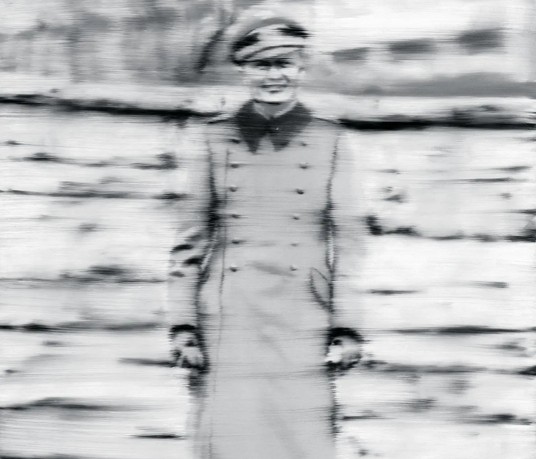
Onkel Rudi (Uncle Rudi), Gerhard Richter, 1965.
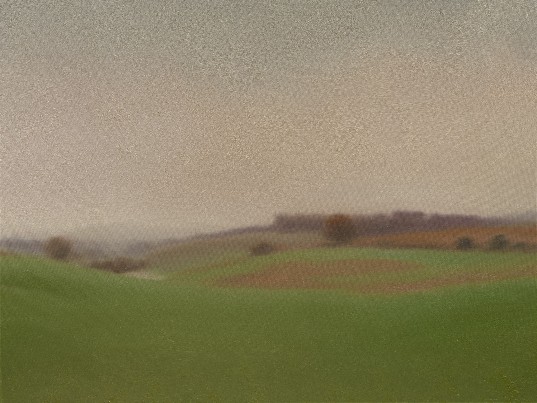
Grünes Feld (Green Field), Gerhard Richter, 1969.
A still from My Undesirable Friends: Part II — Exile (2026)
THE SKY IS BLUE: A CONVERSATION WITH JULIA LOKTEV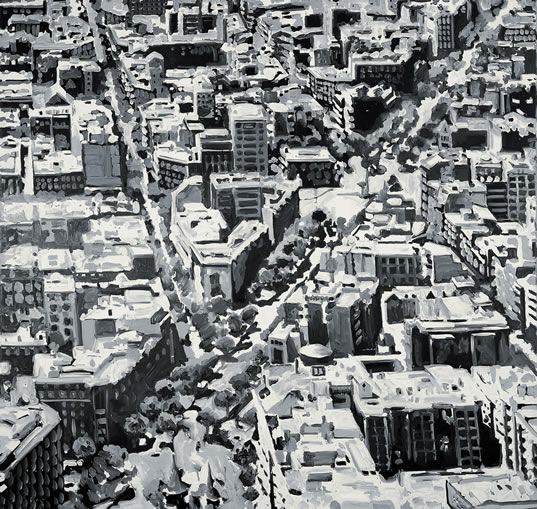
Stadtbild Madrid (Cityscape Madrid), Gerhard Richter, 1968.
INTRODUCTION: SYMPOSIUM ON CRITICAL THEORY
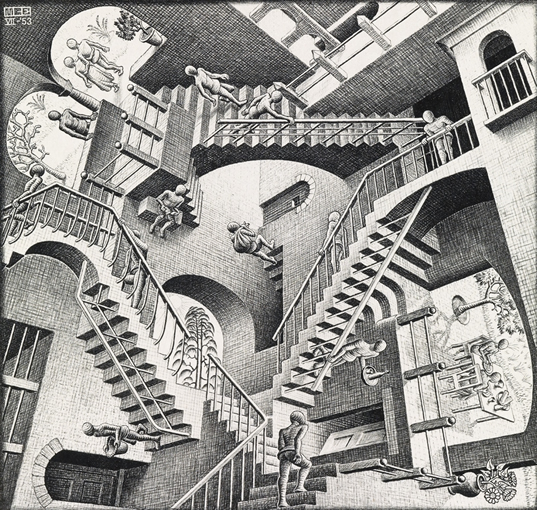
Relativity, M.C. Escher, 1953.
Cage 6, Gerhard Richter, 2006.
5. Jan. 98, Gerhard Richter.
|

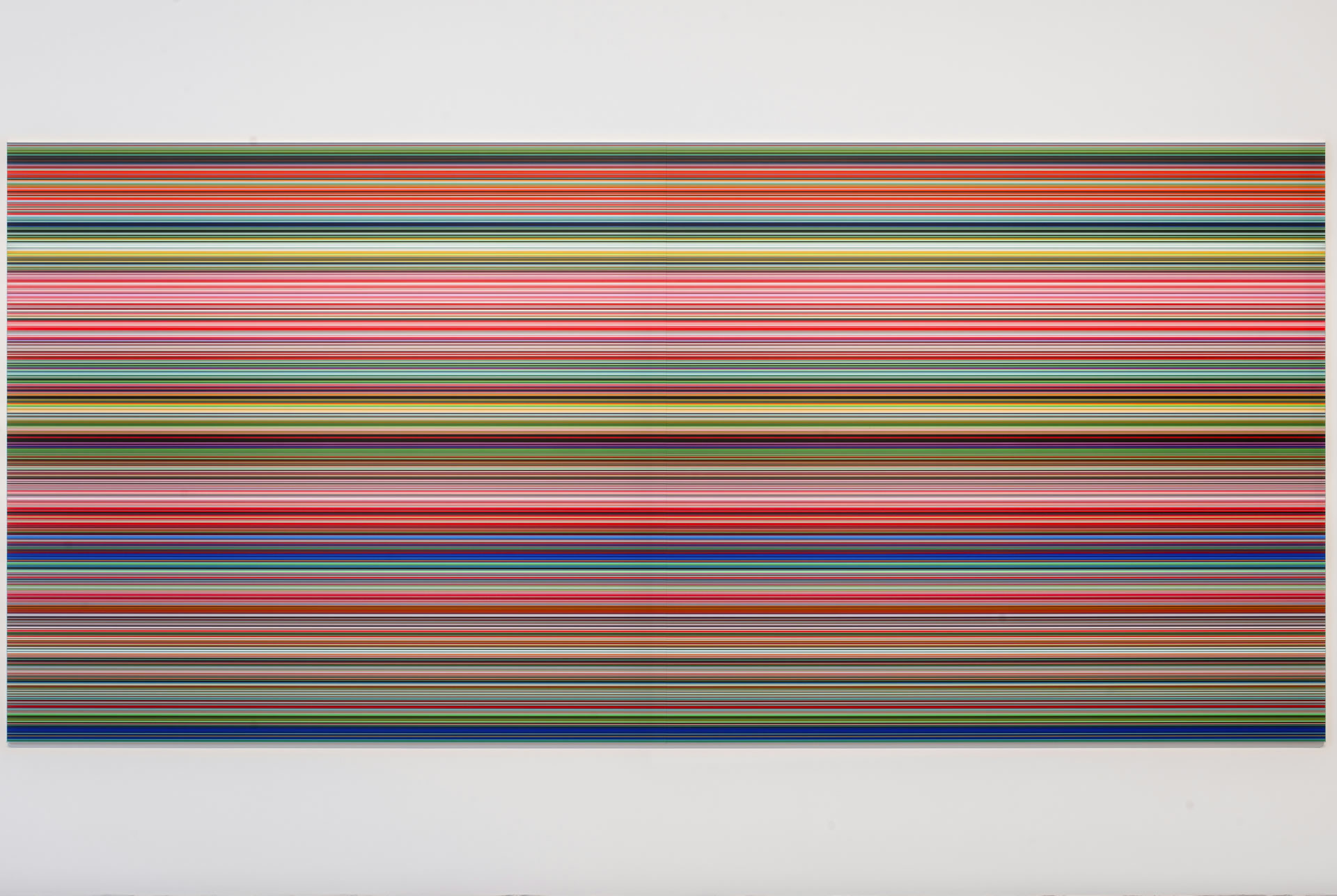
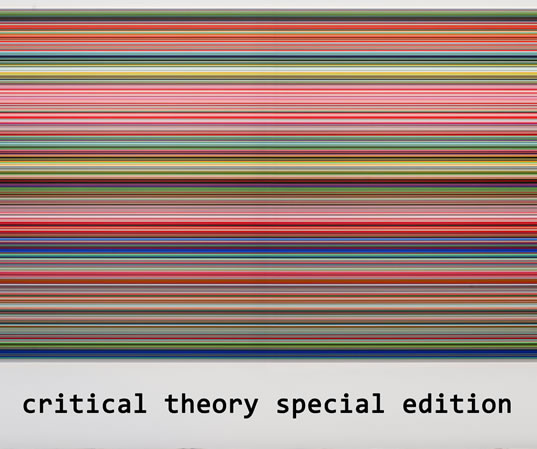
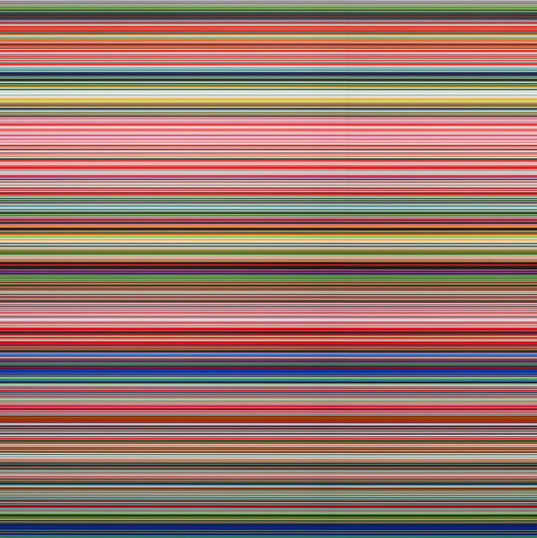
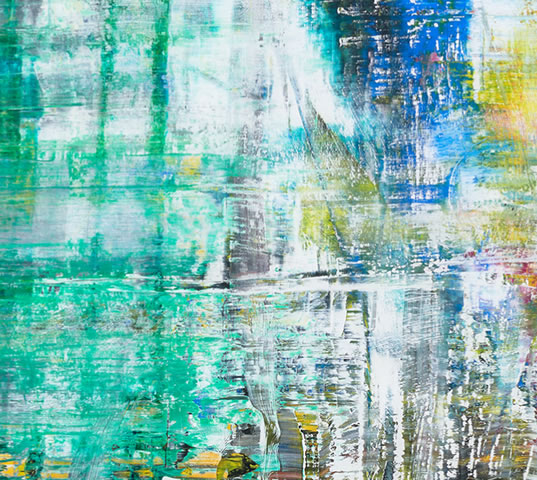
Art Note: Strip, Gerhard Richter, 2011. Richter took one of his own hand-painted canvases, fed it through a digital process — sliced, mirrored, sliced again, up to 4,096 times — and let the software finish what his brush began. Paint became data; gesture became a repeating line. The result is still recognizably his, still beautiful, and no longer entirely his doing. Digital print on paper between aluminum and Perspex (Diasec), derived from the 1990 painting Abstraktes Bild (Catalogue Raisonné 724-4). From the Strip series, begun 2011 — image and details via David Zwirner and Fondation Louis Vuitton. © Gerhard Richter, courtesy of the artist and Gerhard Richter Archive.