A LOFTIER MISERY? By Samir Gandesha *** The Montréal Review, September 2026 |
|||
Let me start by saying how delighted I am to have been invited to participate in a discussion of such an outstanding and important book by a friend and colleague whose work I have admired for several years. One’s task on a book panel such as this is made particularly difficult when one agrees with virtually every argument of the book in question. Although there is a central claim in the book that I’m not sure I am fully convinced by. I’ll come to that shortly, but before I do, I think it might be helpful to lay out some of the general challenges Critical Theory faces today, which have come to a head in the wake of the attacks of October 7, 2023. Adumbrating such challenges will help, I think, to show the importance of the book in addressing some of them, if only implicitly. The first challenge arises from the crisis of the social sciences and humanities going back to the 1980s. After the post-World War II expansion of higher education from 1945 to roughly the mid-1970s throughout the Western world, fuelled by amongst other things Cold War anxieties, these disciplines begin to enter a period of retrenchment, accelerated by worries first about the “closing of the American mind”[1] and, three decades later, its “coddling.”[2] Advances made by women’s, queer and gender and ethnic studies programs and departments, emerging out of the vital historical civil rights and larger emancipatory struggles in the late 1960s and 1970s, begin to be rolled back largely predicated on concerns about the future of a national canon and a perceived decline in “cultural literacy” shared by all Americans.[3] In fact, this was part and parcel of a larger attempt to undo and reverse the advances made by the radicalism of the 1960s, one that shapes profoundly the contemporary far-right’s agenda. The striking down of Roe v Wade in June, 2022, more general attacks on the women’s voting rights, DEI and “wokeism” are cases in point. Similar developments have been afoot in Canada in roughly the same period. Anxieties about a shared cultural inheritance were significantly accelerated by the underlying neoliberal reorganization of capitalism which submitted everything to a renewed and turbo-charged market logic in the context of a new global division of labour which saw industrial capital increasingly relocated to the Global South. Despite the initial celebration of the advent of a “knowledge society,” globalization contributed to reducing, on the supply side, the value of humanistic education via the merciless quantifying metrics of assorted key performance indicators and, for example, Thatcher’s infamous Research Assessment Exercise (1986) which, after 2014, became universalized, treating knowledge reductively as an economic input or resource like any other oriented to maximizing GDP and shareholder value. The qualitative value of humanistic education in the creation and maintenance of a shared world of meanings, assumptions and background understandings as the basis for engaged citizenship was simply shunted aside. Today, we see the bitter fruit of this instrumentalization of education in the dramatic and possibly irreparable fracturing of civil society.[4] On the demand side, prospective students and, more importantly, their parents who typically paid the meteorically rising bill for higher education, became increasingly convinced, despite ample evidence to the contrary, that social science and humanities graduates were unemployable and consequently gravitated, instead, to other putatively more employable fields such as engineering and computer science. This was perhaps an ill-considered decision considering the rapid recent advances in AI which is fast laying waste to mid-level jobs in these fields, coding for example, among many others such as law, architecture and engineering. But, as they say, hindsight is 20/20. Politically, the writing was on the wall at least twenty years ago when Narendra Modi became Chief Minister of the Indian State of Gujarat and, as Martha Nussbaum has shown, set about eliminating critical thinking from public education curricula in favour of rote learning.[5] Upon becoming Prime Minister, Modi began leading a concerted attack on elite Indian Universities, in particular the “Harvard of India” Jawaharlal Nehru University (JNU), for their alleged harbouring of what he calls “urban Naxalites.” This term referred to leftist professors and students sympathetic to the Adivasis or India’s indigenous peoples, the Maoist guerrilla movement in Chhattisgarh, as well as the plight of the long-suffering Muslim minority, effectively stripped of equal citizenship rights and under siege in India. The political assault on the university which we see in India as well as other authoritarian states such as Hungary and Brazil under Bolsonaro does not distinguish between critical thinking and varieties of critical theory including Frankfurt Critical Theory. For example, I was set to teach for a couple of weeks at the University of São Paulo on the invitation of Brazilian philosopher Vladimir Safatle. A couple of months before I was due to arrive, police entered the campus and began to tear down posters advocating human rights in the forthcoming elections that was to lead to the formation of the government of former President Jair Bolsonaro on January 1, 2019. One year earlier, Judith Butler had been attacked by a mob and burned in effigy for being the originator of “gender ideology.” More recently, a professor at Texas A&M University was prevented, bizzarely, from teaching Plato due to his apparent connection with the same gender ideology.[6] Before my stint in Brazil, I had delivered some lectures in the Indian state of Kerala, long governed by Left Front governments in which the Communist Party played a leading role, and was informed that seminars were routinely interrupted and even broken up by Hindutva (Hindu nationalist) thugs. In fact, I got a direct taste of this a few years later when the institute I direct at Simon Fraser University in Vancouver was itself vandalized by Hindu extremists, furious that the Institute for the Humanities had had the temerity to provide modest financial support for the conference “Dismantling Global Hindutva.” The vandalism was done in the name of Hindu identity politics. It was an extremely tense and perilous time for academic freedom. And, as no one needs reminding, it has become even more tense and perilous in recent years. The Trump administration has followed the same authoritarian playbook as Modi by first taking aim at the archetypical “Critical Race Theorist” (the Trumpian version of Modi’s “Urban Naxalite”) and then cracking down hard on diversity, equity, and inclusion policies or DEI (in Canada: EDI). This authoritarian strategy goes back to the Nazis’ attacks on so-called “cultural bolshevism” and entartete Kunst. Under the smoke screen of fighting antisemitism, the Trump regime is currently seeking to exercise unprecedented control over institutions of higher education and their foreign students along the lines laid down by the Heritage Foundation’s “Project Esther.”[7] The targeting of individual professors put on watchlists by Turning Point USA––founded by that recently murdered, supposed doyen of free speech and open debate Charlie Kirk––has been ramped up. In the fall of 2025, Mark Bray Rutgers historian and New York Times best-selling author of a book on antifascism[8] was forced to flee the US to Spain with his family after receiving death threats in the wake of Trump’s executive order declaring antifa a “terrorist” organization and a petition to get him fired by Turning Point USA. Authoritarian regimes are typically not wont to distinguish between critical thinking, varieties of critical theory and Critical Theory with a capital “c” and “t.”. Critical thinking entails a minimal attitude of scepticism brought to bear on propositions and forms of rhetoric, political and otherwise, to scrutinize their logical soundness and grounding in evidence, be it in the form of data sets or textual passages. Critical theory with a lower-case “c” and a “t,” typically refers to cultural or literary theory per se such as Foucauldian genealogy, Derridean deconstruction, or Saidian post-colonial criticism, etc. entailing certain specific assumptions, respectively, about the relationship between power and knowledge, the differing and deferring spatial and temporal logics of the text and, the contextual relation between world, the text and the critic. Critical Theory with a capital “C” and a capital “T” is that interdisciplinary research program established at the Institute for Social Research established by Felix Weil in Frankfurt in 1923 and often referred to as the Frankfurt School. It sought to effect a synthesis combining the Marxian critique of political economy with Freudian psychoanalysis to continue in historical terms the Kantian project of a rational critique of reason married to the normative aspiration to Mündigkeit which means individual autonomy or the ability to think and act for oneself, unassisted by external authorities. Critical Theory was a product of what has been called the “dialectic of defeat,” that is, it registers the experiences of the failure of the Russian and German Revolutions and concomitant rise of fascism.[9] Its inter-disciplinary contributions on the range of topics Shuster discusses in the eloquent individual chapters in this book on “Critique,” “Self,” “Society,” “Art” and “Religion” remain both unsurpassed and particularly relevant to our contemporary situation. Importantly, Critical Theory remains alive today because, as Shuster shows, it remains flexible and open enough to be corrected and updated via conversations with, for example, post-colonial theory or the tradition of Black Marxism with which it has a deep connection, of course, through the figure of Angela Davis a former student of both Adorno’s in Frankfurt and Marcuse’s in La Jolla, with whom she wrote a doctoral dissertation on Kant’s theory of force. While Adorno is often justifiably criticized for his “colonial unconscious” or apparent disinterest in questions of colonialism and slavery (the historical backdrop to the Holocaust)[10] his thought can certainly be reconstructed in terms that are quite closely aligned with post-colonial and anti-colonial thinking.[11] At least three points can be identified: 1. The argument of Dialectic of Enlightenment is a powerful elaboration of Benjamin’s central insight that “there is no document of civilization that is not at the same time a document of barbarism” which is powerfully captured by his widely cited interpretation of Paul Klee’s 1920 monoprint “Angelus Novus” as the unfolding of a single catastrophe. 2. Building on Lukács’ account of reification, Adorno criticizes what he calls the “imperialism of the concept.” This mustn’t simply be read as a metaphor but is concretely tied to the global spread of the value form and the ensuing effacement and subordination of heterogeneity or what he calls the “non-identical” to the logic of identification understood socio-economically, psychologically and philosophically. Such a logic can be seen at work in the European project of colonization that often entailed, among other things, the annihilation of the cultures and practices of the colonized and enslaved. 3. The genealogy of such a logic of identification is mapped out brilliantly in the audacious and virtuosic reading of the Odyssey in Dialectic of Enlightenment. In the key episode in which Odysseus encounters Polyphemus, the cyclops are depicted as living in a milieu characterized by the absence of “rational labour,” common laws, and the fixed order of private property to which Odysseus is compelled to return. In other words, the cyclops are depicted as living on what comes to be called terra nullius or empty land:
Terra nullius was precisely the condition, according to John Locke, which justified genocidal colonization of the so-called “new world.” So, in their reading of Odysseus as the Ur-bourgeois figure, Horkheimer and Adorno are not unmindful of the fundamentally imperialistic nature of European bourgeois society insofar as it is premised upon slavery and territorial acquisition justified by a doctrine of progress constituted by processes of what Max Weber called rationalization and disenchantment (Entzauberung) and through these a direct, linear movements from myth to enlightenment, from barbarism to civilization. What remains crucial is that Shuster argues that Critical Theory is unique in maintaining an oppositional position towards the “entire social, political and economic order.” And herein lies its indisputable importance in our catastrophic present which requires nothing less than such thorough-going opposition instead of an empty rhetoric of “sustainability,” green capitalism or technological solutions to problems that require, instead, a fundamental restructuring of human subjectivity, social relations and our relationship with non-human animals and natural ecosystems. If this does not happen, it is very difficult to imagine a viable future on this planet. One wants to say here that authoritarians target Critical Theory precisely because of these insights and there can be no doubt that the Frankfurt School has been singled out for special attention for inventing “wokeness” for example.[13] This is about as accurate, however, as the proposition that Adorno co-wrote the entire Beatles back catalogue as the once-viral meme suggested! As already previously alluded to, the truth of the matter is that authoritarians target anything that remotely passes for thinking; the only thing they can tolerate is the easily remembered and repeatable slogan such as “Take America Back,” “America First,” “Drain the Swamp,” “Stop the Steal!,” and, well, “Make America Great Again.” But Critical Theory, with a capital “c” and a capital “t,” as a project of opposition to the entire social, political and economic order, isn’t just attacked from outside of the university and intellectual life more broadly, but also within it. There are several sorts of other challenges here: 1. Subsequent generations of Critical Theorists, such as Habermas, Honneth, Forst and others, who attempt, as Michael Thompson points out, to “domesticate Critical theory” by making it a species of anodyne liberal-democratic theory broadly understood.[14] 2. Orthodox Marxist critics such as Domenico Losurdo and his Villanova follower Gabriel Rockhill for whom the Frankfurt School is denigrated as “Western Marxism.”[15] For these critics, Critical Theory therefore betrays the core of Marxism which for Losurdo consists in prioritizing a reductively understood anti-imperialist struggle. For Rockhill, Critical Theorists were simply cynical proxies of the CIA.[16] 3. Certain German Critical Theorists, figures such as Lars Rensmann, and his colleague at the University of Passau, Karin Stögner. For Rensmann and Stögner, anti-semitism has become the ultimate fetish. By equating criticism of Israel with antisemitism, they provide cover for Israel’s genocidal attacks on Gaza and increasing designs on the West Bank and further delegitimize Critical Theory in the eyes of those who already are inclined to dismiss it precisely for its unreconstructed “colonial unconscious.”[17] 4. Post-structural, and more recently de-colonial, criticism which challenges reason from the exact opposite direction of Habermas and Honneth, in tending to reduce knowledge, following a certain tendentious Nietzscheanism, to nothing more than a function of power.[18] All the forementioned criticisms coalesce in a recent book by de-colonial Iranian American thinker Hamid Dabashi in which he writes: “We are at a moment of radical epistemic shifts. The tradition of the irredeemably Eurocentric “Critical Theory” deeply disappoints us. Gaza has become a defining trauma of the rest of our humanity. Gaza spells an epistemic shift in our unfolding future.”[19] And this is precisely why Shuster’s book is so timely, important and necessary. While its brief is to serve as an introduction to a particular field, not only does the book accomplish this objective brilliantly but it can also be read, moreover, as implicitly and subtly addressing most if not all the challenges I just mentioned. 1. While defending Critical Theory from its would-be domesticators, the book adroitly shows the continuity of conceptual concerns, for example, the problem of reification is a common one running from Lukács through Adorno and Horkheimer to Habermas and Honneth. 2. Against the charge that Critical Theory is not grounded strongly enough in Marxian categories, Shuster spends considerable time subtly discussing Marx’s mature critique of political economy as articulated in the Grundrisse and Capital. In contrast to a good deal of the reception of Critical Theory in the discipline of philosophy in the English-speaking world––which tends to downplay the importance of the later Marx––Shuster laudably shows in precise detail the important role played by the Moor’s mature critique of political economy. 3. Against the reprehensible position of the Passau School, as one would only expect of an author who has not only written Autonomy after Auschwitz but also co-edited a book entitled Logics of Genocide: The Structures of Violence and the Contemporary World, Shuster has fascinating and deeply important things to say about Critical Theory’s limits and possibilities when considering the phenomenon of genocide. 4. He is acutely sensitive to the historical role of racism and addresses head on Critical Theory’s colonial blind spot. This leads me to the last position from which Critical Theory has been challenged. This is the postcolonial critique. Paradoxically, one would expect post-colonial criticism to be far more sympathetic to Critical Theory than it is because, as Asha Varadharajan pointed out several decades ago, not only are there profound affinities between the two, but its seminal figure, Edward Said, as is well known, was profoundly influenced by Adorno, particularly through the latter’s notion of “late style” as well as exemplifying some of the profoundly important exilic motifs that can be found throughout Adorno’s post-1934 writings.[20] These motifs highlight the importance of the philosopheme of non-identity in Adorno’s writings. A particularly illustrative example of the post-colonial hostility towards Critical Theory is the “Decolonize Our Minds” campaign at the School of Oriental and African Studies (SOAS) in 2017. Students demanded that they should only have to read European thinkers “critically” which is to say, “not to praise them but only to bury them.” The properly dialectical approach, of course, would be to do both simultaneously given that every thought form is inherently contradictory and contains both false and true elements. The idea as expressed by the “Decolonising Our Minds” campaign statement is that “If white philosophers are required, then to teach their work from a critical viewpoint.” The assumption of this, as Kenan Malik has indicated, was that White philosophers’ ideas will reflect Whiteness and therefore racism. [21] As the imbroglio surrounding the teaching of Plato at Texas A&M shows, a good deal hinges on the question of how texts are interpreted. Not only did the SOAS campaign essentialize “Whiteness,” which is a socio-historical not an ontological category, but it also smuggles in a dubious standpoint epistemology, which I suggest is a form of the ad hominem fallacy in reverse.[22] This effectively means that nothing of value can be learned from the European tradition including, ironically, the very idea of standpoint epistemology, itself, which stems from the work of a gifted though quintessentially bourgeois, central European thinker: Georg Lukács. Standpoint epistemology was also implicitly evoked in the dreadful Hypatia scandal in which a young White untenured woman philosopher, Rebecca Tuvel, was all but cancelled for apparently failing to consult adequately with trans-women of colour about an article she published in the journal on the possibility of “trans-racialism” in connection with the case of Rachel Dolezal. Dolezal was a White woman who identified strongly with the Black community, so much so that she personally identified herself as a Black woman and worked, by all accounts, energetically and impactfully for the Spokane branch of the NAACP. A petition signed by over 800 academics, many of them senior professors including her supervisor, citing the harmfulness of Tuvel’s article, demanded that it be retracted. One would have thought that especially within the discipline of philosophy, were there conceptual problems with the blind peer-reviewed article, it would, simply as a matter of course, be subjected to critical scrutiny. The implicit assumption here being that much could be learned from the open and reasonable discussion of such thorny conceptual problems. But this was not the demand. The demand was that because he article was harmful it had to be retracted.[23] Scandals such as this, of which there are countless other examples, inestimably weaken the principle without which the university cannot properly function, namely: academic freedom. But perhaps what was at issue here was more than just a question about the limits of philosophical debate. Maybe it was about the way in which, as Benjamin says, “history flashes up in a moment of danger.” The historical traumas of the oppressed, the history of colonization, Indigenous genocide and the Trans-Atlantic slave trade, not to mention the very real and mounting violence directed against trans- and non-binary people, have become all the more present and pressing considering global developments. This could be seen as strong evidence for what Cameroonian philosopher Achille Mbembe calls the “becoming Black of the world,” by which he means that the precarity, dispossession, surveillance and exposure to violence that has been the historical experience of Black people globally is now being quickly expanded to ever more categories of people.[24] So, perhaps what we see in the SOAS campaign and in the Hypatia controversy are the effects of a profound historical trauma. First order trauma is the violent nature of the historical event itself which can be successfully addressed if, and only if, there exists a grammar and vocabulary adequate for the trauma to be successfully “worked through,” for the historical wound to be properly healed by way of discourse. Second order trauma is that which results when language shows itself as not quite up to the task, when it is stretched to its limit or breaking point. Second order trauma consists of the fact that the event shatters our frameworks of intelligibility themselves constituted by symbolic resources and institutionalized norms, values and beliefs or culture broadly understood. This is what Hegel called “objective spirit” and was arguably anchored in a quasi-rationalist understanding of history as the unfolding of the idea of freedom. Adorno implicitly suggests the idea of second order trauma when he states in a reference to Brecht: "All post-Auschwitz culture, including its urgently needed critique, is garbage." Garbage here is the image of a framework of intelligibility that has become hollowed out and used up, thereby, as it were refusing to properly function any longer. Culture as refuse. Much modernist art thematizes this hollowing out of the symbolic resources of language. In Adorno’s comments on poetry after Auschwitz and in the leitmotiv of Beckett’s writings, that of language falling silent, we see the acknowledgement of precisely such a second order trauma. Beyond high modernism, this takes the form, as Hal Foster has argued in a Lacanian register, of the traumatic return of the “real”––or that which defies or even shatters the conditions for the possibility of linguistic expression (the symbolic order)––in the artistic practice of the neo-avant-garde since 1960.[25] Could this have been what was at issue in the “Decolonize our Minds” campaign and countless others like it? A sympathetic reading would suggest so. A heightened consciousness of the violence of colonization and slavery provoked by the events of the first two decades of the twenty-first century triggers a profound re-living of collective trauma caused by an all-too real historical suffering. This brings to the fore a shared and growing perception of the utter insufficiency of European philosophy to even begin to come to terms with such violence. This is because European philosophy, particularly its liberal-democratic political theory, seems to be so profoundly complicit in it.[26] As Dabashi suggests, Gaza is the condensation point of this complicity. He writes:
I think Shuster’s book shows clearly that while this European framework of intelligibility has, indeed, been profoundly shaken, it hasn’t yet been completely incapacitated or morally bankrupted in the way that Dabashi polemically insists, because it remains, itself, capable of being both cancelled and preserved, forging a timely means of coming to terms with the extreme depredations of our present. The book suggests, in other words, nothing less than the need for, and possibility of, the renovation of the capacities of the language of critique. But if what I’ve said is true, doesn’t such second order trauma also spill over into and possibly subvert ordinary language itself? Isn’t this why Adorno, for example, points not to the imperative of the direct but rather the aesthetic mediation of the expression of suffering? It is not simply high culture that is hollowed out but also the structures of ordinary language. And might it not be the case that the triggers of such trauma tend to multiply within everyday life to the point where the perception of the risk of violence, harm and indeed suffering seems to spin dizzyingly out of control?[28] How else are we to make sense of the pathology of exaggerated inflation of claims to harm and suffering and measures to mitigate these experiences both inside the university and beyond it as exemplified by the Hypatia case. Various identity groups who might have built solidarity based on a constellation of common causes, zealously and jealously vie to assert that there is no loftier suffering than their own.[29] Amidst this exaggerated sense of harm, the threat of real violence is evidently lost sight of: the enormous concentration of wealth and power, especially in big tech, the weaponization of fears and anxieties of alienated young White men, the rampant homelessness and substance abuse descending on abandoned communities of the hinterland has fuelled the resurgence of fascism to the point where the US verges on dictatorship. This takes the form of ICE being given “absolute immunity” and unleashed on blue states, the building of concentration camps like “Alligator Alcatraz,” attacks, both real and threatened, on sovereign nations under the guise of a renewed Monroe (or Donroe) Doctrine, the disappearing of migrants and US citizens, the list goes on. And this is part of an undeniable catastrophic mutually reinforcing global trend, as I have already alluded to, from Budapest to São Paulo, Delhi to Tel Aviv. And this leads me to both the most original and, I think at the same time not entirely convincing aspect of Shuster’s book central claim. This is that while positive knowledge of, for example, what it is to be human or the right way to live is not or no longer possible given the irreducible pluralism of modernity, we can have access to a kind of negative awareness of the existence of needless suffering. Certain, though not all, forms of suffering are historically contingent precisely because specific social, economic and political arrangements could be different, better, more just and equitable.[30] Ordinary language philosophy, in Shuster’s view, can provide a sufficient basis for such a critique. The only expertise required, in Shuster’s view, is insight into the fact of needless suffering in a world that is a result of neither “nature” nor historical theodicy but rather of natural-history or historical relations that have become frozen into seemingly rigid, unchangeable law-like regularities. Shuster refers to J.L. Austin to suggest that we make use of specific words to sharpen the perception of or disclose the phenomena to which they refer. When we do, we are inviting others to see the world (as constituted by needless suffering) as we do and this is why such claims are, and here he cites Stanley Cavell, claims to community. Ultimately the nature of speech acts is not just constative but performative, that is, oriented to transforming the world for the better. Shuster relates ordinary philosophy to Critical Theory in the following passage, which I quote at length:
But I wonder if the very understanding of the meaning of “needless suffering” could be so deeply contested––precisely because of the effects of historical traumas on language itself I mentioned above––that community becomes, in fact, an impossibility? Think, for example, of the profound differences in the understanding of suffering between, on the one hand, those historical materialists who insist on the primacy of class, such as Adolph Reed Jr. whose most recent book (with Walter Benn Michaels) is polemically entitled No Politics But Class Politics,[31] and, on the other, advocates of “intersectionality” or identity politics. Reed Jr. and Benn Michaels assert that, while we must take racism, misogyny and homophobia, and so on seriously, the truth of these ultimately can and must be located in class relations and that struggles to overcome these oppressions will depend on class unity, beyond particularistic allegiances. Advocates of intersectionality and identity politics such as legal scholar Kimberlé Crenshaw suggest that oppression is a function of a convergence or “intersection” of several irreducible systems of oppression such as White supremacy, patriarchy, heteronormativity, and so on. Struggles need to be differentiated and entail on-going negotiations of the relations among various “allies.” While empirically the working class is without question diverse (which came fully into view during the pandemic) appeals to class, on the one hand, and racial, gender, queer, and other kinds of identities, on the other, entail quite different grammars and vocabularies, each of them grounded in quite different and possibly incompatible “forms of life.” The former appeal takes the form of symbolic practices emphasizing structures of socio-economic inequality; the latter, those emphasizing recognition and representation. Now, these can themselves be overlapping in important ways such as the
idea of employees’ representation on executive boards of companies or, more radically,
“workers’ councils,” but generally speaking these are quite different kinds of
“language games.” This is especially the case when it comes to the struggles
for “recognition.” While racial, gender and queer, other identities not
unreasonably seek the recognition of difference, the radically egalitarian
logic inherent in struggles to ameliorate class inequality ultimately must
offer at least the possibility that in a properly “just society,” class itself
would play an ever-diminishing role in the allocation of social goods and
opportunities. Indeed, if the existence of class itself is a historically
determinate form of violence, then it must be understood as a particularly
significant source of unnecessary suffering that can and must be abolished,
tout court. Typically, cultural identities, broadly understood, are not
regarded as historical sources of violence, although in some cases they perhaps
ought to be. The demand, as I already mentioned, is for the on-going
recognition of precisely these identities not their abolition.
CONTENTS
Onkel Rudi (Uncle Rudi), Gerhard Richter, 1965.
Grünes Feld (Green Field), Gerhard Richter, 1969.

A still from My Undesirable Friends: Part II — Exile (2026)
THE SKY IS BLUE: A CONVERSATION WITH JULIA LOKTEV
Stadtbild Madrid (Cityscape Madrid), Gerhard Richter, 1968.
INTRODUCTION: SYMPOSIUM ON CRITICAL THEORY
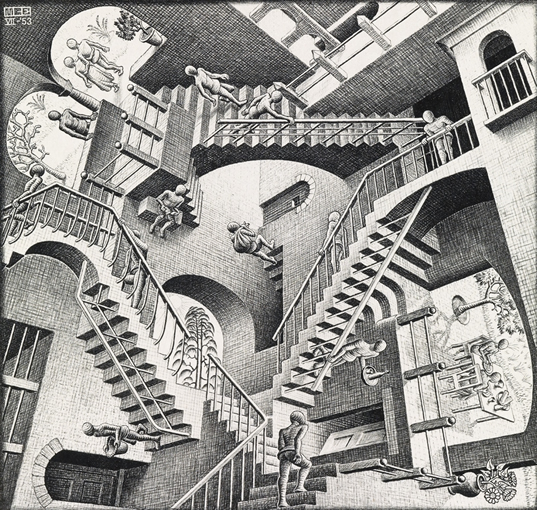
Relativity, M.C. Escher, 1953.
Cage 6, Gerhard Richter, 2006.
5. Jan. 98, Gerhard Richter.
|


Art Note: Betty, Gerhard Richter, 1988. Richter's daughter turns her back to us, her face angled toward one of the artist's own abstract canvases, unreadable. Nothing here is offered directly — not her expression, not the painting she's facing, only the fact of a turning-away. It is close to what this essay argues suffering itself demands after catastrophe: not direct statement but aesthetic mediation, the refusal of the face-on gaze in favor of an indirection that still, somehow, asks to be understood. Oil on canvas, 102.2 × 72.4 cm. Collection Saint Louis Art Museum. © Gerhard Richter, courtesy of the artist and Gerhard Richter Archive.