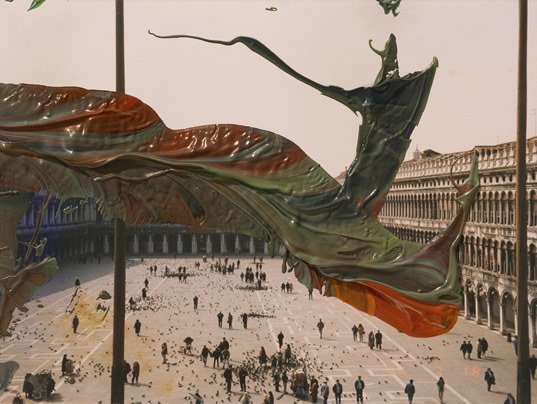
ROADKILL By Oshrat C. Silberbusch *** The Montréal Review, September 2026 |
|||
1
“Hazard reported ahead”, warns the disembodied voice of the navigation app as the car speeds along the highway. A few seconds later, the driver catches a fleeting glimpse of the bloody, mangled body of a deer, his majestic antlers no match for the two tons of steel that crushed him. As the cars speed by the carcass, nobody lingers on the cruel irony that turned the animal that never stood a chance into the hazard to watch out for. Relieved to have skirted the corpse without incident, the true hazards roll swiftly on.
2
In the United States, an estimated one million animals are killed by cars every day. It is an invisible hecatomb. “Most people don’t realize how many animals die on the road every day, they just don’t see it”[1]. They don’t see much at all of the world whizzing by outside their car window. The disconnect is built-in. Whereas historically, roads followed natural landscape contours, modern highways “diverged from the sinuous, landscape form of roads and became more angular and rectilinear in order to provide efficient travel between population centers”[2]. Today, multi-lane concrete strips built for optimal speed cut across landscapes, intersect ecosystems and fragment habitats, while severing the connection between traveler, road and land. Nature is a backdrop, its invisible destruction only occasionally brought to mind by a bloody hazard on the road.
3
[American roads] are abruptly inserted into the landscape, and the more impressively smooth and large they are, the more unrelated and violent their gleaming track appears against its wild, overgrown surroundings. They are expressionless. Just as they know no marks of foot or wheel, no soft footpaths along their edges as a transition to the vegetation, no trails leading off into the valley, so they are without the mild, un-angular, soothing quality that have felt the touch of hands or their immediate tools. It is as if no one had ever stroked the landscape’s hair. It is unconsoled and without consolation, and it is perceived that way. For what the hurrying eye has only seen from the car it cannot retain, and the landscape without footprints vanishes without a trace.[3]
4
In the fall of 1964, Romaine Tenney locked himself into his Vermont farmhouse and set it on fire, surrounded by bulldozers that had come to raze it to the ground to make way for the new interstate highway. Living without car or tractor, irrationally attached to the land of which his unhurried eyes knew every mound, every tree stump, every footpath, he was an anomaly for which progress had no time, no more than for the stately deer slowly ambling across the highway. And just like the latter, he never stood a chance, another roadkill in the collision between the blindly forward hurtling subjugation of nature and the remnants of the unsubjugated. Today, the land where his farm once stood is a big parking lot next to the I-91 where rushed commuters speed by, their hurried eyes oblivious to what vanished without a trace.[4]
5
After his brother was fatally struck by a vehicle while crossing the seven lanes of Jackson Avenue in Memphis, Keith Smith found a single clue: a chunk of broken headlight that he suspected came from a utility vehicle. The impact separated David Booker’s skull from the bones in his neck, left his brain bleeding, tore a lung and caused severe internal injuries, according to an autopsy.[5]
6
Unmatched Craft, Unstoppable You. Born to Break Limits. Unleash the Beast Within. Feel the Power, Fear Nothing. Drive the Fire. The Road Is Yours. Pure Speed, Pure Freedom. Roar of Victory. Dare to Dominate. Fuel Your Fire. Run Wild, Ride Fast. Victory Starts with a Vroom. Power in Every Path. Conquer Every Corner. Built Tough, Driven Smart. Unstoppable Journeys Begin Here. Built for the Bold. Drive Your Wild Side. Every Second Counts. Power That Protects. Every Road, Yours to Rule.[6]
7
In 2024, SUVs and light trucks made up 75% of new car sales in the US.[7] In the case of a crash, being hit by an SUV increases the odds of a pedestrian or cyclist being killed by 44% for adult/all-age samples and by 82% for children.[8]
8
Technologization is making gestures precise and brutal, and humanity with them. It eliminates from them all hesitation, all deliberation, all civility. It subjects them to the unforgiving demands of the objects. Thus people lose the ability to close a door quietly, gently yet firmly. Those of cars and refrigerators have to be slammed, others have the tendency to snap shut by themselves… One cannot do justice to the new human type without awareness of what is incessantly done to him by the things that surround him. What does it mean for the subject that there are no more wide opening casement windows, but only sliding panes to be shoved rudely, no more gentle door handles but only turnable knobs, no forecourt, no threshold before the street, no wall around the garden? And which driver has not been tempted by the sheer power of his engine, to squash the vermin of the street, the pedestrians, children and cyclists, reduce them to pulp?[9]
9
A simple look at an SUV and its supersize front hood leaves no doubt that the latter demands to reduce to pulp more than just hedgehogs. The moment you slam the door of your GMC Sierra 1500 Denali Ultimate (front hood height 5’-1”/154 cm)[10] and grab your steering wheel, the world outside becomes a silent, irrelevant backdrop, the crushable pendant to your invincibility. So you crush and speed on – frogs, squirrels, birds, deer, hedgehogs, cats, mice, snakes, pedestrians, children, cyclists. The difference in species is not a difference in kind, just a statistical one. Dead animals outnumber dead pedestrians only because the former anachronistically insist on walking (slithering, jumping, ambling), when most people have long ago adjusted to car culture and walk as little as possible, cautiously. When humans do get hit, their fate is not so different from that of roadkill. More than a quarter of pedestrian deaths in the US are hit-and-runs[11]. Every year, just like innumerable animals, thousands of humans are run over and left to die on the hard concrete as the drivers steady their wheel and speed on.
10
11
The possibility of pogroms is decided in the moment when the eye of the mortally wounded animal falls on a human being. The defiance with which he repels that gaze – „after all, it is just an animal“ – , is repeated irresistibly in the cruelties done to humans, in which the perpetrators need to reaffirm to themselves again and again that same ‘Just an animal’, because already with the animal they couldn’t fully believe it.[13]
12
Most drivers won't even catch a glimpse of the eyes of the mortally wounded animal proverbially caught in the headlights. Still, the possibility of (vehicular) pogroms, just like the possibility of the hit and run, is decided the moment the driver steps on the gas pedal and leaves the animal to agonize while his mind turns to the possible damage done to the car. Behind the soundproof protection of two tons of steel, the bloody mess (whether animal or human) is barely registered, while the sheer power of the engine, completely disproportionate to our own frail self, allows to add to the however faintly thought “it’s just an animal/reckless pedestrian” a reassuring “it’s not my fault”. Whatever it was that stood in my way, it wasn’t supposed to be there.
13
Technologization is making gestures precise and brutal and humanity with them. It also exponentially increases our capacity to harm unharmed. When the front hood of your car reaches the height of an average 13-year-old, your safety is gained at the expense of the chances of survival of whoever and whatever stands in your way. Feel the Power, Fear Nothing. Ecocidal, resource-guzzling, highly lethal, and proudly indifferent to a lifeworld with which contact has been reduced to, at most, a faint bump, SUVs allow you to kill unscathed. They are the proud symbol of a culture whose goal is not to protect the weak, but to make sure you’re not one of them. In 2025, a record 3 out of 4 US car buyers chose a vehicle type whose intrinsic brutality is a marketable reason for its appeal. That same year, US federal agents began prowling city neighborhoods in unmarked SUVs, chasing terrified humans down the street, dragging people out of their houses and cars, ripping children from their mothers’ arms, and shooting whoever tried to stop them. There may not be a direct causal relationship between the brutality of said agents and the SUVs they drive, but the two share more than an elective affinity. In a cruel twist that would not at all have surprised Adorno, America’s politics have come to resemble its favorite vehicle type. The same fundamental indifference to the havoc it causes, the same power that fears nothing and dares to dominate because it can, the same unharmed harm – armed-to-the teeth federal agents killing in perfect impunity on one side, the lethal armor of the 2-ton SUV on the other. A resemblance that results naturally from an object world where the object is both fruit and root of the violence it embodies : The movements machines demand of their users already contain the violence, the blows, the jerky repetitiveness of fascist torture.[14] The thought experiment of ICE agents emerging from a light blue VW beetle is evidence to the fact that the dark, tainted SUVs they drive are not a mere prop, but part of their very essence. “His style”, a NYT columnist writes about the head of ICE, “is not to negotiate obstacles, but to crush them.”[15] Every Street, Yours to Rule.
14
For the so-called man of purpose, with interests to pursue, plans to realize, the people he comes into contact with are metamorphosed automatically into friends or enemies. In looking at them with a view to deciding how well they fit in with his intentions, he reduces them from the outset to objects: some are usable, others an obstacle.[16] That man of purpose, unable to see [the other] as such and not as function of one’s own will[17], is not only in charge of today’s immigration policy, offshore oil drilling and transactional diplomacy, he also traced the highway that disfigured the landscape, ordered the Tenney farm to be flattened to the ground, and designed the eco- and homocidal trucks that now predominantly drive over the latter. For the instrumental rationality he embodies, not just people but the entire Earth is made up of friend or foe, of resources to be exploited and obstacles to be crushed, everything between him and his streamlined goal a nuisance, an anomaly that should not have been there in the first place. His is a world where, unsurprisingly, the damaged bumper is more deplored than the life the latter ended, where the dying animal’s gaze is repelled with the same defiance as the pleading mother’s cries. In the balance sheet of the man of purpose, the uncountable, unmeasurable nonidentical[18] has no place, its only function that of being most profitably erased.
15
Adorno’s idiosyncratic reaction to American car culture, and to the scars it inflicted on the land (Welcome to this ugly soil inhabited by cars, drugstores and hotdogs[19]), is an early, prescient acknowledgement of the brutality of that culture, an intuition that the latter carries within it all the violence of technological modernity.[20] When Adorno musesd about the (now quaint) 1950s cars and their desire to reduce everyone to pulp, when he mournsed the vanishing American landscape that the drivers’ hurried eyes no longer retained, he felt dimly that the American car culture becomes a metonymywhose triumphant beginnings he witnessed for the greater whole, advanced capitalist society, and the devastation the latter leaves in its wakewould become singularly devastating to the nonidentical his philosophy so desperately tried to save. The bloody, mangled deer is but one particularly vivid instance of that devastation. As the animal’s eyes break on the hard concrete, it not only tells us about the possibility of pogroms, but also of the very real massacre already underway, the nonidentical crushed, flattened, silenced in a world that has no time nor desire to negotiate difference.
16
In existing without any purpose recognizable to men, animals present as expression their own name, as it were, the utterly non-fungible.[21] Just like the carcasses of roadkill epitomize the violence of a certain relationship to the world, living wildlife embodies what the man of purpose cannot countenance: the non-fungible, the purposeless, that which resists subsumption. It is precisely that absence of purpose, Adorno writes, that makes them so beloved by children, their contemplation a bliss.[22]A deer in the forest, an eagle soaring high up in the air, a mountain goat jumping on the rocks fill (the child in) us with happiness, because they give us a glimpse of something outside the fully administered world, an experience not truncated by any preset purpose: a hint of freedom. The wild animal briefly stops us in our tracks, opening a crack to something ungraspable but exhilarating. He who mortally wounds the animal puts an end to that – the hunter by turning it into the fungible object it is not (“just an animal”), the driver by not stopping in his tracks, speeding on, leaving behind him (in every sense of the word) the life he ended. It is not without irony that today, when those whose contemplation holds a promise of bliss die millionfold on American roads, it is precisely the engines that kill them that have stepped into the breach, pretending to offer the very freedom they erase. Pure Speed, Pure Freedom. Americans seem to buy it, in great numbers, running wild and riding fast. Somewhere deep down however, dimly, they sense the fraud, and in the end it is with that ersatz freedom just like with the animal whose dying gaze they defiantly repelled: they need to reaffirm to themselves again and again the worn-out lie because already with the animal they couldn’t fully believe it.
17
Philosophy is really here to make good on what
lies in the gaze of an animal.[23]
CONTENTS
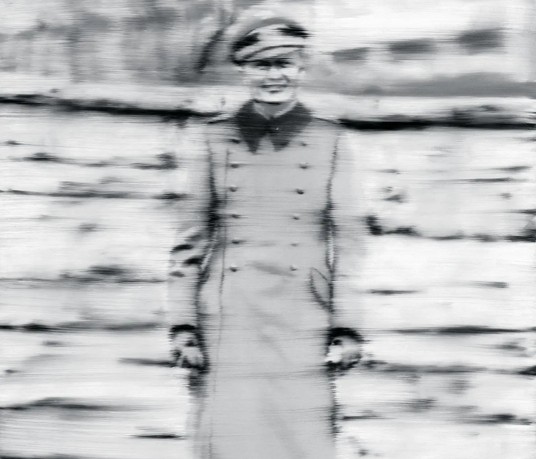
Onkel Rudi (Uncle Rudi), Gerhard Richter, 1965.
Grünes Feld (Green Field), Gerhard Richter, 1969.
A still from My Undesirable Friends: Part II — Exile (2026)
THE SKY IS BLUE: A CONVERSATION WITH JULIA LOKTEV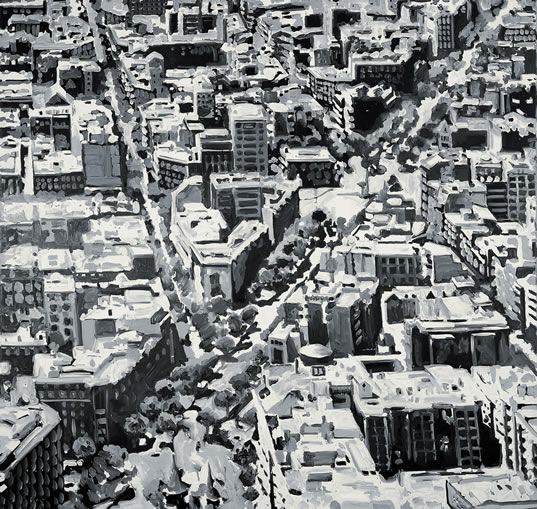
Stadtbild Madrid (Cityscape Madrid), Gerhard Richter, 1968.
INTRODUCTION: SYMPOSIUM ON CRITICAL THEORY
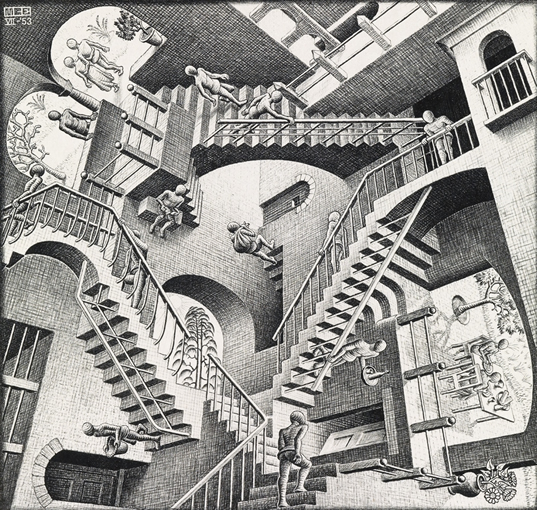
Relativity, M.C. Escher, 1953.
Cage 6, Gerhard Richter, 2006.
5. Jan. 98, Gerhard Richter.
|

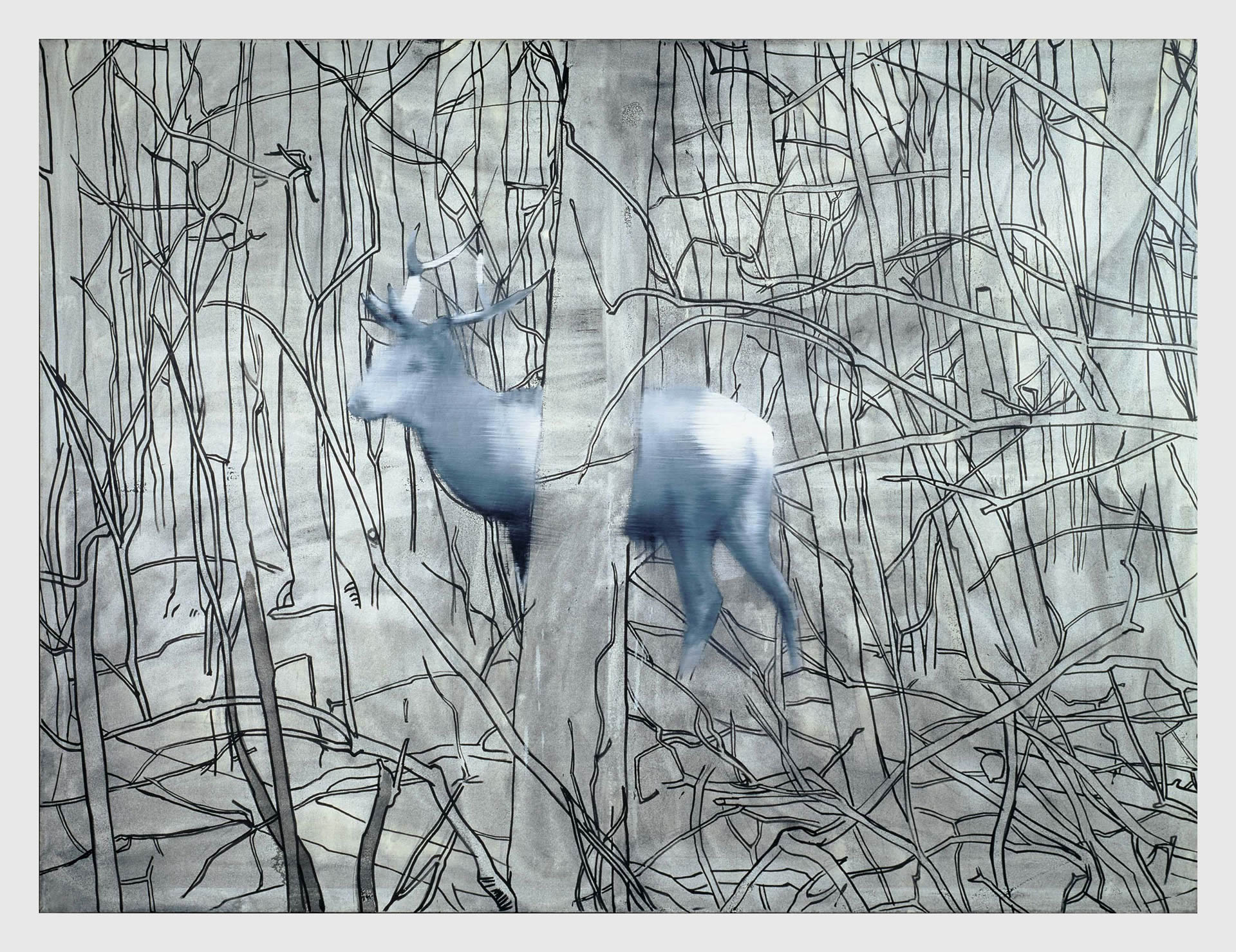
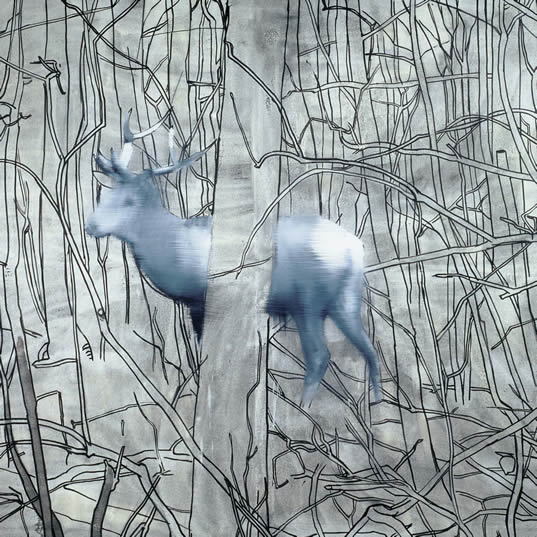
Art Note: Hirsch (Deer), Gerhard Richter, 1963. One of Richter's earliest photo-paintings: a found, banal image — the kind that turns a living animal into a trophy, a specimen, a picture — copied onto canvas and blurred, its gaze softened into nothing anyone has to meet. This is the deer before the highway ever touches it: already reduced, already just an image of an animal, which is one way of saying "just an animal." Oil on canvas, 150 × 200 cm (Catalogue Raisonné 7). Collection Fondation Louis Vuitton, Paris. © Gerhard Richter, courtesy of the artist and Gerhard Richter Archive.