RESPONSE By Martin Shuster *** The Montréal Review, September 2026 |
|||
Introduction
Let me begin by saying that I am incredibly grateful to Samir Gandesha, Kathy Kiloh, Jordan Daniels, Lorraine Markotic, and Henry Pickford for their generous and wide-ranging responses. It is really such an honor and pleasure to be in dialogue with such remarkable colleagues, friends, and scholars. I have deep respect for all of them. This entire encounter grew out of an “author meets critics” panel at the Society for Phenomenology and Existential Philosophy annual meeting this past year. The discussion there was equally wide-ranging and I am grateful also to the audience there for probing questions and comments. Finally, I am also grateful to Tsoncho Tsonchev for suggesting The Montréal Review as a site for this entire symposium. I can’t think of a much better place nor better issue for this entire conversation. I also want to take these opening lines to say a little bit about what follows. I wrote Critical Theory: The Basics somewhat on a whim. I never imagined that I would write this sort of text, and when I did, at the suggestion of an editor, I figured I would finish it in about 6 months or so and get back to my “real work.” Two years later, when I finally finished up the text, I realized that writing it was profoundly transformative. Writing a text of this sort, where you aim to introduce a complex topic to a generalist audience is incredibly rewarding and also frustrating. It is distinctly frustrating when you realize that certain things can only be made available in certain ways (e.g., having read a popular piece on popular writing, I encountered the advice that you should write for roughly an 8th grade reading level; using Word’s feature to assess the reading level of a document—after months of tweaking—I was informed by Word that I was still writing at grade 17). It is rewarding when you realize that there are better and worse ways of presenting complex material and that, after months of work, you can present something in a (generalist) way that may have some effect on a reader down the line. In short, what writing such a book allows you to discover—especially after presenting its ideas to audiences—is that critical theory can and does matter, as does our dissemination of it. I hope this exchange contributes—however slightly—to that continuing and necessary task.
Response to Samir Gandesha
I want to begin by saying that I appreciate Samir Gandesha’s deep contextualization of the state of critical theory today. I agree with many of the claims and with the basic thought that this is a worthwhile exercise, but I also think that there are a few important caveats that I want to add to his account. So, while I very much sympathize with and indeed would also prioritize the kinds of material conditions that Gandesha sketches, most notably the Cold War context, the rise of what we may term global neoliberalism, the defunding of public education, the seeming disintegration of the Western even nominally liberal order, the popularity of authoritarian movements across the globe, and so forth, I also would want to acknowledge the extent to which there are certain core philosophical issues that arise with modernity, issues which I am hesitant to reduce exclusively or merely to these material conditions, even as I would wholeheartedly acknowledge—indeed stress—their intimate connection to these conditions.[1] Here the gamut of issues are in fact quite difficult to summarize economically, but involve in one way or another the kind of dissatisfactions with modernity that begin roughly with Rousseau’s 2nd discourse and continue through Kant and German Idealism and the European philosophy that follows, culminating especially in variations of, on one hand, religious extremism and, on the other hand, nihilism (and with Nietzsche thereby being a central figure at both nodes). A challenge that critical theory confronts, then, is the continuance of this kind of dissatisfaction in a range of domains, including disciplinary, literary, political, religious, and so forth. This has a lot of overlap but should not be reduced merely to the post-structural kinds of critique that Gandesha highlights. Bringing this into focus helps us understand that the danger to critical theory—as Gandesha notes—comes not only from outside of the academy, but also from inside. But I think that danger can’t solely be reduced to the four groups that Gandesha notes. I understand that these weren’t meant to be exhaustive, but I think it is important to add another broad current, which is something like a kind of philosophical or existential challenge. This would be one way to situate several developments within the Frankfurt School itself, especially the first generation,[2] most notably around their robust engagement with Heidegger and phenomenology (think here of Adorno as much as Marcuse) and also with existentialism, most notably, I would say, in Fromm’s split from the School and in the development of his later, existentialist psychoanalysis (but equally, we might say also with the way in which they engage Sartre’s work). I have wanted to mention this to press a couple of issues. First, we should not understate the extent to which Frankfurt School critical theory has itself become a tradition, especially an academic one. I mention this because it seems to me one easy way to situate what Gandesha and I have both, following Michael Thompson, termed the “domestication” of critical theory, but equally also the potential critical theoretical schism that we are witnessing in real time, borne especially out of Germany’s unique context with respect to the Nazi genocide and to the contemporary state of Israel and also the criticisms of the kinds of more Orthodox Marxist critics that Gandesha mentions. These are all—it seems to me—different ways of highlighting the extent to which Frankfurt School theory has become a tradition. As both Max Pensky and also Cecilia Sebastian has stressed in different ways,[3] especially the so-called first-generation of critical theory, in its first robust form, ultimately coalesced into something that eschewed tradition, aiming to have no fixed methods, but rather to pursue a constant adjustment of methods in the face of empirical developments. So much so, and here I am quoting Max Pensky, that critical theory be “envisioned as an interdisciplinary cooperative enterprise, in which an interlocking constellation of various theoretical-critical interventions in modern culture would coalesce to form a basis for organized oppositional political action.”[4] Note, importantly, though, that this was not in fact how the Institute originated. So, while, as Gandesha notes, Felix Weil was deeply crucial to its formation through his funding, its first director—preceding Horkheimer—was Carl Grünberg, who had the following to say as a kind of mission statement upon his inauguration: “I have already emphasized that the Institute will strictly refrain from engaging in day-to-day politics. Should it, through its work, exert any influence—this influence will be, in both nature and scope—no different from that which scholarly activity is generally capable of exerting: namely, by virtue of its findings making an impression upon public opinion.”[5] Grünberg’s vision, then, was to have the Institute be a site where certain kinds of academic work could be done, i.e., Marxist work which was incapable of being pursued in the academy at the time. This is quite far from, though certainly not unrelated to, the eventual mission that develops around Horkheimer, Adorno, Marcuse, and Fromm, which is neatly summarized by Horkheimer’s thought in “Traditional and Critical Theory” that “the real function” of the critical theorist emerges only when “the theoretician and his specific object are seen as forming a dynamic unity with the oppressed class, so that his presentation of societal contradictions is not merely an expression of the concrete historical situation but also a force within it to stimulate change.”[6] In a deep sense, then, I think the establishment of Frankfurt School critical theory as a kind of disciplinary tradition within the academy has threatened the very existence of its ambitions as critical theory, especially as the university itself has come to feel the weight of its internal contradictions (formed as they are by the kinds of dissatisfactions I’ve noted earlier, which revolve around the status of knowledge altogether and which are even broader than, although certainly not unrelated to, the cluster of issues Gandesha situates around the potential aim to reduce all knowledge to power). The same is true also of the kinds of external pressures the university has experienced (exemplified chiefly by the kinds of economic and cultural pressures Gandesha has noted, which are culminating now, especially here in the USA, with a full-scale attack on the academy, which testifies still to the critical potential still inherent to and available to the academy). It seems not too much to me to suggest that such critical theory may be reaching a point where it may no longer be successfully practiced in the academy and may in fact have more success outside of the academy, and not, I would stress, exclusively because of external threats to the academy, but rather as much from internal, disciplinary threats within the academy. I mention all of this because it seems to me central to addressing a key feature of Gandesha’s framing of the issues. He mentions first and second order trauma as being a salient point of analysis with respect to the kinds of problems that have been thrown up for critical theory broadly conceived. So, he suggests that: “A heightened consciousness of the violence of colonization and slavery provoked by the events of the first two decades of the twenty-first century, triggers a profound re-living of collective trauma caused by an all-too real historical suffering. This brings to the fore a shared perception of the utter insufficiency of European philosophy to even begin to come to terms with such violence.” Gandesha frames this as a kind of insufficiency, underwritten on his account, it seems to me, by “the fact that the event shatters our frameworks of intelligibility themselves.” I find this unconvincing for a couple of reasons. First, I think if read a certain way it leads us exactly back to the sort of robust, philosophical quandaries that I mentioned at the very beginning: quandaries that are framed exclusively in philosophical terms, so that there are alleged limits to language, underwritten by some sort of ontology that shows how reality or aspects of reality somehow stand outside of language. We are here, it seems to me, on our way to the realm of Being, with everything that this may imply when it comes to Heidegger’s or Nietzsche’s or even Derrida’s possible interventions. I have no desire to take a position on these issues. For present purposes, I am willing to say that these may be genuine issues that we do indeed have to work through philosophically or that we may never be able to until something allegedly happens (I think here of Heidegger’s problematic suggestion that perhaps “only a god can save us”). Second, the reason that I want to bracket all of this is because I do not think this kind of failure of intelligibility broadly conceived is what Adorno has in mind. I think, as elsewhere, Adorno’s is a kind of ethical objection: the failure of intelligibility is an ethical failure to acknowledge this suffering and everything that it implies: society writ large—culture writ large—is implicated in this failure because it is arranged in a certain way to make it so that such suffering is not acknowledged. To bring this into just slightly sharper focus, let me say that, like Samir, I also read Hamid Dabashi’s After Savagery with great interest. But—despite agreeing with some of his broader points—the book is profoundly flawed when it comes to its analysis of Adorno and the Frankfurt School, relying as it does on the unserious work of Gabriel Rockhill. Note that the criticisms of Adorno and the Frankfurt School in After Savagery all rely on claims about the particular biographical details of various figures in the School (that, say, Horkheimer or Adorno had racial or colonial assumptions).[7] This is not news. Furthermore, and more pressing, does this invalidate their philosophical insights? This doesn’t follow; it’s not a two-for-one deal. This is why I think it is imprecise to speak, as Gandesha does, of an “insufficiency of European philosophy” to come to terms with such violence. What is the nature of this insufficiency? European philosophy could have come to terms with it, indeed, I would suggest that it has made movements towards what that would mean (critical theory being one site where this is initiated—here it is obvious that the Frankfurt School was composed of different individuals whose personal and philosophical views differed). In suggesting this, I do not mean to deny that, on the whole, much of philosophy has generally made a choice—theoretically and practically—not to come to terms with such points, exactly to avoid doing so. This is not an insufficiency inherent to philosophy, though, it is a failure of acknowledgment by philosophy. This failure is prompted especially, I would argue, because of the present disciplinary situation, where ideological and material conditions reign quite dominantly in the academy, especially in philosophy (a point no less true in earlier generations). It is also difficult to capture all of the issues involved here in any compact way, but I would include here things like the composition of the academy itself, especially philosophy; the construction of a distinct kind of canon; the location of certain kinds of assumptions about what counts and doesn’t count as knowledge; stylistic biases about how to do philosophy; deep assumptions about the nature of critique, testimony, and history; and hiring practices in academic departments. And, of course, likely most importantly, the material—economic—underpinnings of the academy writ large (including its involvement, especially in the United States and elsewhere, with the military-industrial complex). Frankfurt School critical theory is theoretically—philosophically—capable of acknowledging these features, but it had, for too long, avoided doing so, exactly because it became itself situated within the academy, with everything that that implies (a point obvious from Grünberg’s first address, itself only potentially called into question with Horkheimer’s subsequent proposal). It just is the case that as soon as it came into existence, Frankfurt School critical theory was threatened—literally—with extinction in the form of the Nazi genocide and world war. This is not to excuse any theoretical or philosophical shortcomings or biographical biases; it is simply to contextualize them so that we can move beyond them. What is happening now with the ways in which antisemitism might be understood (whether in, say, Germany, due to its Nazi past, or in, say, the United States, due to how this notion is being weaponized by the Trump administration) is a species of a related phenomenon and thereby by no means extraordinary (material conditions do indeed have robust effects on practice). (As a parenthetical, this is all also another way of saying that it may be possible in the example that Gandesha cites that Tuvel’s article was indeed harmful—but that in this regard it was no more harmful than many others—and that therefore the field should have also never called for its retraction without calling for the retraction of many others or—better—for an overhaul of how it produces and acknowledges knowledge and expertise in the first place). I mention all of this to respond to the two specific worries that Gandesha raises. First, he raises questions about a potential “inflation of claims to harm and suffering.” This is prompted by a concern that my notion of “needless suffering” may be too imprecise or to raise unforeseen consequences in certain contexts (a point that Kiloh also raises and to which I will return again in my response to her). Gandesha invites us to inquire about “the profound differences in the understanding of suffering between … those historical materialists who insist on the primacy of class … and … [those] advocates of ‘intersectionality’ or identity politics.” He cites here Adolph Reed Jr. and Walter Benn Michaels’s work, especially their recently—as he notes polemically entitled—No Politics but Class Politics. In response, I want first to stress Gandesha’s own observation about the polemical nature of the title. I would suggest that the polemical nature of the title reveals exactly the disciplinary situatedness of the people involved. Are these two perspectives as oppositional as such polemics—themselves useful for disciplinary belonging not to mention book sales—suggest? At bottom, it seems to me that the most fruitful analyses—including by Marx himself—easily acknowledge both perspectives, refusing any kind of reductionism in either direction. Intersectionality in the contemporary context means that we understand that there are distinct ways for agents to be situated within the world, so that, say, being a Black woman subjects one to particular, concrete socio-economic conditions that can be distinguished from those of being a Black male in the same society. This is merely a variation, I would argue, on a theme that Marx himself pursues in the 18th Brumaire and also in Capital when he suggests that politics sometimes plays a leading role (Hauptrolle) in certain milieus so that we may say—with Marx—that politics comes to be “refracted” through a mode of production. Just as like in a leading role in theater: the stage is set by forces outside of the control of the actor, but the actor also contributes something important. (Another way to make this point available is to note that this point doesn’t cut only in the direction of the oppressed but also helps us understand the oppressor. For example, especially with an eye to the present moment, that the marker of being a Christian White Nationalist makes a difference, even as it is of course intimately tied and underwritten by certain material and economic conditions: something new emerges when those three terms are put together that is more than the sum of its parts, more than merely being a Christian, a white supremacist, or a nationalist. To get a grip on this point, just note how resistant those under the sway of Christian White Nationalism are to arguments or developments that may change the minds of anyone operating under the sway of only one of those; here, each term inoculates someone from criticisms that could brought against them by leveraging arguments around other terms in the triad).[8] I think, though, Gandesha quite expertly doesn’t simply rely solely on these claims but also suggests that there is a deeper issue of which all of this is symptomatic, which is my reliance on drawing an— admittedly, from the perspective of critical theory, peculiar—analogy to ordinary language philosophy. Here, I am relying especially on a distinct kind of understanding of ordinary language philosophy, one informed most prominently by Stanley Cavell. Gandesha, presses the former point about potential differing understandings of suffering to suggest that we may have in his words, “possibly incompatible ‘forms of life’” so that one “appeal takes the form of symbolic practices emphasizing structures of socio-economic inequality” while another emphasizes “recognition and representation.” He notes that in one case what needs to happen is that class itself needs to disappear—and thereby class society—while in another what is needed is recognition and affirmation of a distinct identity, not its abolition. While it didn’t end up in the published version, in an earlier presentation of this point at a panel on the book at the Society for Phenomenology and Existential Philosophy annual meeting, Gandesha offered as evidence for this claim the cancellation of a co-hosted DSA talk by Adolph Reed Jr. in 2020 for his alleged class reductionism. This is a smart and important point: there does indeed seem to be a distinct difference in prioritizing class or other material features (say, homelessness) so that the solution to them involves the very abolition of those things, whereas no one would allegedly want to say that what’s necessary is the abolition of certain identity markers, but rather their recognition. It’s important, though, to focus on this issue in more detail. I think it is important to assess the exact nature of the alleged incommensurability involved. Note that Gandesha uses a somewhat vague formulation when he claims that these are “possibly incompatible.” The imprecision is important. My first suggestion (and not meant to apply to Gandesha himself) is that these sorts of debates are frequently not conducted in good faith: they are instead debates that are oriented by external concerns, whether a kind of jockeying for position or resources amongst scholars (this method is passe while this one is new and more fruitful or liable to be funded), or just the kind of faddishness that swims through the academic ecosystem in regular cycles. Equally, I think, in this regard, the academy reflects broader currents so that certain kinds of approaches and even knowledge of those approaches are oftentimes undermined, overshadowed, or deprioritized by ruling powers. So, it may be true—that is—that a certain kind of identity politics was useful to the ruling classes because it exactly convinced many to ignore class issues (as is commonly put, “Black faces in high places” may be quite compatible with continuing racial oppression). But this doesn’t mean that there is no politics but class politics, it rather means that race and class—and gender, and ability—are intertwined in complex ways that require cogent and materially grounded analysis. If that’s true, then we must ask: in what sense are these in fact incompatible? Only if these are understood in quite un-nuanced and unsophisticated ways; in short, only if we do not properly pursue a robust critical-theoretical analysis. Class, race, gender, ability, are all bound up with each other and the focus on needless suffering is meant to be exactly the fulcrum that allows us to see their connection rather than disconnection. If the focus is on the alleviation of such needless suffering, then there emerge myriad possibilities for dialogue between a variety of groups, each of whom could benefit from the insights of the other. I do not think such discourses are incommensurable or incompatible, and I have yet to see arguments for why we need to think that they are. Were the groups who are invested in staking out these positions exclusively interested in genuine dialogue—as many of us who work on these issues are—I think they could easily understand the ambitions and problems to which the other is responding. But, of course, there is much at stake in continuing the polemics so as to carve out particular niche audiences and platforms (which correspond to acquiring particular material resources and conditions). Here it is worth understanding that the idea two forms of life being “incompatible” can—as Cavell suggests and as I think Adorno and other members of the Frankfurt School would agree—only mean that they let something come between them; what we have are failures of acknowledgment not knowledge.[9] As soon as we are language users who share enough physical characteristics to be able to register our linguistic creations, then we are capable of commensurability. While this point has been most forcefully pursued by Donald Davidson in response to Quine,[10] it is also found in Cavell’s reading of Wittgenstein, where he stresses that disagreement also implies a kind of community. In Cavell’s words, we may have “intellectual tragedy,” so that it is “not a matter of saying something false,” nor is it “an inability or refusal to say something or to hear something.” Rather, what is going on is not that something false has been said about “us” but rather we have learned that “there is no us” not now and perhaps may be never “to say anything about.”[11] (One finds analogous views in members of the Frankfurt School, I believe, especially in some of Horkheimer and Adorno’s early reflections on language). On such a view, yes, of course, we may come to disagree. Indeed, we may not be able to move past this disagreement: the disagreement may be vicious, it may be the case that we will never come to agree. There may be groups or people who simply refuse to see this bit of suffering as needless (or may, indeed, refuse to see any suffering as needless). But such incompatibility is not a theoretical problem (as if, language or Being or whatever else) prevents us from agreeing. It is rather a practical problem: we are prevented from agreeing by us, by our relationship (which may not even exist). What we have are entrenched (or violent) positions in the same form of life. The difficulties in communication here are wrought exactly because of things like class, race, gender, ability, and so forth; they are positions adopted in a shared form of life, not decreed by incompatible forms of life. As Adorno himself puts it, “what would be beyond, appears only in the materials and categories inside.”[12] One solution here, then, is to speak to each more, and better, with greater precision, under the sway of more intense critique, but equally also with more compassion and possibility, with an eye towards acknowledgment of both our limits and those of others. Another solution, of course, is, as Richard Rorty once noted in response to Apel and Habermas, is to recognize that speaking more—language—may be of no help, for someone may think—and be utterly incapable of being convinced otherwise—that, say, “the Aryan race is in tune with the intrinsic, necessary, nature of things,” and, in such a case, the only option unfortunately left is for us to “reach for our guns.”[13] These are the two extremes, I would argue. Most of everyday life falls in between them, and we, as critical theorists, have not even scratched the surface of trying our best to leverage the former strategy outside of the academy and with those with whom we already generally agree let alone with those with whom we do not (this is one way to register the importance of Adorno’s countless radio addresses during his time).
Response to Kathy Kiloh
That is how I would respond to Gandesha’s points as he’s framed them, but I want—on his behalf—to sharpen a point he raises. It seems to me that the most forceful way to make his point is to challenge the deployment of ordinary language philosophy in this context regarding the kind of claims of needless suffering that may be encouraged or wholly manufactured by nefarious forces. I am thinking here of alt-right identitarian victim politics, claims of white genocide, misogynistic victimhood politics, outright embraces of fascism, denials of democracy, and so forth. This is where Gandesha’s worries dovetail with Kiloh’s; we are thinking here of the kinds of mutilations of subjectivity that occur throughout advanced capitalist societies, now more so easily and numerously than ever owing to social media. Before turning explicitly to Kathy Kiloh’s worries, let me say first that on this front, perhaps the kinds of concerns about racial or gender identities that Gandesha wants to starkly distinguish from class identities are not in fact as different as Gandesha imagines. As James Baldwin stresses: “America became white—the people who, as they claim, ‘settled’ the country became white—because of the necessity of denying the black presence, and justifying black subjugation … White men—from Norway, for example, where they were Norwegians—became white by slaughtering cattle, poisoning the wells, torching the houses, massacring Native Americans, raping black women.”[14] Baldwin points out that there are in fact no White people; it is a kind of moral choice; so, our present identity categories will themselves in fact have to disappear to the extent that they too are already always wrought by—or in Marx’s words refracted through—material conditions. But this exactly takes us to the kinds of subjectivities we do indeed now have, and it will be, then, exactly these subjectivities that will set the horizon for any deployments of ordinary language. In short, I want to turn explicitly to Kiloh’s worries. She notes that I claim that everyone is only “potentially” an expert in testifying to needless suffering. So now we have her worries and Gandesha’s: on one hand, that people may deploy claims of suffering that mistake the genuine origins or nature of their suffering, or that they may be so constituted that they are incapable of formulating the nature of their suffering altogether (the worry about deploying claims of needless suffering hypocritically or ironically, as I do not think merits a unique analysis; such claims are part and parcel either of fascist projects or nihilistic ones). And these issues are not unrelated, since as Kiloh so expertly notes that when people may be “unable to identify the cause of their pain,” they may then “lash out” and “instead scape-goat … groups.” Kiloh then spends significant time in her response circling around certain key issues in aesthetics and how they relate to this state of affairs. Before turning to those issues, I just want to register that I do not think either Adorno or Marcuse—or the Frankfurt School more generally—views art as the sole site where negativity and resistance can appear and can be cultivated. I don’t think Kiloh intends to suggest this, but I just want to note this to make an initial response to her worries: simply put, there is no simple or single way to respond to the sorts of agency that the contemporary world throws up. In cases where we think people are mistaken about their suffering, we must engage with them, aesthetically, politically, philosophically, and also sometimes just socially or intersubjectively. It is not by accident that both Marcuse and Adorno did an immense amount of public engagement across different media and at different times and at different ways. As I’ve already suggested, my sense of the contemporary situation is that we (academics, critical theorists, people) don’t do this as robustly as we could; we simply do not have the same kind of institutional and technological reach and networks that exist around regressive causes (this is a two-fold point: we generally oftentimes do not have an interest in doing this and society is set up structurally to make this more difficult, given the media ecosystem that billionaires have created around us). With that said, though, it also important to understand that there are further distinctions to be drawn here: there are subjects who may be mutilated in their immaturity but nonetheless amenable to discourse and at least receptive to democracy and there may also be subjects who are in fact not mutilated but actually quite well formed agents who are committed to opposing democracy and everything that implies. These are not genuine interlocutors and perhaps the procedures of critical theory and ordinary language are not our best means for engaging with them. This is another way of saying that it is not by accident that the Frankfurt School went into exile and fled Nazi Germany. You cannot speak to everyone about everything. (As a parenthetical, this is exactly why I wanted to stress in response to Gandesha that issues of nihilism, religious extremism are genuine philosophical positions and ought not to be reduced always and solely to material conditions). Putting this point to the side for a second, Kiloh highlights in such a sharp, fruitful, and compact way how Marcuse and Adorno have quite differing conceptions of how to harness Freud’s theory of drives towards liberatory ends. I really don’t have much to add to her keen analysis, except to say that I am not sure that Marcuse and Adorno are as far on their approaches to art and aesthetic analysis even if they are—as we agree—quite far in their development of Freud’s drive theory in response to such analyses of art. That is, I think even if Marcuse is committed to the “liberation of the drives” in the way he envisions in Eros and Civilization, his account in The Aesthetic Dimension still dovetails in important ways with Adorno’s in Aesthetic Theory. What both share and what remains important in this context is their commitment to understanding a successful work of art as invoking or involving a longing for something outside of present conditions; the nature of this longing may then be framed in quite differing ways, but the earlier commonality is still worth stressing, especially in the kind of generalist context I envisioned for this book. Equally, I take Kiloh’s point about the importance of the domination of nature as a salient point in Adorno’s aesthetics. As she notes, I do touch on it but certainly not in the depth it would require; I chalk this up simply to trying to work in issues of environmental domination in a different context: I touch on it in the chapter on crisis and suffering, thinking when I wrote it that it would be more amenable as a point there than in the aesthetics chapter where it took great effort just to make the Frankfurt School theories on art palatable and understandable to a generalist audience (this is a larger point, though, and which Jordan Daniels also brings up in her response and to which I return to briefly, though likely not very satisfactorily). Kiloh also raises concerns—which I deeply share—about even so much as the fit between something like the autonomy of art and of contemporary culture, what she describes so well as “the era of influencer ‘culture,’ and curation by algorithm.” Here she seems to me to raise two distinct concerns. First, is the question whether perhaps “viable theories of sublimation no longer matter now that repressive desublimation is the order of the day.” Second, is the cluster of questions she raises around whether such aesthetic experience is any longer so much as possible because of the kinds of agents we are becoming. (These are framed analogously as being about “accessing the sense that things could be otherwise,” having “the conception of art as autonomous, and following from that, that it might provide a model of ethical relations”, a point she notes “comes across as quite alien.” All these lead Kiloh to ask whether a “socially critical philosophy [can] do without the amazement and enthusiasm for the truth that aesthetic experience awakens in us?”) These are not easy questions nor merely abstract worries. I too share Kiloh’s worries, and I feel that my students frequently strike me as quite akin to hers. Nonetheless, I think there are some potential promising signs here—some better than others. With regard to repressive desublimation, it seems sadly that the world is solving this problem for us: regular, old school repression is on the rise in Western societies and so the days of a repressive desublimation may be on the way out (this is, of course, only promising from a theoretical perspective, of course, and this remark is obviously a bit of gallows humor). More pressingly, since she shared her experience with students, I want to share my own: my sense is that students are still capable of acknowledging serious works of art and of experiencing the kind of shudder that they can create. In short, totalization is not complete, even if it seems omnipresent and growing. What it does seem to require is time and care and criticism: students require initiation into viewing art and the aesthetic sphere in this way; in short, they require education. And this just makes the attack on the academy currently in process more salient and more pressing; it also shows—despite whatever problems the contemporary academy has—that these attacks are not accidental. Once again, the question about what kind of opposition we are dealing with becomes pressing. What seems important to me is for critical theory to imagine more sites—institutional, social, political, ethical, aesthetic, equally virtual—where we can build capacity for maturity. My sense is that we have failed spectacularly on this front, especially on the institutional front which is so important: we have no serious competitors to the conspiracy theories of AM radio, to the pipelines of misogyny on YouTube, to the health to eugenics influencers on Instagram, to the international coterie of religious nonprofits promoting evangelical Christian theocracy, and to the plethora of economically radical fundamentalist think tanks across the USA, and so forth. What we need to do in this case is to develop a wide range of novel institutions that can engage robustly with the public in ways that promote critical consciousness and maturity. My experience, limited as it may be, is that when we do, there are remarkable opportunities and effects, but we have rarely done so exactly because we have for too long prioritized Frankfurt School critical theory as a disciplinary, academic tradition rather than as a site where something as ambitious as the liberation of humankind might be pursued.
Response to Jordan Daniels
I am grateful to Jordan Daniels for such a sympathetic but also lucid and critical response. She raises, to my mind, quite important points, especially about the domination of nature and also its connections to the notion of maturity or autonomy and does so in the context of both the Frankfurt School and of ecofeminism. Daniels asks why the notion of the domination of nature goes largely unmentioned in the book, raising some potential possibilities: I wonder then if the domination of nature goes unmentioned in Critical Theory: The Basics because, having been so prevalent, it has lost some of its power. Could it be possible that the concept, once sharp, became blunted by overuse? Or blurrier through overexposure? Could its absence be due to a worry about how the “domination of nature” has become a piece of jargon, a kind of buzzword or fetish, that shuts down dynamic thinking? Is it linked with too grand a narrative about instrumental rationality and the development of Western science? Is the domination of nature too abstract to serve novice critical theorists today? Each of these captures exactly my thinking and also—I think—suggests several essays worth of reflection. In response, I mostly want to stress that I think the domination of nature thesis—as Daniels herself illustrates so well—connects profoundly to all the most basic building blocks of critical theory, indeed to an analysis of capitalism itself. Because environmental action has been so usurped and so coopted by the culture industry, I found myself shying away from employing it as a linchpin in my analysis (I hoped—perhaps naively—to appeal to the broadest possible base for critical theory, which seems to me, must rest on a sober estimation of contemporary life, of which environmental degradation and the domination of nature is surely as feature, but this was not the place I wanted to begin given the myriad positions staked out under the moniker of “environmental ethics”). And indeed, the domination of nature—as Daniels so effectively and convincingly demonstrates—is such a mediated phenomenon, encompassing so many different issues, that I somehow felt it would be unmanageable to add it to the rubric I had designed to present Critical Theory: The Basics. It struck me as including it in the way that Daniels suggests would have made the book somehow unwieldly. In reading her remarks and formulating my response, though, I wonder if that indeed was a mistake. Certainly, there is very little in what Daniels wrote that I would disagree with, and to them, I think we could just as easily fold in contemporary events, e.g., Ukraine, Gaza, Sudan, Iran which each have drastic and robust ecological effects. My thought when drafting the book was to try to work up to such broader issues from a much smaller point that might be convincing to novices (e.g., alleviating needless suffering, something that could be diagnosed across a range of local foci). Daniels’s response seems to me to show that one could easily start with the broader issue and work down to local ones. Is there a significant difference in such approaches? I’m inclined to say there is not, but even if there is, I am not sure it matters that much since Daniels’s point was to ask about the notion not to suggest that the book needed to be oriented around it. My sense, though, is that there is still such an immense literature on the topic—and also even divergent ways in which it can appear in well intentioned ecologically themed thought[15]—that I still have trouble envisioning a compact way to incorporate it in any robust way. The domination of nature issue also, I think, takes us into the heart of how to read the Dialectic of Enlightenment, and there, I think, there is such a robust literature, and so many distinct issues, that, again, it just felt unmanageable for an introduction. But I think given my own mention of potential ecological collapse and invocation of Mark Levene’s notion of omnicide, it likely could have featured more prominently without issue. I take Daniels’s concluding point also: that thinking seriously about the domination of nature likely involves thinking about our own animality in robust ways, and that this all forms an important complex of training with regards to the potential disposability towards life that permeates the contemporary world more generally. I am again in broad agreement but find here too that there are many well-intentioned positions that end up in an unnecessary romanticization of non-human life, so that the inherent destructiveness and violence of the non-human world is minimized or undervalued. I am not suggesting Daniels or the Adorno she invokes are engaged in this, only mentioning it to note choices are always made in writing introductory texts, choices which require the author to balance the established literature and debates amidst the possibilities for lucid explanation. In any case, Daniels’s response is such a great elaboration of many of the book’s themes around the topic that I certainly do take her points.
Response to Lorraine Markotic
I am grateful to Lorraine Markotic for a very keen and wide-ranging response, especially one that introduces such a wonderful and timely and productive reading of Marcuse into this conversation. I don’t have a lot about which to dispute in Markotic’s reading, though I do want to use it as an opportunity to press some formulations around non-identity and Adorno that I encountered in Markotic’s response. I think these may perhaps overstate the case in certain ways. I wholeheartedly agree with Markotic that “Adorno’s insistence on non-identity … opposes equating things with their current form and conditions,” but I am unsure of some other formulations that she pursues. For example, she later claims that: “To reprise: we read the world through our concepts, and this reading will always be misreading.” She continues: It will always be an under- and an over-interpretation. It will be an under-interpretation because of all that conceptual thinking misses in any particular phenomena, including their potential. It will always be an over-interpretation because concepts impose themselves upon objects, structuring and shaping them. Adorno’s negative dialectics, and his critique of identity-theory, insist upon both conceptual thinking’s inherent inadequacy and its imperialism. My sense here is that there is a way of reading this that overstates the case. For example, in Negative Dialectics, in a famous section referred to as “‘Peephole Metaphysics (Guckkastenmetaphysik),” Adorno claims that “there is no peeping out”[16] Adorno continues noting that (and this is a passage I’ve already quoted in response to Samir Gandesha): What would be beyond, appears only in the materials and categories inside. That is where the truth and untruth of Kantian philosophy falls asunder. It is true, as far as it destroys the illusion of an immediate knowledge of the absolute. It is untrue, as far as it describes this absolute with a model of an immediate consciousness, even if this consciousness were an intellectus archetypus.[17] In the first part of this passage, I think Adorno rejects any kind of philosophy that would prioritize givenness (we may say that Adorno too is a kind of philosopher who sees “the given” as a myth).[18] Note the invocation of the “intellectus archetypus” in the last sentence. Adorno points out that not even a divine intellect could know the absolute. I think this is best understood by rehearsing certain Kantian themes. For example, Kant also invokes the notion of an intellectus archetypus, as early as his famous 1772 letter to Marcus Herz. There, Kant highlights that: if that in us which we call ‘representation’ were active with regard to the object, that is, if the object itself were created by the representation (as when divine cognitions are conceived as the archetypes of all things), the conformity of these representations to their objects could be understood. Thus the possibility of both an intellectus archetypi (on whose intuition the things themselves would be grounded) and an intellectus ectypi (which would derive the data for its logical procedure from the sensuous intuition of things) is at least intelligible.[19] The two options Kant considers are as follows. The first option is an intellect that creates the object through its act of representing. Such an intuitive understanding has the whole and produces the object through the very act of possessing that whole. The epistemological issues that occupy Kant in the 1st Critique, then, would not arise for such an understanding, for there is no separation between intuition and representation; the two are one and the same, and created immediately.[20] The second option, where an intellect has a sensible intuition and then forms a representation of it, is the one that is most germane to our capacities. Such an intellect proceeds from a part to the whole. For such an intellect the great panoply of skeptical options arises (about how intuition and representation can be known to correspond, and in turn, the problem that drives Kant, how the ‘ground’ of their ‘relation’ is to be understood). Because the whole exists apart from the intellect in question, that intellect gains access to the whole only discretely, discursively. Noting this passage in Adorno and its invocation of Kant allows us to burrow deeper into his thoughts about non-identity. A tempting way to understand Adorno on non-identity is to see him as a kind of realist: there just is something out there, beyond our concepts. Non-identity, then, is a term of art for what’s not captured by concepts. The problem, on such a view, is human conceptuality writ large (they will always fail to capture something out there just given the disconnect between them and what’s out there). What we would need to do, then, is to acknowledge a basic fact about all particulars: they are the sort of things that will always elude our conceptual capacities. I think such a view is not Adorno’s (as should already be obvious from my response to Samir Gandesha above). When Adorno notes that (1) “what would be beyond, appears only in the materials and categories inside”, and (2) that even an intuitive understanding could not capture what is non-identical, he is drawing our eye to a different problem. The reason that not even an intuitive understanding could capture what is in question is that there is nothing “out there” that could be captured, rather what is captured (or failed to be captured) is a relationship between individuals, a relationship that is not “out there” (as if it could somehow be “read off”) but rather something that appears only in the relating itself, something that emerges between people, through the process of standing in relation to each other (i.e., it is not a quality of an object in relation to a subject but rather the byproduct of a relation between two subjects).[21] Of course, such relations can be (and indeed frequently— if in contemporary late capitalism in fact almost always—are) hidden, obscured, reified, and so forth. Putting things in this way, though, already stresses that the issue is not our conceptual capacities but rather the relations that underwrite our them, so that what our concepts miss is exactly the ways in which we are in relation with each other, seeing such relations instead as facts of nature, seeing a world of people as instead a collection of things. This is just Marx’s analysis of capitalism in a more robust form: that the institutions of society make hidden the ways in which that society structures material conditions of oppression and domination. This is why Adorno will claim that when our vision is “emancipated” from such a mistake, “non-identical moments show themselves as matter, or as inseparably fused with what is material” (ND 192-193 / 6:193, translation modified and emphasis added). The materiality here is the suffering that certain configurations engender amongst subjects, relations which appear to be of one sort (say, mutually agreed upon) but which are in fact of quite another sort (domination). What’s ignored is the materiality of suffering that accompanies such configurations, which is an ignorance of the true state of affairs in the world. A problem with our current concepts not a problem with concepts as such; it is a problem with the fact that we take certain current concepts as expressing what’s true (say, that this group of workers and this corporation have entered into allegedly mutually beneficial relations equally allegedly freely) while ignoring or being unaware of other concepts that would draw this whole picture into question (say, an analysis of relations in capitalism more generally).
Response to Henry Pickford
I am grateful to Henry Pickford for his keen observations and his discerning reply. He certainly captures a central focus of my book, especially its stress on developing the notion of “needless suffering” as the “cynosure” that anchors the book and, I think, the innermost ambitions of critical theory as first proposed by the Frankfurt School. Pickford, however, has reservations about such an approach. It seems to me his reservations fall out across a few related but nonetheless distinct points. Before getting to that, I just want to respond very quickly and very briefly to a suggestion that Pickford makes in his opening comments: that someone like Adorno may have bristled at the short length of the book. Implied it seems to me is also that Adorno may have bristled at the entire approach, so that mentioning things like post-punk[22] somehow runs counter to the aims or possibilities of critical theory, i.e., hence Adorno’s alleged potential apoplexy. In response,[23] I would flag the opening remarks by Jordan Daniels in her response in this symposium. Her opening remarks around Brecht and Benjamin seem to me to capture something crucial; I would add, as I’ve already mentioned, also that Adorno himself gave plenty of public addresses. My thought continues to be that we need to bring critical theory to more and more elements of (contemporary) life and do so in new and creative ways. With that aside, let me turn to Pickford’s broader questions. First, Pickford is skeptical about needless suffering serving as a normative ground for critique. Here he proposes a few related points. He notes that “what is needless and what is needful, necessary, is not fixed but rather historically and socially relative.” Here he marshals the well-known—as much inspired by Hegel as by Marx as by Benjamin—development, pursued especially by Adorno, of a dialectical notion of natural history. I take it that the idea here is that what counts as needless suffering changes over time and space. This point is sharpened, I equally take it, when Pickford stresses that there are even subjective components to such a view: that even within the same society or same milieu, one person may be willing to suffer something that another is not (this is the Nietzschean point he wants to raise). Second, Pickford raises questions about whether needless suffering really captures the core worries of critical theory. This is what I take to be his point when he claims that “modern society dominates not by inflicting suffering preeminently and insidiously but through regression: thwarting autonomy and delivering distraction and dispensation from maturity, self-reflection, and the individual demands of free association.” The idea here is that if there is something involved here, it is not exactly suffering, but rather something like a block or a thwarting of the development of our human capacities. This point is sharpened further, I take it, because modern society in fact also frequently produces pleasure and so we may ask “What normative standpoint does one occupy from which to deny that the pleasant deliverances of modernity in general and the culture industry in particular do not constitute the right sort of happiness and pleasure?” Finally, third, Pickford presents a thought from Raymond Geuss’s excellent essay, “Suffering and Knowledge in Adorno” in order to suggest that there is something deficient—because allegedly undialectical—with my conception of needless suffering. Geuss’s essay spends time noting that contemporary liberal society is in fact full of calls to “alleviate suffering” and that—a point now only even more true than since when Geuss wrote—liberalism in fact promotes the adoption of a range of stances of victimhood to highlight the extent to which someone or their group is suffering. So much so that many “liberal theories that are focused on the alleviation of suffering nowadays function in fact as part of the justification for an apparatus that uses extreme coercion to stabilize a worldwide system of oppression.”[24] I have wanted to separate these issues in this way because, while they circle around the same issue of normative foundations, they seem to me to do so in different ways, thereby requiring slightly different responses. I want to begin with the point that I in fact wholeheartedly agree with the historicism that Pickford wants to marshal here: of course, it is true that what’s needed and needless varies. I acknowledge as much in the book, but this also requires some nuance: critical theory, at least as envisioned by the first generation of the Frankfurt School, also evinced a commitment to Freud’s drive theory, which means that what we have here is a kind of sedimented historicism, one wherein conflicting or varied demands for happiness and assessments of needless suffering frequently coexist (a point I pursue in more detail in 84ff in the book). This is the balm and the pain of being human, but it also means, I think, that while these elements change over time, it does not mean that at any given moment, there is not a discernable idea of what is and what isn’t needless (suffering) and thereby—at least potentially—what’s needed and what’s not. This also thereby tempers the Nietzsche inspired point. What we are raising here are normative questions: ought someone accede to a particular bit of suffering, or ought they view it as needless? It is no objection to the claim that they ought to see it as needless when they may in fact not (especially not immediately) see it as needless (another way to put this point, is just to note that ideology is indeed a problem). Of course, this just raises again the question of normative foundations. I have only wanted to stress where that question must occur, which must be at the level of specific claims about needless suffering, not at the level of whether we are justified in deploying that category altogether. (Or at least, if there is an argument against the category altogether, it will need to be different than what Pickford has marshaled: historicism is not enough; my claim is not that there is some fixed sense of needless suffering that exists outside of history, but that rather there is a fixable sense of needless suffering that exists for particular moments, even as it is open to revision in response to continually changing circumstances). Taking this point seriously, though, just sharpens the other critiques that Pickford marshals: that the culture industry is prominent and effective (I take it that the wonderful scene from Franzen’s novel is meant to highlight that even critical theory itself has become commodified, a point I also acknowledge in the book) and that invocations of and reflections on suffering can be harnessed for regressive agendas (as pursued by certain strands of liberalism). I think Geuss and Pickford are right about the latter, but this to me says more about the liberal reliance of categories of identity and associated logics than it does on any problems with the notion of needless suffering. With regard to the culture industry, I think the response must be something similar: does the notion of needless suffering need to be jettisoned because some people are mistaken or refuse to acknowledge their suffering, as in the students Pickford mentions? I note that he deploys the term “surveillance capitalism” which suggests a relatively robust (critical theoretical) analysis (perhaps, say, an analysis of the sort that Shoshana Zuboff provides in The Age of Surveillance Capitalism). Is the strength of that analysis—and the way in which, it seems to me, palpably shows us ways in which we needlessly suffer—undermined by the fact that the culture industry is effective in hiding that analysis or making it difficult for people to see it? I don’t think so. I think what it suggests is that critical theory is a human pursuit, and so doesn’t convince outside of human contexts (speech, art, religion, and so forth—all the great variety of human meaning making). That we—critical theorists more generally—haven’t been able to convince everyone says as much about our society (its homogenized, massified, commercialized, culture industrial nature) as it does about the approaches we’ve taken in doing that convincing (again, this point ought to be taken in the context of my earlier replies to others). Of course, I
realize that this doesn’t entirely solve the core issue that Pickford
has raised: how do we justify—normatively—claims about needless
suffering? I can only say here what I said in the book: that we present
specific instances of claims of suffering being needless and we see how they
can be justified and where they are alleged to be unjustifiable. I do not think
it is part and parcel of critical theory—at least as inspired by the first
generation of critical theory—to need to provide some sort of ahistorical, or a
priori justification(s) of such claims. We can situate and assess each claim in
its own context, simply through reference to the fact that we could imagine the
world without such suffering (for example, there is an important difference
between, say, the suffering involved in a genocide, or the suffering that
surveillance capitalism produces—with its water requirements, chip child labor
regimes, and deformation of human capacities, just to name two prominent
examples—and the kind of suffering that is produced in, say, unrequited love,
where I love someone who may not love me back or the kind of suffering
necessary to achieve a four minute mile; the former two are linked structurally
and systematically to how we have organized ourselves, the latter may be
unavoidable features of what it means to be a human organism). This means, I
think, that we have to give serious consideration to the kinds of structural
and systemic analyses that critical theory inherits from Marx. Regression and
the various deformations of subjectivity that occur alongside (or even
due to) such structural or systemic effects—as in the production of shortage,
crisis, war, and so forth—are also a problem, but they cannot be the
sole concern of critical theory, as the present moment—with its prevalence of violence,
genocide, war, shortage, deprivation, and global crisis—makes only all too
clear. That many around us do not acknowledge such systemic ills or actively
avoid or deny them, does not make them any less present. My sense is that the
case for such systemic or structural ills—certainly since Marx’s time if not
before—has consistently been made by some segment of the human population, so
that even under the sway of the culture industry or a deformed, regressed
subjectivity, humans make a choice to ignore or avoid them, at
least to the extent that we have consistently minimized or undermined the
assessments of the great many of humans who originate and make such claims from
the Global South and the rest of the so-called third world. This is perfectly
compatible—I would add—with the culture industry prioritizing means for
guaranteeing this be the case and for critical theorists themselves either
being ineffective (practically) in making their case, or, worse, themselves
avoiding or actualizing (intentionally or unintentionally) their own racial or
colonial assumptions (i.e., my response should here be read in the context of
the discussion with Samir Gandesha above).[25]
CONTENTS
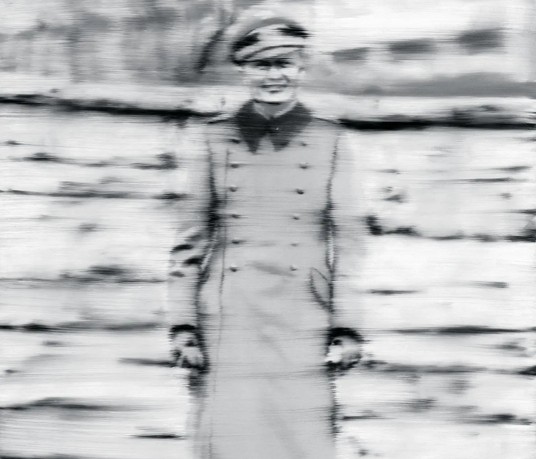
Onkel Rudi (Uncle Rudi), Gerhard Richter, 1965.
Grünes Feld (Green Field), Gerhard Richter, 1969.

A still from My Undesirable Friends: Part II — Exile (2026)
THE SKY IS BLUE: A CONVERSATION WITH JULIA LOKTEV
Stadtbild Madrid (Cityscape Madrid), Gerhard Richter, 1968.
INTRODUCTION: SYMPOSIUM ON CRITICAL THEORY
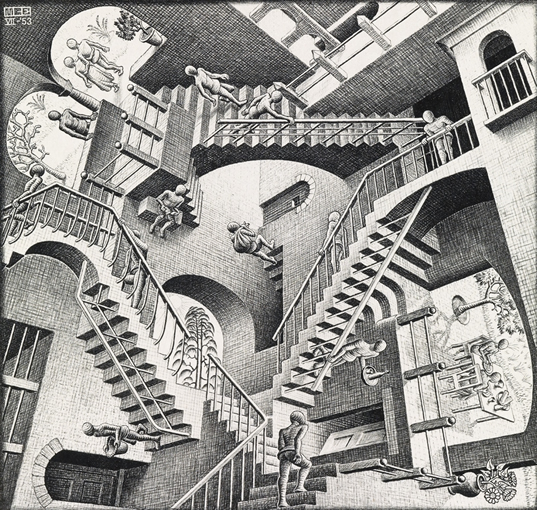
Relativity, M.C. Escher, 1953.
Cage 6, Gerhard Richter, 2006.
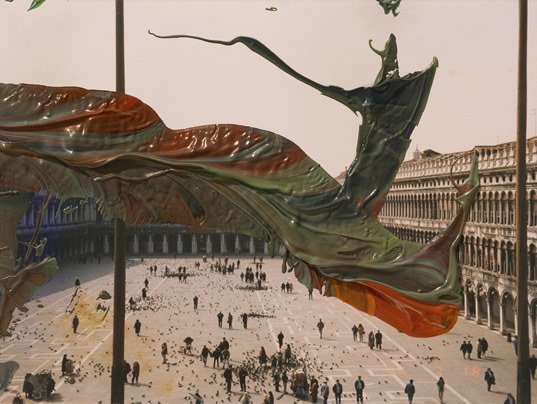
5. Jan. 98, Gerhard Richter.
|

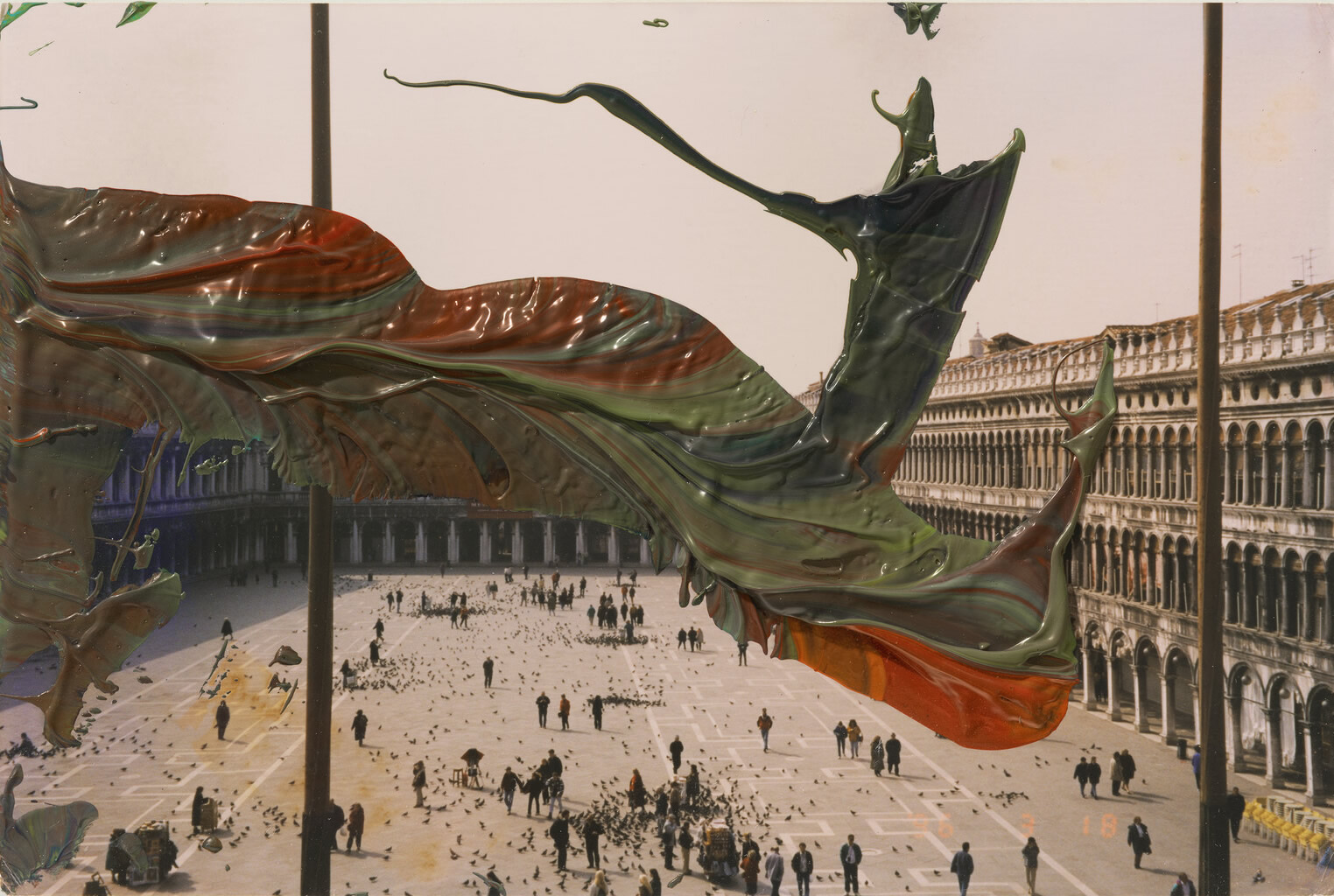
Art Note: 5. Jan. 98, Gerhard Richter. A squeegee drags thick oil paint across a photograph of daily life, leaving a fracture between the immediate, captured moment and the heavy medium applied over it. The work turns on that friction—between raw, concrete existence and the conceptual frameworks imposed to interpret or contain it, where what is concealed always threatens to disrupt the surface. Oil on photograph, 12.0 x 12.0 cm, 1998 (Catalogue Raisonné: 849-5). © Gerhard Richter, courtesy of the artist and Gerhard Richter Archive.