CRITICAL THEORY AND ITS CRITICAL CONCEPTS By Lorraine Markotic *** The Montréal Review, September 2026 |
|||
We live in a time in which authoritarian leaders are on the rise and conspiracy theories abound. This was even more the case, of course, when Max Horkheimer and Theodor Adorno wrote Dialectic of Enlightenment. They did not, however, simply lament people’s stupidity or lack of education; they sought to comprehend how the embrace of authoritarian, often buffoon-like figures and the drastic slide into irrational ideas could occur in a world that had experienced critical, Enlightenment thinking. The “Critical theorists” or the “Frankfurt School” did not shake their heads in disbelief or disapprobation but sought to understand a world that seemed to be regressing from democracy and critical thought. Martin Shuster’s timely Critical Theory: The Basics provides an impressive rendering of this school of thinkers in the contemporary context. His book presents both a comprehensive overview and a detailed analysis of their ideas in relation to current concerns. We also live in a time of influencers and a relatively new, but exponentially increasing, reliance on AI. AI is utilized not only when factual, practical information is sought; it is also turned to for answers to personal questions and questions of judgement. Such reliance is undeniably eroding independent thought. What the Critical Theorists of the Frankfurt School advocated, above all, was autonomy and autonomous thinking: from Adorno’s The Authoritarian Personality to his Aesthetic Theory; from Horkheimer’s Eclipse of Reason to his Dawn & Decline, to his and Adorno’s Dialectic of Enlightenment; from Marcuse’s One-Dimensional Man to Negations. Shuster’s Critical Theory: The Basics reminds us (63) that Adorno takes up Kant’s insistence in “What is Enlightenment?” that humans move beyond “self-incurred tutelage [Unmündigkeit]”—in other words, that we learn to think for ourselves. Unmündigkeit is generally translated as tutelage, and Mündigkeit as maturity or responsibility or (my preferred term) autonomy. Shuster notes that a certain level of maturity is required “to pursue critical theory” (12), but that this is not an easy task in a totalizing society (126). Nevertheless, living under tutelage is both undesirable (for the individual, but also for society) and dangerous (for society, but also for the individual). Self-incurred tutelage involves allowing one’s thoughts and actions to be dominated—or even determined—by others or by another. The importance of critical, autonomous thinking, along with its complexity and difficulty, will be addressed in this chapter. Unfortunately, we also live in a time of needless suffering, a fact made all the more egregious by the social and technological advancements that our world boasts. Moreover, needless suffering is not always recognized as needless; it is often seen as unavoidable, a part of life as we live it. Needless suffering is embedded in the status quo, regarded almost as natural, which militates against attempts to alleviate it and even against thinking about how alleviation might be possible. Shuster’s introduction is on “Suffering,” and he makes the straightforward point that “when we focus on needless suffering, we also recognize the possibility of changing or ending the systems that produce such suffering” (11). He reminds us that “the first‑generation of Frankfurt School theorists frequently pointed out that humans possess the capacity to feed everyone on the planet. Yet people still starve, and food is in fact wasted by the tons” (11). The fact that we have not done more to eliminate or at least reduce needless suffering, especially its most extreme forms, and that we often do not even recognize such suffering as needless, is what impels critical theory.
Noting that Horkheimer stresses “the extent to which humans profoundly shape their world” (67), Shuster provides a succinct summary of critical theory’s position: “Needless suffering is not a cosmic tragedy, but rather a humanly created catastrophe” (67). Hence, critical theory “frequently questions accepted ways of understanding the world, since it is exactly the status quo that maintains needless suffering” (45). Critical theory encourages us to pay attention to the many kinds of needless suffering that exist: to think about how and why they occur, and whether and why we would accept their occurrence. The ongoing presence of needless suffering and the entrenchment of the social structures that support it is the force that drives critical theory.
Needless suffering is not only the motor of critical theory, but also the motor of Shuster’s book—its guiding thread and the frame of his analysis. Needless suffering is central to every chapter, not only the ones on “Critique,” “Society,” and “Religion,” but the chapter on the “Self”, which discusses psychic suffering, and the chapter on “Art,” which addresses works of art that acknowledge that society “instantiates needless suffering” and simultaneously “pushes against” this suffering (143). The term “needless suffering” occurs over one hundred times in Shuster’s book. This is not too many, I feel, for needless suffering is truly the impetus of critical theory and the basis of its focus on change. In the chapter on “Society,” Shuster writes:
Simply put, critical theory strives to disclose suffering, especially the fact that so much of it is needless, and it studies how we can change the social structures that operate to enable this suffering. As the name would suggest, Critical Theory is insistently critical. Not only does it take a critical stance towards a world replete with needless suffering, but it also takes a critical approach towards the means and methods by which we seek to comprehend this world. The term originates in Horkheimer’s definitive “Traditional and Critical Theory.” In this essay, Horkheimer argues that “traditional” theory seeks to collect allegedly neutral information about how society is organized and how it functions, describing social operations in a way that makes them seem entrenched. “Critical” theory, to the contrary, rejects any false cloak of neutrality and is explicitly interested in human liberation; it draws attention to systems of domination and to power relations, especially hidden ones and those that present themselves as natural. As Shuster notes, Horkheimer’s critical theory “never aims simply at an increase of knowledge as such,” but seeks to emancipate humans (59). In “Traditional and Critical Theory,” Horkheimer writes that the very “future of humanity depends on the existence of the critical attitude” (italics added)—a statement Shuster quotes on the first page of his book, and which he says he does not take as hyperbole (xi). Given the urgency of critique, and given the complexity of society and the self, the critical attitude enjoined the Frankfurt School to draw on a variety of disciplines and approaches. Shuster writes that understanding “modern society and modern subjectivity” requires
He further notes: “The present moment has shifted, though, and to this list may be added new disciplines and insights, like, for example, critical theories of race and gender, approaches around artificial intelligence, developments in bioethics, and so forth” (41). An insistently critical attitude clearly opposes “self-incurred tutelage” and limited autonomy. Here I would like very briefly to introduce Marcuse’s “The Concept of Essence” from Negations: Essays in Critical Theory,[1] although it is not discussed in Shuster’s book. Marcuse argues for the importance of a concept of “essence” throughout the history of philosophy. Against the traditional notion of essence as “the abstraction and isolation of the one true Being from the constantly changing multiplicity of appearances” (CE 31), Marcuse links the notion of essence to potentialities. Concepts of essence might seem to refer to what is eternal and unchanging but, according to Marcuse, essences point to suppressed possibilities. They assure a critical relation to the given world. Even in Plato, Marcuse argues, the idea of essence is a critical concept clearly indicating that the way in which the world manifests itself is not definitive. He explains:
Marcuse presents his own “materialist concept of essence” as “a historical concept” (CE 54) that changes and evolves. He praises Hegel, for whom essence is something that “has become” (CE 50). No matter how much objects seem welded to their “reality,” notions of essence point to the possibility of their being otherwise. Denying the distinction between essence and appearance means abandoning things to their present form—a form that suppresses their potential. Like Horkheimer in “Traditional and Critical Theory,” Marcuse argues that an allegedly neutral, descriptive philosophy is inherently false, and he is critical of most aspects of empiricism and positivism. He notes that “a theory for which reality is ‘always essence’ can only be one of resignation” (CE 48)—resignation to that reality. This leads me to the concept of ideology and the Frankfurt School’s ideology critique. Ideology works in multiple ways. It is often the means by which the views of powerful groups become hegemonic. But ideology can also cover societal structures and economic systems in a way that makes them impenetrable, opaque, or simply confusing. Shuster writes:
I would agree with Geuss that ideology is of paramount concern to critical theory. In addition to concealing and obfuscating power, ideology can operate to present what is social and historical as natural, which of course obviates change—sometimes even thoughts about change. Critical theorists insist that the world is historical and contingent, not immutable and eternal. Not only has current society emerged historically, but we are deeply historical beings. In “Traditional and Critical Theory,”[2] Horkheimer argues that humans are products of history “not only in clothing and appearance, in outward form and emotional make-up,” but even in the way they “see and hear” (TaCT 200):
In other words, the senses are not passive ahistorical registers; sense perceptions are socially and historically formed. Shuster mentions Adorno’s important discussion of “second nature,” wherein social practices, customs, and rules come to seem natural. They are experienced as “first nature,” rather than as a way of doing, feeling, and thinking—and even perceiving—that one has inculcated. Not recognizing “second nature” as second nature means, Shuster writes, “that our social world oftentimes appears to us as entirely natural, as if the way things are is the way they must be” (7). Naturalizing ideologies hinder change and prevent us from looking to other possibilities—which might even seem “unnatural.” Shuster’s book frames critical theory as follows: “ordinary life cannot be accepted at face value” (69). Critical theory seeks to reveal how ideology underwrites hegemony and to disclose how it naturalizes norms. Adorno’s non-identity theory But critical theory goes further. Adorno asks us to critically consider the concepts with which we think. As Shuster notes, “our concepts matter, as do their origins and shifts” (41). Ineluctably, concepts cast our thoughts. It makes a great difference, Shuster notes, whether we think of Columbus as having discovered or invaded North America. He repeats the point with another example: “whether something is termed ‘demonic possession’ or ‘gender dysphoria’ affects what’s seen, what might be done, and what can or cannot be imagined” (41). For Adorno, though, it is not simply a question of which concepts we use to apprehend a phenomenon and how a conceptual framework affects what is seen, possibly done, and imagined. Adorno argues that conceptual thinking is intrinsically problematic. And one of its problems is that we tend to forget or ignore this fact. A central focus in Adorno’s philosophy, one requiring further attention, I would contend, is Adorno’s critique of the belief that objects can be grasped by a thinking subject—whether these objects or things are a physical entity, a specific construction or practice (like democracy), or a more general idea (like freedom). Adorno asseverates that “things elude capture by the concept” (13). He insists that there is always more to phenomena than concepts can ever contain. This idea is consistently elaborated throughout his work. It is present in his 1931 inaugural talk “The Actuality of Philosophy”; it is reiterated almost forty years later in his 1969 essay “On Subject and Object”; and it is most thoroughly elaborated in Negative Dialectics.[3] Indeed, a preeminent idea in Negative Dialectics is Adorno’s claim that objects—again, entities, practices, ideas—are always more than and other than what we can conceptualize. Concepts are inherently general and, therefore, too coarse to discern the particularity of phenomena: some specificity is lost or glossed over. Adorno writes: “A matter of urgency to the concept would be what it fails to cover, what its abstractionist mechanism eliminates, what is not already a case of the concept” (ND 8). The fact that concepts overlook or even suppress some non-conceptual elements is exactly what conceptual thinking needs to consider. Inevitably, there is something that does not “show up” in our conceptions: something left out, something left over. Adorno refers to conceptual remainders. Furthermore, phenomena are not only too complicated and intricate to be compressed into concepts, but they are also part of a social matrix and should not be cognized in isolation. They exist within historical assemblages. To put Adorno’s points another way: an object defined by a concept is less like an orphan who has been given a suitable home, and more like a non-human animal placed in a zoo. Adorno’s philosophy is a tribute to the complexity and potential of the world. Our presumption to grasp things is misplaced and our knowledge intrinsically limited. Adorno writes that the idea “that the concept can transcend the concept” and “can thus reach the nonconceptual—is one of philosophy’s inalienable features and part of the naïveté that ails it” (ND 9). Shuster notes that Adorno states (in Problems of Moral Philosophy) that were he pressed to make a list of cardinal virtues, he would respond that he could “think of nothing except for modesty” (57). In the opening sentence of “The Actuality of Philosophy,” Adorno writes that philosophy must begin by rejecting the illusion of earlier philosophical enterprises: “that the power of thought is sufficient to grasp the totality of the real.”[4] Indeed, Adorno recommends that philosophy begin by being cognizant of its failures. Hegel presumes to cast a conceptual net that permits us to apprehend the world, but Adorno chides such a dialectic of progressive rapprochement and eventual reconciliation between subject and world. In the Phenomenology of Spirit, Hegel depicts an increasingly capacious, increasingly evolved subject, altered by its encounter with objects, who is ultimately able to grasp the world in absolute knowledge. Hegelian dialectic propels the sublation of oppositions and (erroneously) presumes upon the eventual reconciliation of the thinking subject and its object-world. Adorno writes: “If Hegel’s dialectics constituted the unsuccessful attempt to use philosophical concepts for coping with all that is heterogeneous to those concepts, the relationship to dialectics is due for an accounting insofar as his attempt failed” (4). Dialectics needs to be rethought, in Adorno’s view, precisely because it runs roughshod over objects—which remain heterogeneous to it. Adorno notes that “all [Hegel’s] statements to the contrary notwithstanding,” Hegel left “the subject’s primacy over the object unchallenged” (ND 38). Adorno accuses Hegel of “identity thinking,” which presumes that subjects can identify objects. Of course, Adorno realizes that thinking intrinsically involves identifying and that philosophy does need concepts: “the appearance of identity is inherent in thought itself, in its pure form. To think is to identify” (ND 5). But this does not mean we should be uncritical of conceptual thought; neither should we prefer irrationalism or mysticism to philosophical thinking:
In contrast with what Adorno refers to as Hegel’s “positive” dialectics, where negation leads to higher, more advanced, and better conceptual apprehension, Adorno seeks to maintain the non-identity between thought and thing. He supports dialectical thinking that embraces opposition and contradiction, but he does not believe dialectics will eventually lead to resolution. Instead, Adorno advocates what he refers to as a negative dialectic, which acknowledges the remainder that thinking yields, and which keeps moving, eschewing any (false) reconciliation with the world. When thought comes to rest, Adorno argues, it thereby forsakes a world whose present form would seem to have forsaken its potential. Realism (often referred to as naïve realism) naively tends to presume that concepts match their objects or at least can increasingly be made to do so as human knowledge accumulates and concepts are refined and made more precise. Such a view denies the non-identical element, the remainder mentioned above, the surplus and the residue. Adorno’s insistence on non-identity, moreover, opposes equating things with their current form and conditions. Adorno’s negative dialectics supports thinking that negates rather than resigns itself to what appears to be “reality.” It reminds us that in trying to nail down what things are, we nail them into place: “The means employed in negative dialectics for the penetration of its hardened objects is possibility—the possibility of which their reality has cheated the objects and which is nonetheless visible in each one” (ND 52). Accordingly, Adorno’s negative dialectics refuses to defraud objects by equating them with their present configurations and conditions. His theory of non-identity insists that objects are more than their socio-historical form—a form that their concepts, also socio-historical, congeal. Furthermore, identity thinking is not simply misleading, not simply an epistemological error. It is also a form of domination. Adorno considers that conceptual thinking—and, as noted, all thinking is conceptual—involves oppression. Although not necessarily conscious or deliberate, conceptual attempts to understand the world end up subjugating it. Throughout Negative Dialectics, Adorno seeks to protect the integrity of the object from the conceptual domination of the subject who seeks to press it into prescribed concepts. A key aspect of Adorno’s negative dialectics is his insistence that not only is the concept unable to encapsulate the innately refractory object, but that there is a certain violence in the attempt to make it do so. Adorno realizes that it is not enough to try to liberate objects from concepts that would corral them without attending to the cowboys doing the corralling. Seeking to emancipate the object inculpates the subject. Subjects frequently demand a world that reflects back to them the conceptual framework through which they cognize it. Adorno explains that “the least surplus of nonidentity feels to the subject like an absolute threat” (ND 183). For example, the dangerous and ridiculous opposition to transgender individuals, and often to the concept of trans itself, can be seen as rooted in and buttressed by conservative traditions; but this opposition can also be connected to the dominating tendency inherent in conceptual thought. Anything that resists or even simply does not fit into existing concepts may enrage. In a section of Negative Dialectics titled “Idealism as Rage,” Adorno refers to Kant and his moral law as a “kind of rationalized rage at non-identity,” at what does not cohere to existing concepts. Underlying the attempt to construct conceptual edifices that map out the world is a wish to control. Concepts seek to capture beings, and if these beings escape, I would argue, there is a desperate attempt to re-capture them and put them back “where they belong.” To reprise: we read the world through our concepts, and this reading will always be misreading. It will always be an under- and an over-interpretation. It will be an under-interpretation because of all that conceptual thinking misses in any particular phenomena, including their potential. It will always be an over-interpretation because concepts impose themselves upon objects, structuring and shaping them. Adorno’s negative dialectics, and his critique of identity theory, insist upon both conceptual thinking’s inherent inadequacy and its imperialism. A deep, persistent problem in our thinking is, then, that we overlook or forget or deny the fact that concepts are both unequal to what they apprehend, and that they involve subjugation. We cannot avoid using concepts, however. They become second nature: a part of how we think, understand, and feel. Since the occlusion and domination of objects will always happen to some extent, Adorno suggests we try to “abide with minutiae.” Rather than philosophize “about concrete things,” he suggests we try to philosophize “out of these things.” (ND 33). In “On Subject and Object,” he encourages us to seek to rend the veil we weave around the object and with which we, as subjects, ensnare it.
Adorno wants us to reflect on the non-conceptual in the concept; he wants us to remind ourselves that a concept does not provide a definitive meaning.
Reflection can
help us resist the rigidity of conceptual designation and remind us of the
extent to which we project onto the world. The substance of an improved
philosophy, in Adorno’s view, would look to the diversity of objects and try to
resist using them “as a mirror in which to reread itself, mistaking its own
image for concretion” (ND 13).
CONTENTS
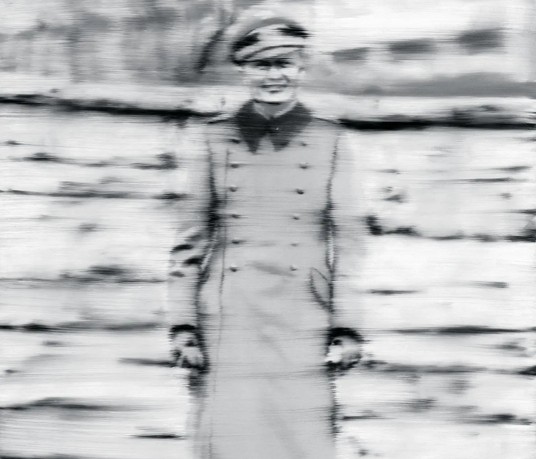
Onkel Rudi (Uncle Rudi), Gerhard Richter, 1965.
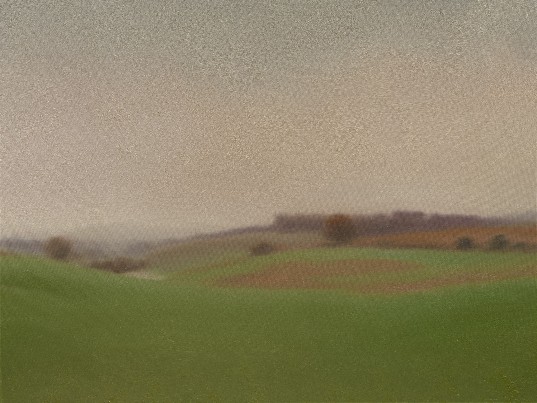
Grünes Feld (Green Field), Gerhard Richter, 1969.

A still from My Undesirable Friends: Part II — Exile (2026)
THE SKY IS BLUE: A CONVERSATION WITH JULIA LOKTEV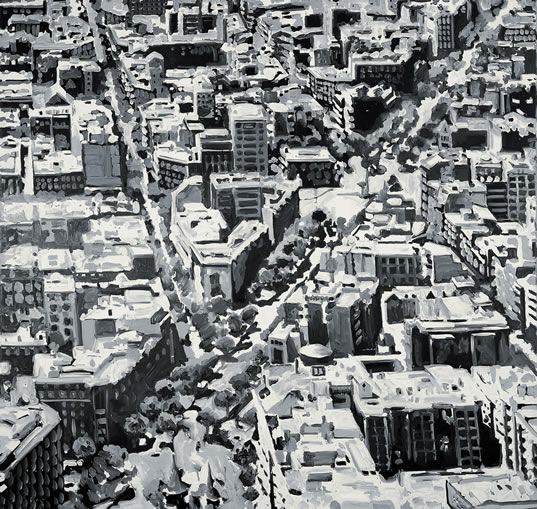
Stadtbild Madrid (Cityscape Madrid), Gerhard Richter, 1968.
INTRODUCTION: SYMPOSIUM ON CRITICAL THEORY
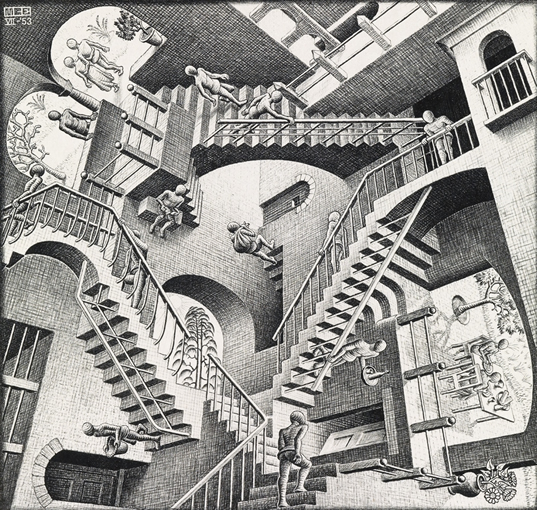
Relativity, M.C. Escher, 1953.
Cage 6, Gerhard Richter, 2006.
5. Jan. 98, Gerhard Richter.
|

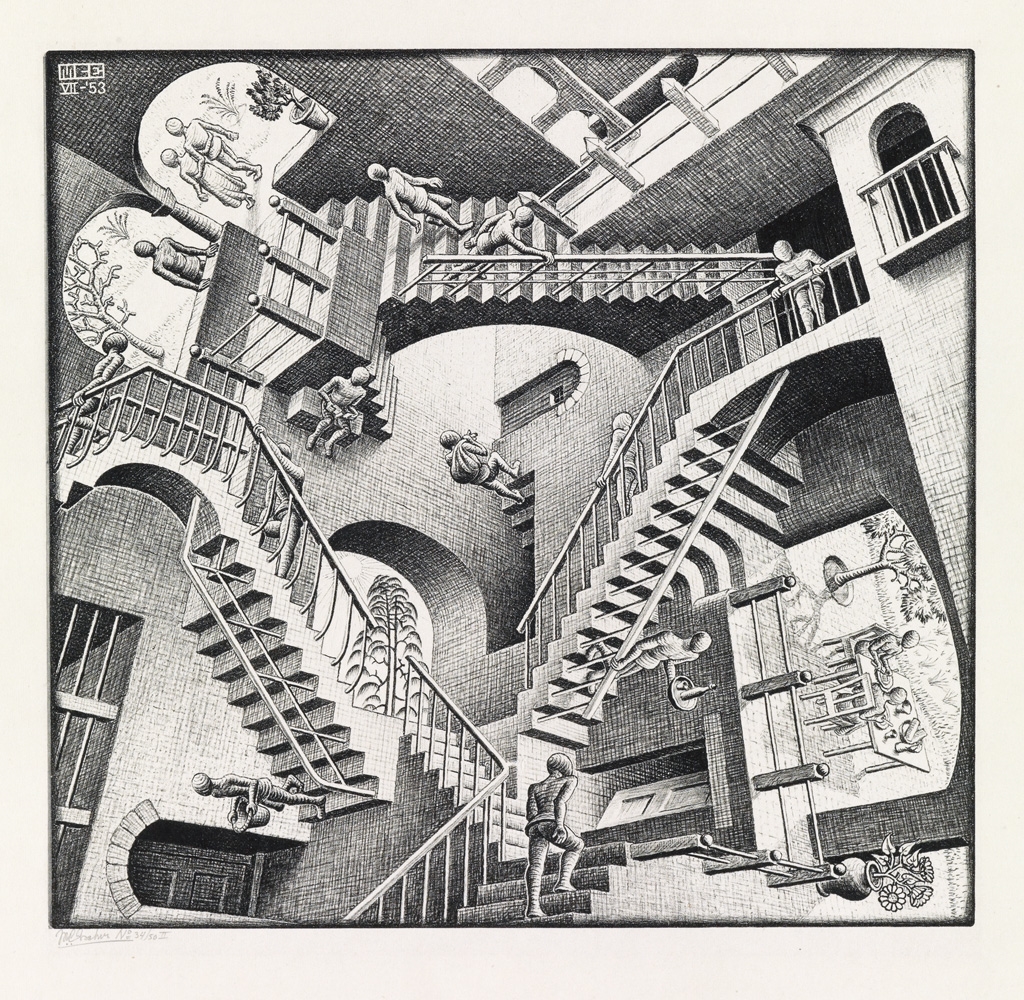
Art Note: Relativity, M.C. Escher, 1953. Nine staircases, three gravities, no single vantage from which the whole structure resolves into sense — what is a floor for one figure is a wall for another, and both are right. Escher's puzzle is a near-literal picture of what Adorno calls identity thinking's failure: any one frame is locally coherent, but the demand that a single concept govern the whole scene is exactly the violence this essay traces — the "rage at non-identity" that can't tolerate a structure with more than one way up. Lithograph, 28 × 29.1 cm. Collection National Gallery of Art, Washington, D.C. (Cornelius Van S. Roosevelt Collection). © The M.C. Escher Company, the Netherlands. All rights reserved.