ON NEEDLESS SUFFERING By Henry W. Pickford *** The Montréal Review, September 2026 |
|||
Written for the novice, Shuster’s book eschews the usual historical introduction to Frankfurt School Critical Theory and the conceit of “generational” supersession in favor of a thematic approach, organized by chapters entitled “critique,” “self,” “society,” “art,” and “religion.” Nonetheless the emphasis is on certain first-generation thinkers, principally Adorno and Marcuse, with some discussion of points by Horkheimer and Fromm, and quick mention of Benjamin, Kirchheimer, Neumann, and Pollock. Of the later thinkers, Habermas receives some attention, Honneth a quick mention, and Forst, Menke, and Jaeggi are absent. Real virtues of the book include its attention to religion (often overlooked or downplayed in introductions), its intricate yet very accessible presentation of lesser-known essays by Marcuse and others, and suggested connections to later developments in critical theory, broadly conceived (feminism, gender theory, post-colonial theory, Foucault, etc.). To my knowledge this is the first introduction to Frankfurt School Critical Theory to cater expressly to aficionados of alternative rock music (cue Adorno’s apoplexy here). According to the conventional intellectual narrative, the Frankfurters were taking up the Hegelian-Marxian legacy to explore how the expected revolutionary instauration of rational freedom in modern Western societies in the early 20th century was supplanted by oppression: by fascism in Germany, Stalinism in Russia, and the welfare-state administration in the US. Investigating how the liberatory potential of reason inverted into irrational domination was how the initial theorists themselves understood their interdisciplinary research program. In its arguably founding text from which numerous later works radiated, the Dialectic of Enlightenment, authors Horkheimer and Adorno state in the preface:
The grand historical narratives of the increasing realization of rational freedom towards “autonomy” and “maturity” (Kant), the “identity of subject and substance” (Hegel), and “free association” (Marx) instead halted and became suspended in the “iron cage” (Weber) of the twentieth century.[2] Although countenancing its explanatory suggestiveness (e.g., p. 12), Shuster avoids directly highlighting this narrative in favor of elevating the alleviation of suffering into the cynosure anchoring the book’s organization. However, positing “needless suffering” as the Archimedean fixed point of Critical Theory (“the theme of this book: what drives things here is needless suffering,” p. 127; “the sort of needless suffering that this book has prioritized,” p. 138; and passim)[3] ultimately denies the eminently dialectical commitments of at least the early Frankfurters. Suffering, even needless suffering, cannot serve as the normative ground for critique. First, what is needless and what is needful, necessary, is not fixed but rather historically and socially relative. Adorno rejects Marx’s axiomatic givenness of human needs; one might claim that thwarting human self-actualization is itself a form of inflicted suffering, or that an “ideal rational agent” would optimally discern needed and needless, but here nuance is required. As adherents of “dialectical anthropology,” and more generally of a dialectical interplay between nature and history such that neither conceptual pole may be isolated or hypostatized (as Shuster rightly notes), Horkheimer and Adorno believe that there are no given independent “bare” facts of human nature, capacities, or needs that can be axiomatically invoked to leverage critique.[4] Instead, what counts as “nature” is always socially conditioned, what counts as “culture” or “history” is always reified as an invariant “second nature.” Each pole can at best serve situationally to criticize its other: the physiological “naturalness” of needless suffering – somatic pain – becomes historically inflected (into phenomena like heartache, grief, psychic trauma, institutional practices of humiliation, non-recognition, etc.), the “historicity” of needless suffering becomes naturalistically inflected (into phenomena like human dignity, invariant human needs, universal human rights, under whose banner liberal Western societies have inflicted untold suffering.). Second, suffering is also individualistically relative: any good Nietzschean knows that the question is whether one can endorse, welcome, will one’s suffering as one becomes who one is:
At issue is not suffering per se, but the value and meaning one ascribes one’s suffering, such as the vertiginous thoughts Nietzsche traced to his own profound ill health, or his apparent approbation of Goethe, Napoleon, and Cesare Borgia. Third, and relatedly, for the Frankfurters modern society dominates not by inflicting suffering preeminently and insidiously but through regression: thwarting autonomy and delivering distraction and dispensation from maturity, self-reflection, and the individual demands of free association. Autonomy is felt not as self-actualization towards self-fulfillment, but as a burden from which one yearns for what nowadays is blithely called “cognitive offloading.” For the Frankfurters, such regression enabled the barbarism of fascism and the Nazi genocide but also characterized the emergence of the politically tractable “authoritarian personality” in the US. The culture industry repeatedly stimulates momentary distractions according to an ethos of superficial “fun” and prurient titillation, while infinitely deferring the promise of genuine pleasure and happiness: “works of art are ascetic and unashamed; the culture industry is pornographic and prudish”; “fun is a medicinal bath which the entertainment industry never ceases to prescribe. It makes laughter the instrument for cheating happiness.”[6] This suggests more Zarathustra’s complacently self-stultifying, squinting “last man” than the wretched protagonist of a late short by Beckett. Shuster acknowledges this only in passing: “society has a massive culture industry dedicated to producing a range of aesthetic [sic] products aimed exactly at obfuscating and hiding the suffering it causes” (141). This isn’t quite right. According to Horkheimer and Adorno, the culture industry doesn’t produce even the semblance of happiness, rather it persistently palms off “fun” and the perpetually deferred pleasure, happiness, and love as labor’s reward. If we are “amusing ourselves to death” (Neil Postman) with pleasurable bagatelles, by what standard, ideal, or norm does Critical Theory bemoan such deplorables? In Jonathan Franzen’s novel The Corrections there is a scene in which the English professor Chip, in the final hour of a semester-length seminar on varieties of postmodern cultural critique, is stymied by Melissa, one of his students:
What normative standpoint does one occupy from which to deny that the pleasant deliverances of modernity in general and the culture industry in particular do not constitute the right sort of happiness and pleasure? And I note from my own experience students’ reluctance to acknowledge the threats posed by “surveillance capitalism” and their willingness, even eagerness to trade their data privacy for the ease and comfort of digital consumer convenience. In a trenchant essay from 2005, the philosopher Raymond Geuss notes that “contemporary liberalism rests on, and also fosters, an extremely highly developed sensitivity vis-à-vis the phenomenon of suffering” and concludes:
What would a
dialectical critical theory of suffering look like? It would tease out,
situationally, how whether suffering is “needless” is often ultimately
determined retrospectively.[9] In a lecture course Shuster does not discuss, Adorno invokes a
“moral addendum,” a somatic jolt that supplements moral reasoning in moving one
to act, and illustrates it with the conversation of one of the July 1944
plotters to assassinate Hitler, who recounts that he simply could not tolerate
the situation anymore, and had to act. The plot by army officers failed and
hundreds were rounded up and executed in Plötzensee, where nearly 3000
political prisoners were murdered during the Third Reich. Was their suffering
needless? Did the German people lose the war or succeed in liberating Germany
from…. themselves? Adorno coined the term “context of guilt” or debt (Schuldzusammenhang)
to refer to the fact that in modern societies even the most morally pristine
action is inextricably interwoven with, interdependent on morally compromising,
economically exploitative, and unjust actions. A dialectical analysis of
suffering would painstakingly articulate the stakes of such pain. Moreover, it
would uncover a structure similiar to what Adorno described as the paradox of
culture: its very existence as ‘free’ intellectual activity towards emancipation
inexorably depends on the respite wrought by necessary material labor. In order
to be the reserve of mimesis, the capacity of expressive suffering[10], art relies for its existence upon the leisure afforded its
creation by the miserable, manual labor – the suffering – of others. The
utopian possibility vouchsafed by art lies in the necessity of “needless”
suffering.
CONTENTS
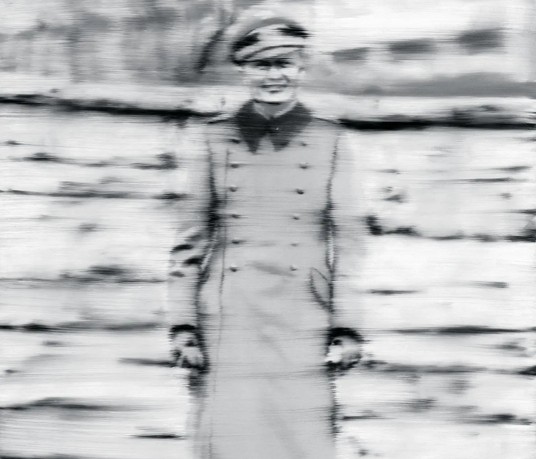
Onkel Rudi (Uncle Rudi), Gerhard Richter, 1965.
Grünes Feld (Green Field), Gerhard Richter, 1969.
A still from My Undesirable Friends: Part II — Exile (2026)
THE SKY IS BLUE: A CONVERSATION WITH JULIA LOKTEV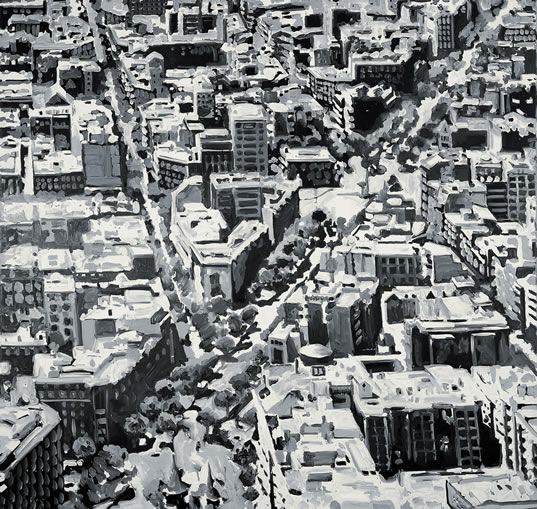
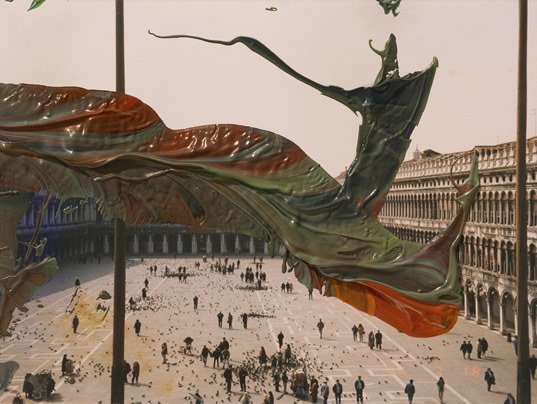
Stadtbild Madrid (Cityscape Madrid), Gerhard Richter, 1968.
INTRODUCTION: SYMPOSIUM ON CRITICAL THEORY
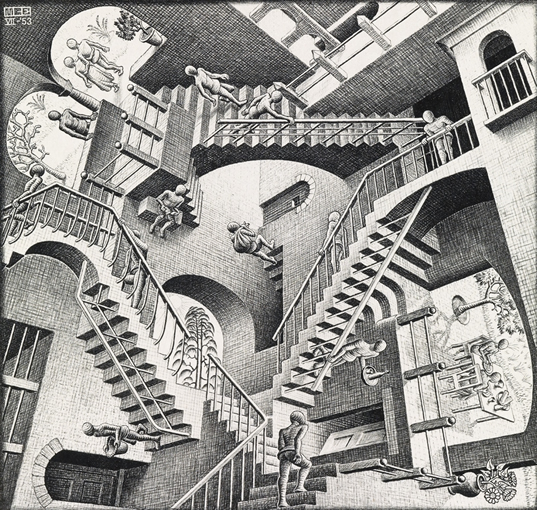
Relativity, M.C. Escher, 1953.
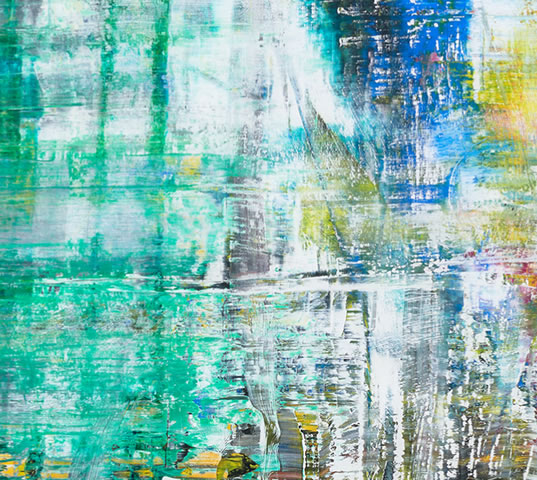
Cage 6, Gerhard Richter, 2006.
5. Jan. 98, Gerhard Richter.
|

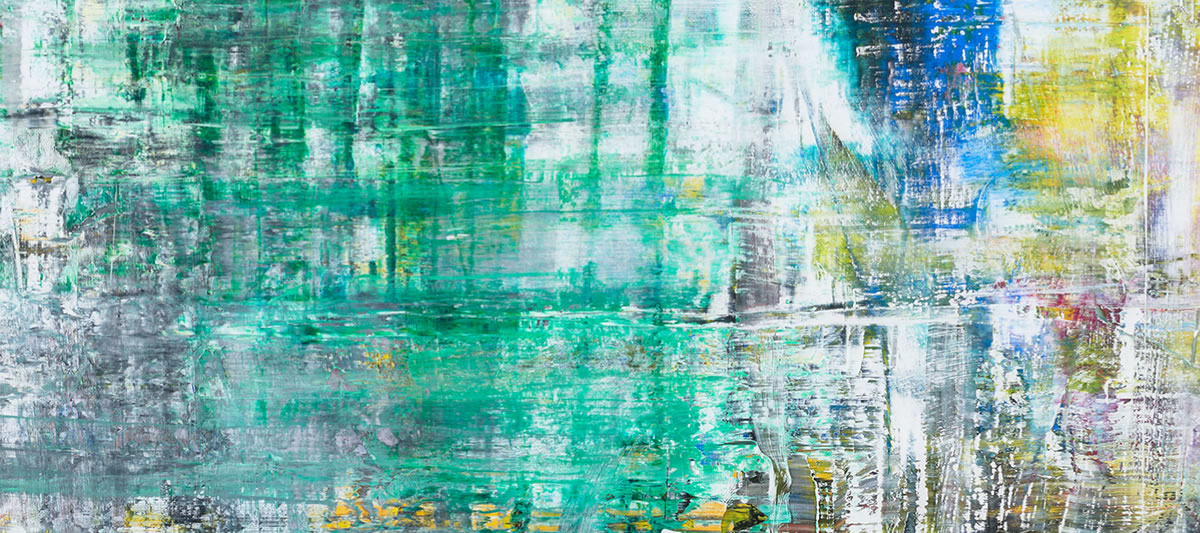
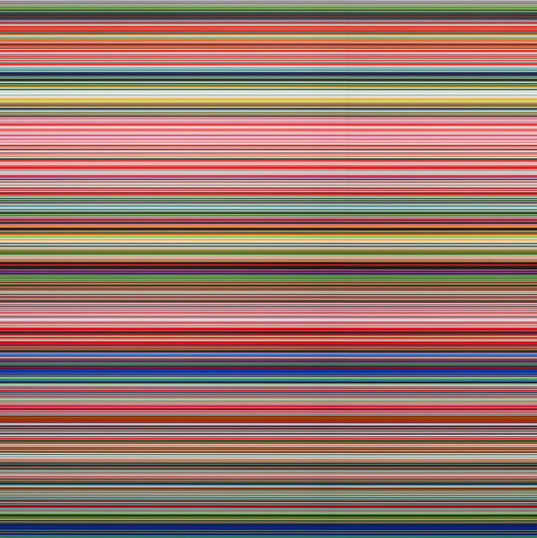
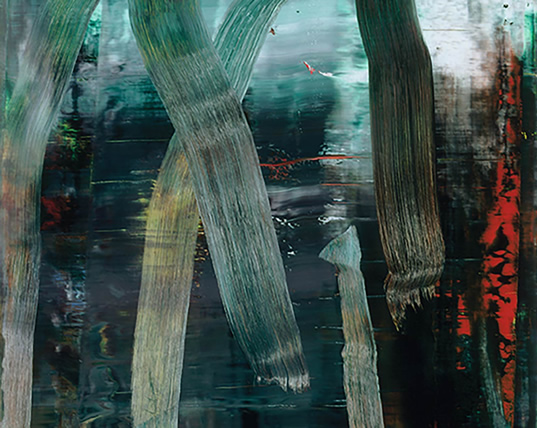
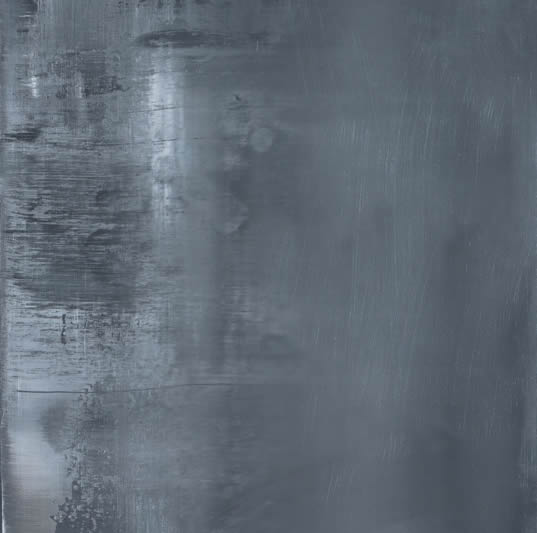
Art Note: Cage 6, Gerhard Richter, after the 2006 painting. Richter built the six Cage canvases by layering paint and scraping it back, again and again, while listening to John Cage — letting chance decide what survived each pass and what got dragged away. No single layer is the "real" one; what shows through is whatever the process happened to leave. That is close to the case this essay makes against treating suffering as a fixed category: what counts as needless, like what counts as visible in the finished canvas, is not given in advance but is settled, unstably, only in retrospect. Giclée print, from the P19 edition (2020), after the 2006 painting Cage (6) (Catalogue Raisonné 897-6). © Gerhard Richter, courtesy of the artist and Gerhard Richter Archive.