THE SETTLER AND THE FASCIST By Samuel Hayim Brody *** The Montréal Review, September 2026 |
|||
In late January 2026, the swamp of social media bubbled forth two images, which I encountered juxtaposed in my feeds. In the first image, a bearded Jewish man wearing a casual black jacket reclines in a chair. He is wearing a large kippah that covers his whole head, and he has large sidelocks that hang down to his chest. One of his legs is raised to display his muddy boot, which looks as though it may be resting on the seat in front of him; or, possibly, he is caught by the camera in the midst of switching between which leg is crossed over the other. He is smiling, smirking even, at something taking place outside the frame.
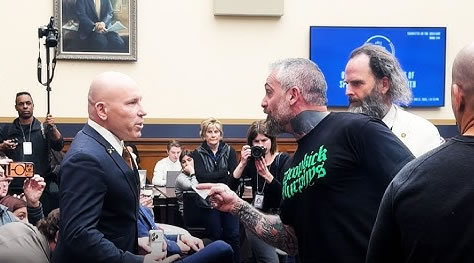
This man’s name is Elisha Yered. He is a leader and unofficial spokesman of the Hilltop Youth, a violent extremist settler organization responsible for numerous attacks on Palestinian lives and livelihoods in the Israeli-occupied West Bank. He has been sanctioned by the European Union, Canada, and Singapore for these actions, although he has faced no permanent legal consequences from the State of Israel. In 2023, Yered was suspected of involvement in the murder of a 19-year-old Palestinian man named Qusai Jamal Matan in the West Bank, and was barred by the IDF from entering the territory for six months—including his home, in the illegal “outpost” of Ramat Migron. Prior to that, he served as spokesman for Limor Son Har-melech, a Knesset member from the Otzma Yehudit (“Jewish Power”) party. In that capacity, he shared a video to a WhatsApp group used by journalists, advocating for the Palestinian village of Huwwara to be “wiped out.” I encountered this photo in a post from the liberal Israeli group UnXeptable, which describes its mission as “saving the Israeli democracy.” The post’s author, Amit Livni, was outraged that Yered was “resting his filth-caked boot with such crude contempt and arrogance on the seat in front of him, wearing a look of lordly supremacy.” For Livni, Yered was not simply being vulgar, but rather engaged in a “calculated expression of deep-seated supremacy and disdain.” The gesture “represents the attitude this criminal and the public he represents hold towards the Knesset, toward everything it stands for, toward the entire Israeli public, and toward the very concept of ‘Israeliness.’” This is a familiar frame for both Israelis and American Jews: on one side, there is secular, liberal, democratic Israel, and on the other, “the twisted worldview of the Kahanists, the messianic zealots, and the ‘Hilltop’ militias…the greatest enemy that has ever risen against Zionism.” The post reminded me of how American liberal Democrats, and some Republicans, had responded immediately in the wake of the insurrectionary riots of January 6, 2021, when some two thousand rioters entered the Capitol building in Washington, DC, and engaged in looting and vandalism, as well as violent altercations with Capitol police, in an attempt to prevent the electoral vote count and certification of Joe Biden’s victory in the 2020 presidential election. In the aftermath, many responded first and foremost to the violent and anti-democratic aspects of the insurrection. But there was another note sounded as well: a deep horror at the violation of the Capitol, which former House Speaker Nancy Pelosi described as “the temple of our democracy.” Shock and dismay were expressed at the flying of the Confederate battle flag by protesters inside the Capitol building; at the casual way the protesters entered and occupied the offices of Congressional representatives, and of course at the violence directed against police officers. Senator Amy Klobuchar, who also used the phrase “temple of our democracy,” affirmed that January 6 was “not just an attack on the building, it was an attack on our Republic itself.” In both cases, a representative of liberal order and the rule of law cries out against the presence inside the hallowed halls of representative democracy of those who do not respect democracy itself. In both cases, a liberal civic religion, represented through the sacralization of the halls of parliamentary power, is confronted with a threat from an alternative, illiberal, theocratic form. In Israel this is the “settler,” who wants to transform the State of Israel into the State of Judea. In the U.S., this is the fascist or White Christian Nationalist, who assaults the Capitol waving “Appeal to Heaven” flags and holding prayer groups. As Bradley Onishi puts it, “They climbed a mezzanine and stopped to pray. And what did they say? They said, ‘We thank God for bringing us here as patriots to help restore the nation.’” In both cases, the affective response from liberals is identical: disgust and contempt for the literally unwashed authoritarian menace, and a stirring call to the defense of “our democracy.” While I was musing over this resemblance, I scrolled further and encountered the second photograph, captured during a Congressional hearing on January 22, 2026, featuring former special counsel Jack Smith testifying about his investigations into President Trump. In this image, two men face off against each other while an observing crowd watches and records their confrontation. The man on the left is shorter, bald and clean-shaven, and wearing a suit, while the man on the right is bearded with a crew cut, tattoos visible on his neck and arms around his T-shirt. (Photographs from other angles reveal that the front of the T-Shirt advertises the Boston Irish punk band Dropkick Murphys; the back of the shirt says “Fighting Nazis Since 1996.”)
This time, however, the aesthetic and political roles are reversed. The informally-dressed, tattooed rebel figure in the picture is former DC Metropolitan Police officer Michael Fanone, who defended the Capitol on January 6, and the man in the suit is Ivan Raiklin, a MAGA activist and conspiracy theorist whose ideas about how the 2020 election was stolen have been taken up and repeated by Trump himself. Their confrontation took place during a break in Smith’s testimony, when Fanone was heard to say “This guy has threatened my family, threatened my children, threatened to rape my children, you sick bastard…You’re a traitor to this fucking country” as other veteran Capitol police held him back from a physical altercation. Raiklin, meanwhile, was heard to say “See how many people are restraining you, and look at me, totally in control over my mind and body.” The juxtaposition of the photographs is revealing, in a number of ways. The first has to do with the aesthetics of power. In the twenty-first century, it is the prerogative of the outsider to proclaim disrespect and even contempt for power, especially when it is held by an opposing faction. Long gone are the days we imagine, spanning most of the mid-twentieth century, when the rituals of power (such as suit-wearing inside a government building) were expected to apply equally to all. This “rebellious disrespect,” however, tells you nothing about the rebel’s fundamental orientation—in other words, nothing about how they would behave if they were the ones with the power. Yered is aligned with a far-right coalition that currently holds power in Israel, but within that coalition he is on the farthest right and is capable of portraying his own allies and comrades as weaklings, quislings and sellouts. His true alignment, as Livni correctly intuits, is to a regime still to come: a fully fascist Kingdom of Judea in which there will be no terrorism against Palestinians because there will be no Palestinians. His casual dress, muddy boots, and “look of lordly supremacy” do, indeed, mock and condemn the Knesset, because the Knesset is not the object of his loyalty. Rather, his loyalty is to this future kingdom, and the Knesset is merely a tool along the way. Fanone, by contrast, is an avatar of the law, a twenty-year veteran of law enforcement. His anti-establishment appearance in this photo is a calculated attack on this establishment, the Trump regime, and on this establishment only. When he received the Presidential Citizens Medal from Joe Biden on the second anniversary of January 6, he wore a blazer and button-down; on the cover of Time in August 2021, he wore his full officer’s formal dress uniform, badge, decorations, and all. Fanone has said that he voted for Trump in 2016. “What if I had not gone through [the insurrection]? I’d be the same dumbass that I was on Jan.5. Not evil in my motivations. But ignorant to the truth.” But he did go through it, and now it is Raiklin, the election denier, the conspiracist, wearing the suit. There is a still deeper dimension to this juxtaposition, however, and it goes to the core of what the United States of America and the State of Israel are: settler-colonial states. These musings on fashion are no mere sideshow to the weighty matters of politics and economics. Think back to eighteenth-and nineteenth-century U.S. history, and to the contrast between the rugged pioneer on the frontier, or the cowboy, and the DC politician. Running “against Washington” is the oldest trick in the politician’s book: those fancy city slickers don’t understand anything about your life, they don’t know farming, they don’t know small towns, they don’t know God and family. The “settler” is from the beginning pitched against the state, and from the beginning the “freedom” they stand for is tied directly to their domination of the other: the land and the Indigenous people who live there. The state, which periodically makes deals with those same Indigenous people, promising “this far but no further,” is the enemy of the settler for precisely this reason. The settler can tolerate no such lines. They cannot accept that they can settle here, but not there. In both the U.S. and Israel, the settler pushes and tests the state, moving out beyond the prescribed binary lines, tolerating the state when they are not interfered with, and vituperatively condemning it when they are. It is therefore an illusion to imagine that the settler can be permanently carved away from the identity of the state itself. This “rebellion” that the settler embodies is always only the flip side of the domination they enact, and ultimately it is the state that determines how far that can go. Just as the British Crown and later the U.S. government gave in, time and time again, as settlers pushed back treaty boundaries, moving further into Georgia, or Ohio, or Texas, so does the Israeli state give in when “illegal outposts” are set up alongside the “settlements” that began as outposts themselves. The “settler” loves to point out that there is no difference between Ramat Migron and Tel Aviv; the “liberal democrat” insists on this difference, even as the negotiated solution that would write it into permanent law recedes invisibly into the horizon. The phantom promise of the “treaty” or “solution” that will bring to a halt the motor of settler-colonial conquest is what links the liberal to the settler, despite the protestations of the former. At every settler victory, the liberal throws up his hands, clean as they are, and shakes his head in frustration, but resolves never to give up. Eventually, the settler is perceived by the liberal to have “won,” at which point it becomes possible to “regret” the whole chain of events while putting it safely in the “dark past.” (The Indigenous, meanwhile, who have not gone away, insist that there is nothing “past” about any of it.) It is therefore necessary to understand how the “difference” between the settler and the liberal, who are manifestly dialectically connected despite their “difference,” is produced. The Tunisian-Jewish writer Albert Memmi (1920-2020), in his 1957 work The Colonizer and the Colonized, described two types of colonizer: the “colonizer who refuses” and the “colonizer who accepts.” The colonizer who refuses is one who either withdraws physically from the material facts that create colonization (e.g. by leaving the country) or who attempts to fight and change them. The latter course is difficult, and psychologically complicated: “What he is actually renouncing is part of himself, and what he slowly becomes as soon as he accepts a life in a colony. He participates in and benefits from those privileges which he half-heartedly denounces” (64). Eventually, “hard-pressed, the role of the left-wing colonizer collapses” (83). It cannot sustain its contradictions. These photographs from the U.S. and Israel, and the responses to them, represent in variant ways the conflict between the colonizer who refuses and the one who accepts. Refusal looks different in both cases—in Israel, it is refusal to acknowledge the colonial nature of Zionism in the first place, while in the U.S., it is a denial of the relevance of the colonial “past” to contemporary political struggles. Nonetheless, in both cases you see the same impulse to distinguish: “this is not who we are.” This supremacy, this will to dominate, this callous disregard for law—this is not who we are! But this argument willfully denies history, or part of history—it seeks to identify “we” only with the liberal half of the dialectic, identified with the present, rather than the settler half, identified either as the past or as a disavowed and unrepresentative part of the present. As a result, it cannot understand its enemy, cannot understand the power of the smirking grin and the muddy boot on the table. What the settler knows is that the law, in a settler-colonial state, simply is the result of past struggles for supremacy and the will to dominate. He takes up this struggle in the present as the direct inheritor of the state’s founders, and sweeps the objections aside just as they were swept aside in the past. The liberal, who (rather arbitrarily) accepts the “settled” form of the state as its permanent one, denounces the “settler” as a fascist. Theorists from Aimé Césaire to Hannah Arendt have argued for a connection between fascism and colonialism, and their observations seem ever more borne out by reality. Whether because the fortunes of liberalism are tied to the business cycle, or because liberalism always involves itself in sordid compromises with arbitrary power even as it proclaims allegiance to the rule of law, we are now living through another historical cycle in which liberal forms of rule “backslide” into autocratic and fascist ones, not just in the racially disregarded colonies but in the cherished homelands. Where does this leave “the colonizer who refuses?” Memmi himself held that this was simply one of those impossible situations that sometimes arise in life. The colonizer who refuses may wish to join the struggle of the colonized against oppression, but this cannot be done while maintaining one’s privileges at the same time. (Later in life, Memmi defended Zionism against charges that it was a form of colonialism, seeing it rather as the liberation movement of the Jewish people. If he were alive today, he would surely be sympathetic to Livni’s critique of Yered. Perhaps he would also be open to challenges on the matter of how things came to this pass, understood in terms of his own theory.) If one mounts one’s opposition to fascism in the name of the rule of law, and this law is the very same law that legitimates the ongoing dispossession and colonization of the land and disenfranchisement of the people in various ways (which is true not just Israel but also, even now, in the U.S.), the opposition will fail. Both Pelosi and Klobuchar, in their “temple of democracy” speeches about January 6, attempted to end on triumphant notes, proclaiming that “our democracy prevailed.” In 2026, we know how that turned out. The Biden administration was a mere interlude in what was, after all, the Trump era. But history is
still being written. And any future worth living depends upon figuring out how
“the colonizer who refuses” can walk away from the material conditions of
colonization, not just by picking up and leaving but by rearranging the
institutions of society—including the law—right where they are. This, and only
this, will wipe the smirk off the settler’s face, regardless of what he is
wearing.
CONTENTS
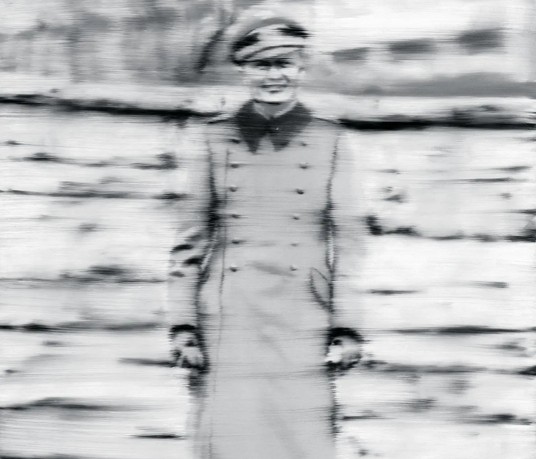
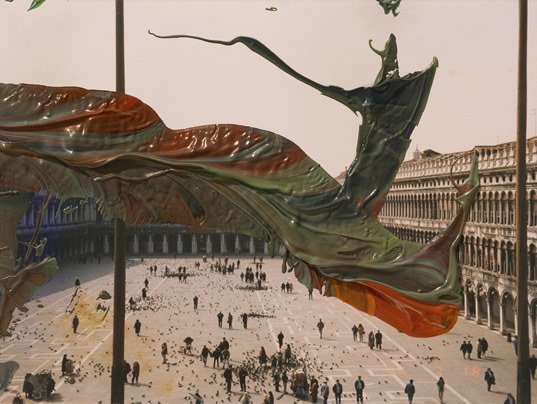
Onkel Rudi (Uncle Rudi), Gerhard Richter, 1965.
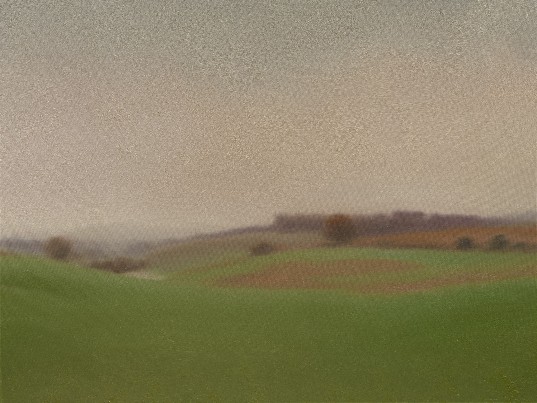
Grünes Feld (Green Field), Gerhard Richter, 1969.

A still from My Undesirable Friends: Part II — Exile (2026)
THE SKY IS BLUE: A CONVERSATION WITH JULIA LOKTEV
Stadtbild Madrid (Cityscape Madrid), Gerhard Richter, 1968.
INTRODUCTION: SYMPOSIUM ON CRITICAL THEORY
Relativity, M.C. Escher, 1953.
Cage 6, Gerhard Richter, 2006.
5. Jan. 98, Gerhard Richter.
|

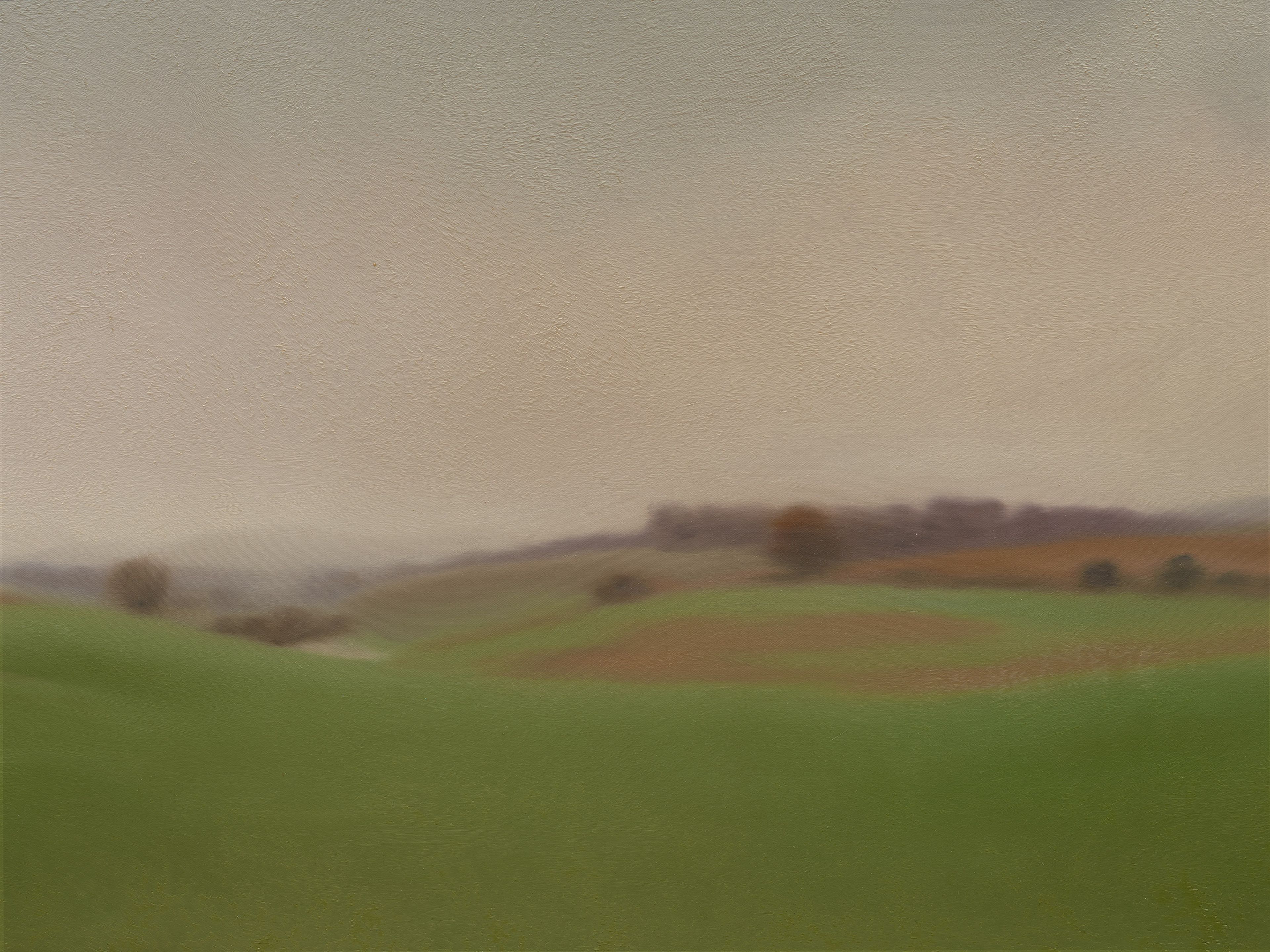
Art Note: Grünes Feld (Green Field), Gerhard Richter, 1969. An empty pasture, blurred to the point of dissolving, painted from a photograph the way all of Richter's landscapes were — a view that looks like nowhere in particular, and could therefore be claimed as anywhere. The blur is the tell: it is the same gesture that lets a settled land be seen as unsettled, a taken field as an open one. Oil on canvas, 99 × 125 cm. Private collection (Catalogue Raisonné 223) — image and details via David Zwirner. © Gerhard Richter, courtesy of the artist and Gerhard Richter Archive.