TEACHING AS CRITIQUE: WHAT FEELS BEAUTIFUL? By Ada S. Jaarsma *** The Montréal Review, September 2026 |
|||
Teaching as Mediation
This essay has begun several times, already, with a title, two epigraphs, and a prompt. A beginning is always provisional, a choice among many possible choices. It often includes an interpretative frame, like a title and, in this case, selected excerpts from texts written by others. The prompt refers to another kind of beginning, an imagined scene in which an interactive session relies on a facilitator’s opening instructions. Like a facilitator’s offering of a prompt, this opening paragraph shares a sense of divisions that separate you, as reader, from this manuscript and from its author and those who’ve been cited so far. At stake in these choices is an understanding of critical theory. “Critique,” the name we might give the key concern of critical theory, is a matter of mediation. I’ve been musing over this definition of critical theory for the past few years, ever since reading Anna Kornbluh’s Immediacy or, The Style of Too Late Capitalism.[4] In the book, the word “mediation” serves as a shorthand for the work of critical theory. This shorthand points to a contrasting word, underscoring the current conditions that make critique feel urgent and strangely missing: immediacy. Immediacy, throughout the book, refers to the intertwined relations of new technologies (social media, apps, generative-AI) with specific kinds of selves, ones that seem disinterested in and incapable of mediation. From artists and curators to consumers and critics (so-called critics, on Kornbluh’s account), aesthetic projects that preoccupy the public realm forgo the social activities of mediation in favour of the private and the personal; at the same time, algorithmic feedback loops reinforce homogeneity and passivity, undermining resources that are required and nourished by mediation. These resources include attention and an investment in ideas, including the ideas of others. A question then emerges: how might critical theory re-enliven these missing qualities in our social worlds and in our own selves? Feeling gripped by this challenge I found on this book’s pages—to find ways to redress this widespread absence of mediation in our contemporary moment—I turned to my own teaching endeavours to take this up. Last year, I created a new undergraduate philosophy course, titled “Taste in the Age of AI,” along with lessons and assignments oriented around mediation. And while these projects feel generative, they open a problem that this essay seeks to explore: what does it means to claim that teaching can be or maybe even is, constitutively, an activity of critique? Mediation, after all, is what classrooms seem to offer to students. For example, a workshop-prompt, like the one above, proffers a bridge between a workshop facilitator and participants. A bridge like a prompt is necessary because of differences between us—differences that do not dissipate but rather underscore gaps between lived experiences and abstractions. This is the generative promise of critical theory. “Theory cultivates and cooks,” Kornbluh writes, “constituting new nourishment for flourishing.”[5] The adjective new is important, here, because it points to horizons beyond what already exists. “[A]rt and literature generate more than what is already given,” Kornbluh explains, “speculatively proposing other worlds, other words.”[6] The adverb speculatively is also important, as it captures in one quick word many ways we might query and imagine possibilities: to speculate is to ponder that “it doesn’t have to be this way.”[7] As a materialist, Kornbluh’s own critical theory reminds us that speculation emerges out of embodied, material scenarios. As Kornbluh notes, “theory is not made in a vacuum.”[8] (How do we change the world for the better? Marx and Engels asked in The Communist Manifesto. Critical theory tends to prioritize answers that look to conditions out of which activities like speculation take place. When we bring existentialists and psychoanalysts into this conversation, as this essay does, things get exciting, especially in terms of where we place our hope for transformation). A bridge, like a prompt, is always specific: the forms or genres by which mediation takes place are themselves wonderful objects for critical theory to work with. It’s essential for mediation, according to Immediacy, that the medium through which communication takes place is part of critical inquiry.[9] Not because of presumptions that ideas can shine transparently through a medium, but rather because of the difference-making import of bridges. Critical theory, like existentialism and psychoanalysis, presumes that the lure of transparency—of knowing ourselves, our longings, other people, fully—is a diversion from more important tasks, like wrestling with the nature of injustice and seeking ways to right wrongs. Here is an insight from Kornbluh that I return to, several times, in what follows: when there is no opacity, no acceptance that transparency is impossible, then what we find instead is only a replica of identity.[10] This phrase by Kornbluh might seem a bit hard to parse, but I find myself mulling over it often: identity is replicated, rather than represented or otherwise shared with others, when immediacy replaces mediation. Critical theorists share with existentialists and psychoanalysts something important about the difference-making at the heart of selfhood itself: relating to one’s own self, we might say, is a constitutive expression of being alive. These expressions can take the form of anxiety and despair; they can take the form of erotic joy, longing, and striving to communicate with others. Whatever its form, “identity” itself is a matter of becoming otherwise, over time—of difference-making. Immediacy, however, replaces difference-making with a false version of selfhood. Replica, not representation or expression. These points mean that my problem – is teaching itself mediation?— involves scrutiny of the media at play, along with queries into the limits and lures of “replicas.” A bridge is specific, when it comes to how it relates to and generates differences. A prompt like scribbling, at the outset of a workshop, offers a bridge out of what “we already want, what we already know” towards simply noticing marks appear on the page, which may be “[h]umble, rough, scratchy, or smooth,” different for each scribbler, each time.[11] Another example, one I often include in my course-designs, is a novel: a genre that exerts, as Kornbluh beautifully puts it, “the magic of the third person.”[12] Like all bridges, novels resist the “only me,” selfie-infused styles of immediacy that evade the import of medium – styles that assume, in Kornbluh’s words, that “[w]hat you see is what you get.”[13] In contrast, bridges mediate by way of the non-immediate, the dissonant, what is not already given. What’s special about fiction, on Kornbluh’s account, is the kind of abstraction that this form affords. Notice how Kornbluh’s description of novels focuses on writing that employs the “third-person.” The third-person, Kornbluh points out, differs in important ways from the voice of immediacy, which takes on a certain style of “first-person,” almost always. Kornbluh notes this especially at play in the resurgence of interest in memoirs. (Is the critical activity of teaching sufficient to overcome a curricular choice to assign these kinds of first-person, memoir-inspired texts to students? To be honest, I’ve created entire courses around The Argonauts and Fleabag, texts that bear at least some of the brunt of Kornbluh’s critique. I’m pondering this question while writing this essay). This is where current conversations in critical theory echo claims in 19th-century existentialist texts by Søren Kierkegaard, someone just as keen on indicting forms of capitalist media as Kornbluh. In his early writings, Kierkegaard also looks to the novel for a special quality of mediation, which on his account is likewise bound up with the kind of bridge that (good) fiction offers its readers. Kierkegaard identifies this as a “life-view,” the quality by which readers enter a novel’s plot, engage its characters and narration, and give over to its fictional truth.[14] The activity of reading conjures an “as if” for readers: I accede to how this character thinks, feels, and adjudicates the world “as if” I share this understanding. Even more, a life-view, suffusing the pages of a novel, provides a “centre of gravity” for readers, as Kierkegaard puts it.[15] (Kierkegaard’s critique here concerns realist novels, specifically). Emily Ogden finds a similar quality in the work of effective literary criticism. Readers engage a persona as they read a text, Ogden points out, rendered persuasive to readers through “idiolects” by which critics lay out their analysis in writing. It is an extraordinary thing, that I am able to take in another perspective—“as if” I uphold it—because of how ideas are crafted on the page.[16] (Note that the emphasis here is on qualities by which a novelist or a critic express themselves in writing; I am interested, in what follows, in extending this list of fiction-writers and critics to include teachers enacting lessons, among others). Existentially, through mediation, the boundaries of my mind expand: “my imagination goes visiting,” as Hannah Arendt famously puts it.[17] What’s essential –what makes this mediation—is that, as readers, we don’t ignore the workings of the bridge itself. We don’t forget that the life-view on the page is different from me, and from the author as well. In a compelling study of existentialist poetics, Yi-Ping Ong finds this point in Kierkegaard’s writing, as well as in texts by 20th-century thinkers like Beauvoir and Sartre: the author, in important ways, does not exist when a novel’s centre of gravity anchors the reading-activity.[18] An author’s “I” on the page is not the same as their embodied, existential self. Along these lines, Kierkegaard writes a fierce review of one of Hans Christian Andersen’s novels, arguing that “Andersen does not distinguish between the real author, the actual concrete existing person of Anderson himself, and the fictional author,”[19] not to mention the characters in the novel itself. As Claus Elhom Andersen explains, Kierkegaard is calling out a mistake of artistry or craft, when it comes to how Andersen relates to his own characters on the page: Andersen inserts himself in the place of the characters, collapsing the bridge by which readers enter a fictional world.[20] One promise of critique, when it comes to activities like reading, rests in the capacities that emerge by expanding our minds, beyond our own boundaries; these capacities, Arendt writes, make judgement itself possible. When the “I” of a text discloses no seeming-replica of an author’s identity but rather offers a persona, alive on the page, there is another promise proffered by the craft and artistry of creative work itself; this persona enables the “as if” for readers. Readers miss out on fiction’s mediating work, in other words, if a paraphrase of a well-executed novel is proffered in its stead[21]. What might these two promises signal, when it comes to the problem of teaching as critique?
Responding as Mediation
One way in which a teacher enacts a persona (a life-view, an idiolect) is through what Margaret Price calls access priming.[23] Access refers to the ways in which a bridge (a prompt, a lesson, an exercise) meets up with the person who is ready to engage mediation: the student, the reader, the workshop participant. Crip studies – and critical disability studies more broadly—is an edifying area of critical theory today. John Lee Clark, an award-winning DeafBlind writer and theorist, describes access that mediates effectively as “complementary”: accommodations that supplement conditions that are already there. An access-tool, like captions that can be turned on when Deaf viewers watch a film, works well for those who already enjoy the sensory experience of viewing movies: captions complement the mediating work on the screen. Along these lines, access priming by a teacher names conditions that might supplement or augment mediations that will be taking place in class. Price’s examples include changing the lighting, making space for pauses and breaks, and suggesting more contingent options that seem unavailable until identified in this way. When captions offer access-bridges to those who do not see the screen, this is no bridge at all but rather, in Clarks words, “a dead end, leading nowhere: captions without images.”[24] When there is no mediation, we find instead immediacy – and, indeed, Clark uses the same term as Kornbluh that I flagged above. Describing an access feature that mimics a bridge, like captions fed into Braille displays, Clark suggests that it is better understood as “a replica, divorced entirely from the original,” standing in as “sorry excuses for what occasioned them in the first place.”[25] How do such false-bridges pass unrecognized, especially by those who are offering them as access tools? Clark’s explanation has similarities to the error that Kierkegaard diagnoses in bad fiction. Just like Andersen forgets the gap between himself and the fictional characters in his novel, a facilitator who proffers a non-bridging feature to Clark and other DeafBlind people seems to presume that “there is one world and one truth,” namely their own.[26] Rather than the difference-making impacts of mediation, Clark explains, a guide or a translator forgets to engage the very differences of others: “They wish only to be happy for themselves through us.”[27] The prompt above solicits anticipatory interest from workshop-participants. Can you imagine the kind of response you might most want to experience, from those around you? Responses can also serve as bridges, when they take on the constraints of a form. Classrooms, like workshops, involve interactions that mediate when the conditions (of seeing or of not seeing, along with so many other salient embodied and existential dynamics) meet up with difference-making. A life-view, in a novel, is what brings fiction to life in ways that readers can “enter into.” An idiolect, in literary criticism, is what lets a reader think “as if” they were the critic. (This list might also include collegial friendship, as Eugenie Brinkema explains: I think “as if I were my colleague,” when I concern myself with their interests, for their sake; I begin to care from the outside, Brinkema writes).[28] Is there an analogue quality, when it comes to what enlivens encounters between students and teachers? Let’s invert this question, somewhat. Is there a pattern in classrooms that aligns with Clark’s diagnosis of “dead ends” pretending to be bridges? Hardly Creatures, a book of crip poetry by Rob Macaisa Colgate, begins with this same “dead ends” passage by Clark, included as its epigraph. The book’s first poem, “We Do Not Enter the Gallery,” reminds me of a prompt in how it lays out a sequence of activities. Except that, in this poem, each activity takes place in the negative: “We do not enter the gallery / Which means the docent does not look at us confused. / Heather does not fail to find instructions on touching the art. / Alex does not notice the digital tour is only available for certain artworks.”[29] The surprise of the “not,” appearing in each line, offers something almost comedic to readers. What would otherwise have been “dead ends” for Heather and for Alex become, in the poem, joyful refusals. We do not enter the gallery. (What follows, in the rest of the book, are many forms of access-priming, bridges, and mediating activities. They include ones addressed to readers directly, as we receive instructions, options, and ways to take up encounters with its pages). Like galleries, classrooms are specific spaces. Anticipatory responses, when shared with students, are part of a teacher’s repertoire of methods. Perhaps method is not quite the right term, since it tends to be understood retroactively like a recipe rather than as emergent and responsive.[30] Just as the friends in the poem that opens Hardly Creatures understand that a range of conditions await them in the gallery, students move from classroom to classroom, becoming deft respondents to specifics that they meet in each space. Students rarely get to enjoy the strategy that the poem’s friends enact, of course: staging a counterfactual, we do not enter the classroom. Instead, students navigate their classrooms, one after the other, to such an extent that Stanley Fish notes, writing in parentheses: “(students always know what they are expected to believe).”[31] Knowledge of this kind, I am positing, belongs on the list that includes what readers know, when they read literary criticism: “Readers of criticism infer the persona of the critic: critics know that, and they write accordingly.”[32] This list also includes what patients know when they enter into a psychoanalyst’s session and encounter a persona that is authorizing the psychoanalytic process.[33] Across these scenarios, from students in classrooms to patients on the couch, a quality like persona (life-view, idiolect) brings an overall persuasiveness to life, so much so that I can think “like” another –and students or clients “know” how this persona seems to be working. It’s key, for the hypothesis emerging here, that students or readers discern such knowledge, not teacher or novelist. (I first began noticing the existence of teacherly personas when an undergraduate student, who was a character in a campus novel, pointed them out; I needed a student, in other words, to name this dimension of teaching-practice).[34] A teacher’s persona is as variable as teachers ourselves. A teacher brings the role itself to life, “enacting its dynamics elements, and no two persons will do so in the same manner.”[35] Also key, this is no replica of who we think we see when we hold up a mirror, create a self-portrait, or tune into our inner worlds. Casting these points in the negative, there is nothing to “know,” when classrooms lack the coherence of a persona. When there is no life-view, to return to Kierkegaard’s critique of fiction, a novel reflects “the detritus of the author’s own experience: a disjointed succession of contingent views, incidents, and moods.”[36] Cast once more in a positive way, if we ascribe an art practice to teaching, as some theorists do, then what counts as teaching expands to include the how of a teacher’s persona.[37] An answer to the problem that opens this essay—is teaching a way of doing critical theory?—involves pointing to personas as part of an affirmative response: yes, it can be, if a teacherly persona is at work. And this brings us into conversation with the artistry or craft of teaching itself. Avgi Sagetopoulou reminds us that the space of opacity is the domain of aesthetics.[38] And this extends to teaching, alongside novel-writing and other practices. Critical theory includes inquiry into the media, forms, and artistic constraints by which ideas come to life on the page—as well as in classrooms. For creators, liveliness does not emerge by way of following recipes; it involves opacity. To some degree, our personas involve aspects and choices that are not entirely voluntary or transparent to us as teachers. Teaching practices include what is not ours, even if it is of us.[39] Since students know what to expect from teachers, our personas are difficult to summon into recognition as practitioners. What bridge or mediating activity might offer a teacher an “immanently critical mode” by which to undertake teaching as critique?[40] Are there ways to inquire into teaching’s medium, accepting opacity as part of this inquiry?
Open-Ended, from the Inside
Mediation includes attention to the medium through which ideas are shared. Literary critics, writing about form, sometimes differ when it comes to the precise ways in which form is named and engaged. Eugenie Brinkema, for example, suggests that form is more useful than its plural, forms, because it points to formal practices of mediation across media and genres. (This differs from an approach like Caroline Levine’s, which I also find to be helpful when it comes to thinking about classrooms and teaching, which invokes “forms” in the plural).[42] There is “no guarantee” of a planned outcome, Brinkema points out, whether activities are reading, teaching, or some other mode of engagement.[43] To read a scribble “in terms of line, form, rhythm, or proportion,” as in the case of the prompt above, “is precisely to refuse to describe it either symbolically or allegorically or from the point of view of atmosphere, mood, affect—all that is bound up with … particular expressive ends.”[44] A formal encounter resists the temptation to interpret formal qualities as proxies for meaning (I see a constellation of scribbled lines, I see colour, I see spaces). At stake in this resistance, Brinkema explains, is the very openness – the “no guarantee” – of mediation itself. (I recognize symbols on this page and cannot discern any lines at all means there is no form, only content).[45] There are more differences, when it comes to the critical theories of Brinkema, Kornbluh, and the other critics I’ve cited so far. Even calling Brinkema’s approach mediation risks eliding key points, I know. (Brinkema prefers the term “formal” or even “meta-formal” to mediation).[46] What is useful for the problem I’m exploring, though, is an attentiveness to “the generative making unknown” of the conditions around us that otherwise seem to resist change.[47] Brinkema explains that “form names the particular, contingent isness—that something is because it could have been otherwise.”[48] How might teachers take up a formal relationship to our teaching-practices, such that these practices conjure up innumerable other possible choices? There is an absence of conceptual work on the persona of teachers. Within philosophy of education, an instructive turn to “art” suggests useful tools and concepts, though. If we attune ourselves to the aesthetics of classrooms, for example, we start to notice what David T. Hanson calls a fusion of person with role: for observers of teachers in action, this means becoming “responsive to the rhythm, feel, and style of the teachers’ practices in the classroom, as well as sensitive to the tone and register of their voices.” Like a reader striving to respond fully to a poem, Hansen suggests, observers adopt interpretive procedures to tune fully into a teacher’s persona.[49] Going further, Mark Selkrig and Gert Biesta posit that the teacher becomes a work of art, themselves: “Viewing the teacher, as a unique creation, echoes the singularity of original artworks, where the biography of each educator is a rich distinct tapestry, highlighting the situated inventiveness of teachers.”[50] This work reflects problems adjacent, if compatible, to the one I’m exploring here. An observer is, notably, not a student, when it comes to classroom interactions. And mediation that employs observation reflects more empiricist-leanings than the critical theory I am drawing on here. Indeed, Kornbluh points out, the style of immediacy tends to express a “romance of empiricism.”[51] Kornbluh’s claim complicates a widespread assumption, in fields like the Scholarship of Teaching and Learning, that empiricism offers the best (or only) approach to teaching-inquiry.[52] While this work can yield critical insights, I am interested in approaches that mediate in a formal sense, in which we encounter “the metalevel seeing of how we see.”[53] But as Kornbluh’s allergy towards memoir-infused styles suggests, it is not as simple as affirming the use of a first-person voice as such. (The use of “I” might seem to displace the romance of empiricism, within a text, and yet, as Kornbluh’s analyses make clear, there is then other temptations of immediacy to be reckoned with: Kornbluh’s ire for the first-person memoir, for example, seems more affectively charged than her dismissals of the third-person empirical in Immediacy). Robert Pippin provides a helpful clarification here, in which it’s not simply a contrast between “first” and “third” person that secures mediation. Rather, it is the pressing open-endedness of mediation itself. Questions like “what ought to be believed and what ought to be done” require perspectives that are implicated, existentially and conceptually, by their stakes and significance. As Pippin puts it, these questions are of a different order than “so-called sideways” or “second-order” questions, which generate explanations in part by evading the evaluative, moral interpretative aspects of inquiry.[54] Of course, knowledge-practices, as a whole, depend upon the full spectrum of inquiry, from the arts and humanities to the sciences and social sciences. What is key for my exploration into the critical import of teaching, however, is that knowledge needs to be sought from the inside, and not from the outside, when it comes to our own teaching-practices. (I find this contrast between inside and outside approaches to be lovely as well as instructive. Robin Wall Kimmerer uses these phrases, knowing from the inside and from the outside, to name a difference in how thinkers relate to the stakes of their knowledge-practices).[55] Teachers, here, are on the hook for how we do and do not accept the implications of our own interpretative (what Pippin would call normative) choices. These choices shape our personas; they deserve inquiry, from the inside. What could be a prompt, like those embedded throughout this essay, that solicits a metalevel engagement with our respective personas? A bridge, like prompts, is anticipatory: a bridge expects and hails specific kinds of difference-making. As in the case of Margaret Price’s practice of access priming, difference-making can include the explicit naming of conditions that might change, before a lesson begins, or become changed, during class. Our personas are relational: join me, I tacitly suggest to students as I enact my teaching, as if this lesson, this exercise, this overall curricular offering matters in the ways that I am implying and laying out. From what we anticipate will take place to how we enjoin students into a provisional “we” in class: these are as singular to our teaching-personas as they are to each critical thinker. Furthermore, the happenings that do take place are not causally connected to our statements, design-choices, promptings, and other mediating actions. (Existentialists and psychoanalysts share an understanding of the opacity at the heart of how we, as well as students, respond to specific bridges and personas; there is no button to push that will cause responses). There is a kind of discovery on offer here, as Stanley Cavell writes—discovery that cannot depend on facts or on knowing from the outside: “you will have to find your own voice,” he writes, and “find your own work,” in order to speak for ourselves (as teachers) while we also speak for others (our students). This discovery involves risk, since students may well respond by asserting, “you do not speak for me” or even, “you do not speak for us.”[56] Heeding such responses is, to a large degree, what it means to know from the inside, as teachers. I conclude by returning to the epigraphs above. A metalevel practice, in whatever way emerges for each teacher, involves reckoning with the cost of our practices. Eugenie Brinkema asserts, “You need to know what your method costs,”[57] and there are always costs. Critical theory, like crip studies, becomes essential reading for teachers, providing corrective insights that each of us requires, in our own ways. When we hail students into the “as if” of our personas, are we asking for assent in the sense of Arendt’s “empowering” of authority?[58] (If not, are we relying on conditions like the ever-present spectre of grades and assessment to secure somehow the efficacy of our practices? This evades the task of receiving empowerment from students, risking injury, sometimes violence, to the students in our classes. The stakes are so high here, when it comes to encounters and occasions for mediation in the classroom). The term
“method,” if we recall, is not always useful since it resembles a recipe or a
checklist more than open-ended practices. We always begin again, as teachers
and as critical practitioners. Along these lines, we might start, following
John Lee Clark, “by asking, ‘What feels beautiful?’”[59] In this passage, Clark is invoking a query by DeafBlind architect
Robert Sirvage; this query holds salience for Clark and other DeafBlind people
because it replaces the recipe-like question: “how do we make it more
accessible?” What feels beautiful, Clark explains, solicits forms of
interacting and of designing protocols, spaces, and practices that are not
preset: people will respond so differently to this query, and these responses
will make many kinds of transformations possible.
CONTENTS
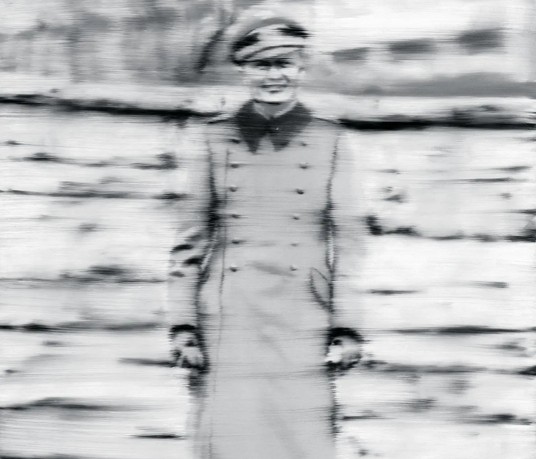
Onkel Rudi (Uncle Rudi), Gerhard Richter, 1965.
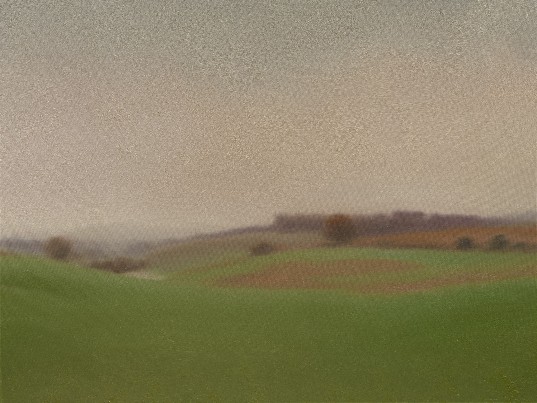
Grünes Feld (Green Field), Gerhard Richter, 1969.

A still from My Undesirable Friends: Part II — Exile (2026)
THE SKY IS BLUE: A CONVERSATION WITH JULIA LOKTEV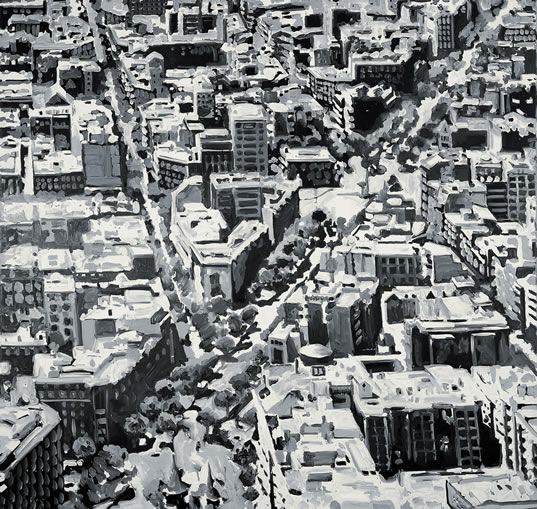
Stadtbild Madrid (Cityscape Madrid), Gerhard Richter, 1968.
INTRODUCTION: SYMPOSIUM ON CRITICAL THEORY
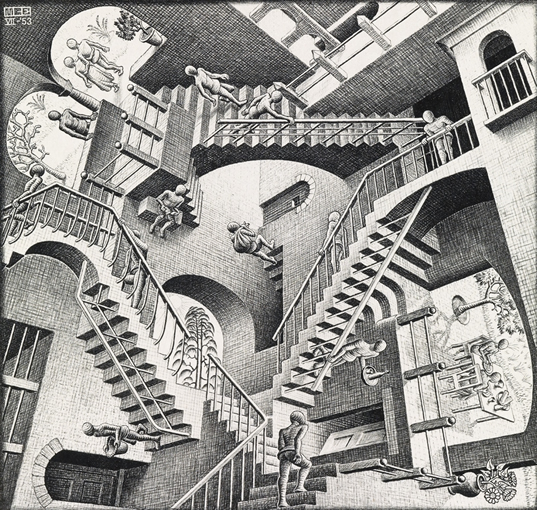
Relativity, M.C. Escher, 1953.
Cage 6, Gerhard Richter, 2006.
5. Jan. 98, Gerhard Richter.
|


Art Note: Lesende (Reader), Gerhard Richter, 1994. A woman absorbed in a magazine, painted from a photograph and softly blurred at the hairline and the page — the two places, tellingly, where a reader most disappears into what she's reading. The blur withholds exactly what a teacher must also withhold: full transparency. What remains legible is only the fact of her absorption, the bridge itself, not what's on the other side of it. Oil on canvas, 72 × 102 cm. Collection San Francisco Museum of Modern Art, purchased through the gifts of Mimi and Peter Haas and Helen and Charles Schwab, and the Accessions Committee Fund. © Gerhard Richter, courtesy of the artist and Gerhard Richter Archive