ON THE DOMINATION OF NATURE By Jordan Daniels *** The Montréal Review, September 2026 |
|||
Like the other authors, I was struck by both the pleasure of reading a book so beautifully written and by the difficulty of responding to a book I agree with so heartily. In keeping with the premise of the Routledge Basics series, and as Kathy Kiloh notes, Martin Shuster avows in the introduction that Critical Theory: The Basics is written “for the novice” (2).[1] Kiloh rightly points out that the work is not only for the novice, as it provides insightful historical contextualization and sophisticated, novel interventions that benefit the seasoned scholar. Before turning to text itself, however, I want to reflect upon the ambitions behind introducing Critical Theory to new audiences by way of a brief detour. Walter Benjamin, who figures in the book, spent three summers with Bertolt Brecht and his wife in Denmark. During the final visit in 1938, Benjamin took note in his diary of Brecht’s resolute decision to include part of the “Children’s Songs” lyric cycle in the new volume of poems to be published:
I’m certainly not suggesting Critical Theory: The Basics is written for children, but I do recognize something of a shared impulse animating Brecht’s resolve, the contributions of the Frankfurt School, and Shuster’s text. Under conditions hostile to history, thought, and life, what might be salvaged for those that are new? For those that come next? For novices? Indeed, how we might both transmit and take up a tradition in dark times is one of the first themes with which Shuster opens the book. He recovers Horkheimer’s image of the Frankfurt School’s work as “destined to being passed on through the night that is approaching: a kind of message in a bottle” (2). One of the key elements Critical Theory: The Basics passes along to the new reader is the Frankfurt School’s determination that critical theory, as opposed to traditional theory, “never aims simply at an increase of knowledge as such” but instead aims at “emancipation from slavery,” again quoting Horkheimer (59). Another recovered insight concerns the concrete demands of the historical present: critical theory “is a program that must perpetually be pursued anew. It shifts as the world shifts” (3). The book not only rearticulates these two commitments but models them for both the novice and the professional. The text demonstrates how one might engage with what is now a century-old “tradition” in order to comprehend a present that does not cease to make demands on us. Put otherwise, what strikes me is that a primer on the Frankfurt School could follow the chronological conventions of intellectual history, but that well-mannered disciplinary practice would fail to capture the aim of the theory: to directly address the thinking reader and instigate new ways of seeing and moving through the world. Shuster’s careful presentation of “a reconstructed core program” renders the problems and principal concepts of the Frankfurt School living thought, encouraging new (and not so new) readers to further analyze contemporary political and cultural situations (3). This approach serves novices especially by recuperating the Frankfurt School’s original mission, which was not to inaugurate a rigid discipline confined to academe but instead, citing Shuster citing Max Pensky, “an interdisciplinary cooperative enterprise, in which an interlocking constellation of various theoretical‑critical interventions in modern culture would coalesce to form a basis for organized oppositional political action” (4). By privileging Critical Theory’s experimental and cooperative aspirations, the book also directly addresses some barriers that might turn newcomers away from this body of work. First, potential newcomers might be put off by the reputation of the Frankfurt School as being elitist and inaccessible. While Adorno in particular is known for impenetrable works, Shuster’s lucid prose and plotting demystify many of the most potent philosophical concepts. Chief among them, the concept of needless suffering serves as an excellent key to unlock the normative claims of the Frankfurt School. Needless suffering denotes the insight that while some forms of suffering are endemic to the human condition, much suffering is contingent upon historically produced systems and structures that might be changed. Against potential (persnickety) charges that rendering critical concepts accessible to newcomers compromises their critical power, Shuster points to the public-facing work and lectures of members of the Frankfurt School. I think here not only of Adorno’s “countless (and quite clear) radio addresses upon returning to Germany after the end of Nazism” (44), but also of Benjamin’s youth radio programs, published in English by Verso recently as Radio Benjamin—and of a recent YouTube interview with Judith Butler produced by PoliticsJoe, a UK media company with a tagline of “Love podcasts? Hate nonces?” and a Buzzfeed aesthetic.[3] After a long and complex description of the Christian nationalist animus against gender theory and the meaning of critique in critical philosophy, Butler self-deprecatingly apologizes to the interviewer, “But see, now I’m getting nerdy [.…] Well, I’m trying to make nerdy available, you know? That seems to be my new job…” Accessibility need not come at the expense of critical content. And if critical thought aims at acting upon the world, then accessibility is imperative. Another potential but serious obstacle for newcomers to the Frankfurt School is the under-theorization of race and gender coupled with a marked focus on European and North American contexts. Offering context but no excuses, Shuster frequently points towards connections with feminist, anti-colonial, and Black Marxist critical theories. Particularly useful for our moment is Shuster’s nuanced approach to the topic of genocide. Shuster stresses that “[w]hile the Nazi genocide is incredible in its scope and scale, it is also by no means singular in the context of the historical record that precedes and follows it” (23-24). Not only are there “direct lines, for example, from the brutal conditions of the Shark Island concentration camp in Germany’s African colonies to the brutal conditions of later Nazi camps” (9), but “prior to the Nazi genocide, slavery, colonialism, antisemitism, and religious annihilation each educated the modern perspective into systematically seeing categories of humans as disposable or eliminable” (24). Shuster connects recent scholarship to the Frankfurt School’s insight that genocide, like other crises of capitalism, is not an exception to the progressive and rational development of institutions facilitating human freedom. Genocide is instead a reliable consequence of the integration of local populations into the political formation of nation-states in a world structured by competitive global capitalism. Shuster cites A. Dirk Moses: “The rise of the West, then, led to unprecedented state‑driven modernization that often destroyed domestic obstacles, like ethnic or national minorities” (26). Reflecting on the genocides that arose despite calls of “Never Again” in Cambodia, Rwanda, and Bosnia, as well as present genocidal stirrings in Yemen, Sudan, Myanmar, and the United States, the book pointedly argues that the conditions for genocide persist. This perspective is well-suited to depart from exclusively European contexts. In addition to these concerns that today’s readers might understandably bring with them, Shuster alludes to a pressing feature of contemporary life: the increasingly likely possibility of planetary ecological collapse. For many young students picking up the book, awareness of ecological crisis—in both its planetary and local dimensions—will have accompanied much if not most of their consciousness upon this earth. Speaking to this sensibility is another way I think the book anticipates the priorities of those open to experimenting with the Frankfurt School. Given the bald acknowledgement of climate collapse, however, I was struck by a conspicuous absence: as far as I could tell, the domination of nature, a critical conceptual figure uniting much of the work of the Frankfurt School, is not mentioned once. While only Marcuse directly engaged with the emergent ecological movement (in the 1970s, at the age of 74), violence directed towards nature provides a guiding thread through the work of Adorno, Horkheimer, and Marcuse over decades. For instance, the domination of nature unites the “philosophical fragments” that comprise Horkheimer and Adorno’s Dialectic of Enlightenment (1944). That work seeks to provide answers as to how enlightenment’s goal of mastering nature, which is ostensibly an emancipatory aim, results in an earth “radiant with triumphant calamity.” While their speculative genealogy reaches back into prehistory, Horkheimer and Adorno argue that especially during the historical period of the Enlightenment, reason became more formalized and less able to evaluate its own ends. The domination of nature there functions as a kind of conceptual lens that brings multiple constitutive features of our present into focus, including: the reduction of the living natural world to mere resource or lifeless object of knowledge, the consequent fungibility of objects and persons under scientific and economic forms of reason, the repressive forms of subjectivity oriented around survival instead of well-being, and the irruptive forms of violence that result from these interrelated elements of modern life. In other words, the domination of nature allows Adorno and Horkheimer to track within both thought and practice how external nature, inner nature, and other human beings are subjected to damage in interlinking and historically contingent ways. Doubling down on the importance of the concept over two decades later, Adorno writes in the History and Freedom Lectures from 1964-65: “The domination of nature—which incidentally is mentioned in one of Benjamin’s theses—welds the discontinuous, hopelessly splintered elements and phases of history together into a unity while at the same time its own pressure senselessly tears them asunder once more.” The domination of nature also appears in Horkheimer’s Eclipse of Reason (1947), Marcuse’s One-Dimensional Man (1964), and in Adorno’s Negative Dialectics (1966), Aesthetic Theory (1970), and other posthumously published lectures. All this is to say that the concept is not a marginal one in the work of the Frankfurt School. The domination of nature has been criticized as an ambiguous, romantic, and untenable term, as in the work of Steven Vogel, or as a component of a thesis without normative foundations, as by Habermas. Subsequent generations of Frankfurt School theorists have more or less abandoned it. Shuster keeps his distance from the second- and third- generations, though, noting their “shift away from radicalism” and “increasing formalism and institutionalism” (4). I wonder then if the domination of nature goes unmentioned in Critical Theory: The Basics because, having been so prevalent, it has lost some of its power. Could it be possible that the concept, once sharp, became blunted by overuse? Or blurrier through overexposure? Could its absence be due to a worry about how the “domination of nature” has become a piece of jargon, a kind of buzzword or fetish, that shuts down dynamic thinking? Is it linked with too grand a narrative about instrumental rationality and the development of Western science? Is the domination of nature too abstract to serve novice critical theorists today? These are genuine questions and genuine attempts at accounting for the absence of this major claim in the Frankfurt School’s body of work. And again, Critical Theory: The Basics does not entirely neglect these themes. Besides evoking planetary ecological collapse, Shuster touches on the interrelatedness of human and more-than-human harms that result from human productive activity as organized by capitalism: global capitalism “continues to degrade the world, causing irrevocable damage to humans and to other species. Whether it is forced labor, deforestation, pollution, species extinction, toxicity, destruction, or ‘just’ continuing or increasing conflict, human relations across the globe continue to be defined by such phenomena” (25). The nonhuman world also bears the consequences of human life being organized around private property, market dependence, commodity production, and the commodification of human labor. But what strikes me as so notable about the Frankfurt School is the integral role the domination of nature thesis plays in issues ranging from epistemology to ethics and aesthetics. In this, I find great resonances between first-generation Critical Theorists and ecofeminists, especially Val Plumwood and Carolyn Merchant. Ecofeminists and other feminist philosophers of science also construct critical histories of science’s development; they too challenge the “naturalness” of knowledge premised upon the hyperseparation of subject from object, upon objectivity construed as emotional detachment and “a view from nowhere,” and upon the overvaluation of control and manipulation in the production of ostensibly “universal” truths. There too we can find a thesis regarding the domination and disenchantment of nature—or “the death of nature as a living being,” per Merchant—that enables not only new forms of technical mastery and economic productivity but also the exclusion of emotions and relational bonds from ethical reasoning. Ecofeminists are particularly interested in how dominant forms of rationality maintain patriarchy and white supremacy. As Lori Gruen and Carol Adams put it, the central commitment of ecofeminism is that the “domination of nature” and the “oppression of women, people of color, Indigenous peoples, workers, and other animals” are linked in material and conceptual ways.[4] I believe this can also be found in the thought the Frankfurt School. The diagnosis of reason’s imbrication with mastery informs Val Plumwood’s objective in Environmental Culture: The Ecological Crisis of Reason: the reconstitution of a “self-critical form of reason,” i.e., the salvaging of reason for a more critical, less dominating form of rationality. Concretely, this takes the form of two major tasks: “(re)situating humans in ecological terms and non-humans in ethical terms.”[5] This is an apt philosophical project given that today’s vanguards of the environmental justice movement, especially Indigenous-led movements like at Standing Rock and in Idle No More, don’t only call for prudential resource use but for Indigenous sovereignty and ethically-rich reciprocal relations with nonhuman entities and ecosystems. In Dialectic of Enlightenment, Horkheimer and Adorno argue for the necessity of critical thinking, for the concept as “the self-reflection of thought.” Remarkably, this self-reflection of thought entails “the remembrance of nature within the subject,” and I’d argue this project can be traced throughout Adorno’s oeuvre from the “priority of the object” in dialectical thinking to the recovery of nature’s suffering in the experience of natural beauty and works of art. I also think that elements of “remembering nature within the subject” are implicit in Shuster’s articulation of needless suffering—which I’ll return to shortly. Making these elements more explicit might further demonstrate the value of the Frankfurt School to new readers in the era of the sixth extinction. At this time habitat loss, pollution, and climactic warming due to greenhouse gas emissions lead scientists to predict, conservatively, that between 15-37% of extent species are “committed to extinction.”[6] (Others make the case, again a conservative calculation, that current extinction rates exceed normal extinction rates by 100 times.[7]) Recent estimates suggest that between 80 to 92.2 billion land animals are slaughtered annually for meat production, 99% of which are raised in “concentrated animal feeding operations” (CAFOs) that maximize efficiency and externalize both animal suffering and ecological consequences. To echo and modify a central claim from the text: while some forms of suffering are endemic to the ecological condition, much suffering today is contingent upon historically produced systems and structures that might be changed. Even if the domination of nature does not figure explicitly in Critical Theory: The Basics, certain linked concepts do. For starters, Shuster opens the introductory chapter with the dialectical concept of natural history; Adorno, following Benjamin, complicates the typical hyperseparation of these terms and argues that history often appears as natural and nature is also genuinely historical. Second nature, which the Frankfurt school inherits from Hegel and Lukács, further denotes the realm of historical and therefore changeable practices that take on the appearance of immutable natural forces. Shuster situates the normative core of the Frankfurt School right here: “Adorno urges philosophical investigation exactly into the point at which nature and history meet,” and “Needless suffering is exactly one such prominent nexus between nature and history” (9). As briefly sketched above, needless suffering channels the insight that much of the pain beings endure is unnecessary and wrong. Such suffering is needless because it is caused by objective social conditions that might be changed. Such suffering is wrong because pain itself makes a normative claim demanding its cessation. As Shuster offers, “Bodily pain may be here a sort of model. The experience of needless pain is enough reason to desire that it not exist. No alternative picture of what else must exist is necessary. Pain carries its own normative force: this ought not be” (36). Again, I find Shuster’s deployment of needless suffering to be an excellent lens through which to focus many of the Frankfurt School’s claims. Part of why I think so is because it unites historical criticism with the weight of the somatic, embodied, and affective register of pain. While the text succeeds in flagging historical conditions’ false appearance as natural and unchangeable, perhaps undernoted is the appearance of nature in its ineluctably historical forms. For example, pain is a capacity typical of the kinds of animal we are: nervous systems first developed over 600 million years ago. Over time and in response to varying environmental conditions, mammals, primates, and eventually human beings developed and inherited the biological capacities for new and increasingly complex forms of pain, indexed to evolving forms of the body as well as shifting social configurations. As contemporary biologists and neuroscientists have been studying over the last few decades (see especially the work of the late Frans de Waal), the mammalian sensorium is not limited to an organism’s own body but extends to others as well via capacities for emotional contagion and affective attunement, where the perception of another’s emotional state prompts mirrored autonomic physical responses, such as elevated heartrate, bodily posture, skin conductance, facial micro-expressions.[8] Such evolved forms of mimetic responsiveness to other’s states—including, importantly, pain—are rendered even more complex by cognitive abilities like perspective taking and theory of mind in primates. Before the thought crosses your mind that I’m punting to the sciences or falling into positivism I’d like to quote Adorno from his review of Roger Caillois’s Praying Mantis: “the attempt to trace back psychological tendencies to real somatic factual findings rather than to the conscious life of the autonomous individual offers a truly materialistic aspect.”[9] Crucially, referring to certain evolved traits and capacities does not require we point to some unmediated and eternal fact. As Adorno discusses in “Theses on Need,” “Need is a social category; nature as ‘drive’ is contained within it. But the social and natural moments of need cannot be split up into secondary and primary in order to set up some sort of ranking of satisfactions.”[10] Similarly, pain in its complexity entails both the biological, material, somatic pole and the historically variable social pole. (And perhaps we encounter a site for further “interdisciplinary” and “cooperative” analysis.) Shuster touches on some of what is at stake in this instance of the “remembrance of nature within the subject” in his discussion of the self in chapter 2. For Adorno, Fromm’s argument that drives are the products of social forces all the way down and without remainder, so to speak, forfeits too much. For Adorno, drives, or instincts, are not eternal and unchanging natural facts but neither are they merely “the products of social processes” (83). They are instead “archaic” sedimentations of both history and nature. It is of critical importance for Adorno that reflection on the historical forms of repression of those drives offer possible grounds for critique of a world in which life is consistently damaged. In an inhumane society, “life does not live.” I’m pressing on the more “archaic” or natural poles informing pain’s normativity for a few reasons. For one, it “(re)situates humans in ecological terms,” to use Plumwood’s terms, which includes the material histories of species on a shared planet. I also want to gesture, however briefly, towards the physiological bases of mimetic comportment, an element of the human being that so deeply informs Adorno’s treatment of aesthetic rationality and aesthetic experience, as well as his critique of bourgeois coldness and analysis of fascism. Ultimately, though, thinking back to the novice and what might be passed on, I’d like to conclude by bringing the issue of embodied suffering to a second major claim of the book that I haven’t yet addressed: the goal of autonomy, or maturity, in critical thinking. As Shuster rightly emphasizes, the Frankfurt School is interested in the historical conditions that allow for the development of a self capable of critical judgment. Modern social conditions—which include subjection to market logics, education organized around discipline and conformity, and a media culture that offers ersatz satisfactions for unmet (and created) needs—pose significant obstacles to the cultivation of critical maturity and autonomy. However, just as “critical theory must perpetually be pursued anew,” maturity and autonomy too might be reconceived in view of the ecological conditions for life and in light of the domination of nature. I end, then, with a pregnant thought from Adorno’s writings on Beethoven:
Especially for
novices and newcomers to this body of work, I think salvaging the notion of
autonomy from a contentious tradition can also include attention to the ways
certain figurations of it have aided in the exclusion of “non-humans from
ethical terms,” to again use Plumwood’s formulation. This structure of
supremacy also bears on social formations that “[educate] the modern
perspective into systematically seeing categories of humans as disposable or
eliminable,” which has by no means ceased since the time of the Frankfurt’s
School’s writing (24). In other words, under conditions hostile to history,
thought, and life, the “remembrance of nature within the subject” is also a
critical message to be passed along and taken up anew.
Works Cited
CONTENTS
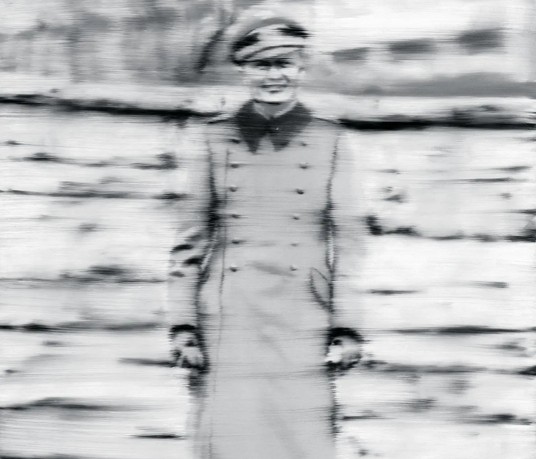
Onkel Rudi (Uncle Rudi), Gerhard Richter, 1965.
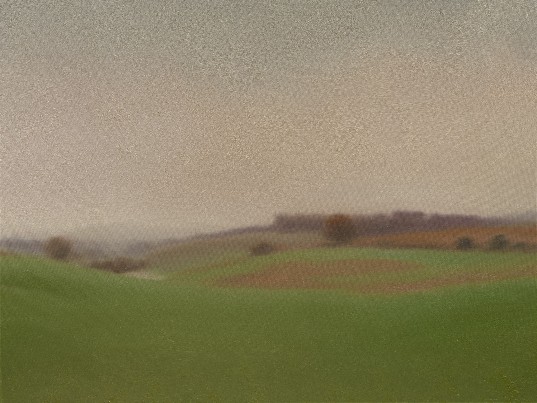
Grünes Feld (Green Field), Gerhard Richter, 1969.

A still from My Undesirable Friends: Part II — Exile (2026)
THE SKY IS BLUE: A CONVERSATION WITH JULIA LOKTEV
Stadtbild Madrid (Cityscape Madrid), Gerhard Richter, 1968.
INTRODUCTION: SYMPOSIUM ON CRITICAL THEORY
Relativity, M.C. Escher, 1953.
Cage 6, Gerhard Richter, 2006.
5. Jan. 98, Gerhard Richter.
|

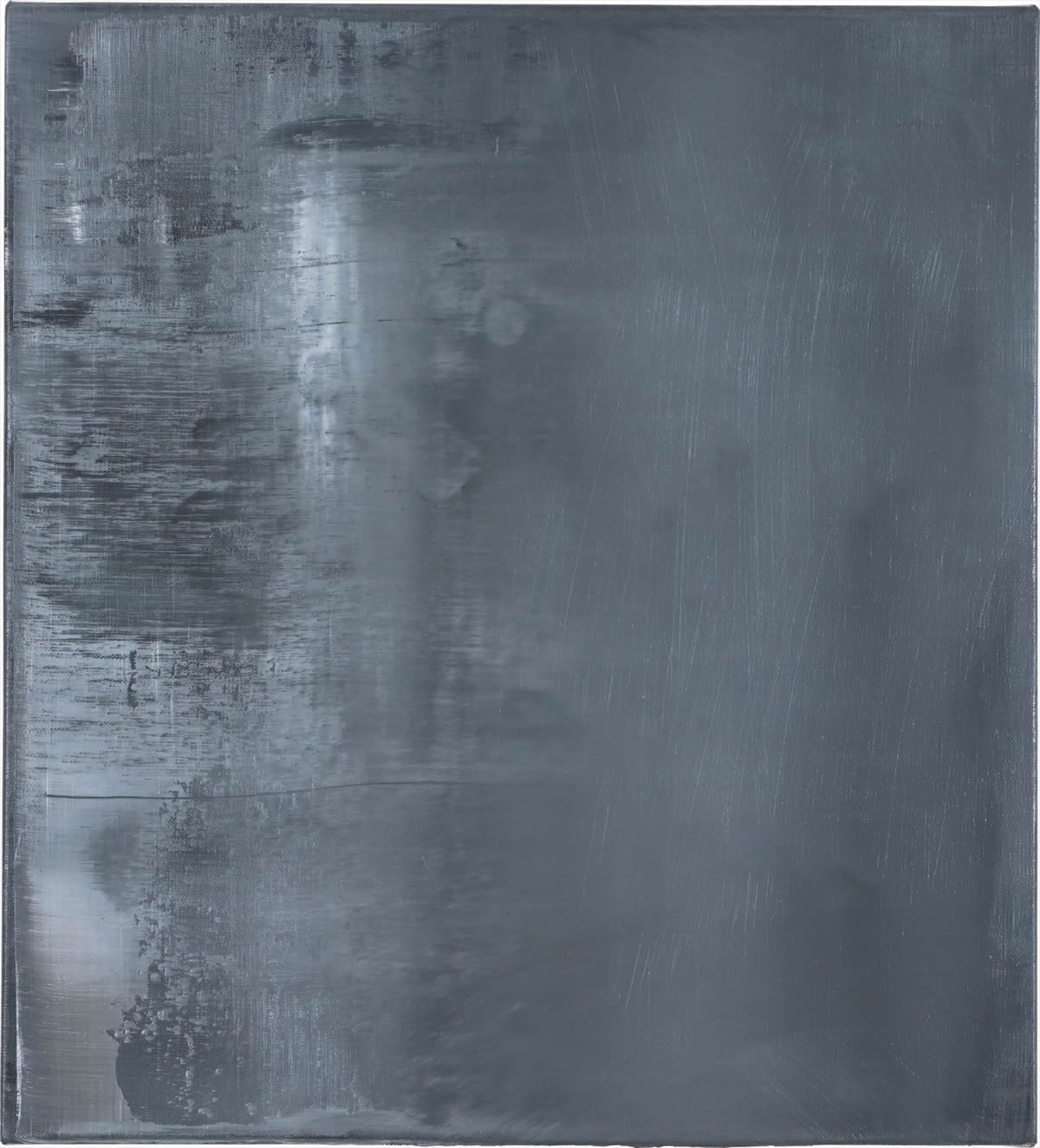
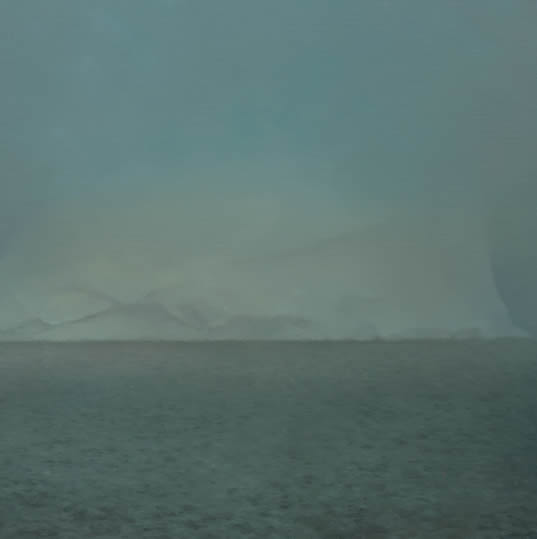
Art Note: Grau (Grey), Gerhard Richter, 2003. Richter turned to grey, he said, when he didn't know what to paint or what there was left to paint — "so wretched a start" that it became a whole practice: color refusing to resolve into black or white, matter without a subject, pulled across the canvas by squeegee rather than shaped by hand. It is one way of picturing what this essay argues instrumental reason does to the living world: reduces it to indifferent material, gray on gray, with nothing left to distinguish one form of life from another. Oil on canvas, 52 × 47 cm (Catalogue Raisonné 883-4). Private collection — image and details via Phillips. © Gerhard Richter, courtesy of the artist and Gerhard Richter Archive.