ON ART AND NEEDLESS SUFFERING By Kathy Kiloh *** The Montréal Review, September 2026 |
|||
In the introduction to Critical Theory: the basics, under the heading “What this book is” Martin Shuster writes that this book is written “for the novice” (2). The prose style is so accessible, the explanations of concepts and theories so well-articulated and so clearly illustrated with reference to relatable examples that yes, it is a great book for those who are new to the study of critical theory. But this book in not only for beginners. This is because Shuster has compiled so much relevant and genuinely interesting information about the origins of the Frankfurt School, the bodies of work that influenced their thinking, and the on-going development of critical theory, that it is a valuable resource for scholars of all levels. A possible fault of the book is that it purports to provide a “basic” introduction to the Frankfurt School, but it seems to be weighted most strongly toward the work of Adorno and Horkheimer, with Marcuse coming in at a close third. That isn’t to say that others—whether members of the first or later generations—are ignored or avoided. However, much less attention is paid to their works. However, one could reasonably argue that Adorno, Horkheimer and Marcuse are the most well-known and most widely read members of the original Frankfurt School. The book does acknowledge others, and it provides enough of an introduction to them that interested students of critical theory could seek out their work on their own. The book is organized thematically rather than historically, and this means that different members and associates of the Frankfurt School as well as theorists from other traditions, including those committed to feminist, critical race and anti-colonial theory appear organically throughout the text as though they are popping in and out of a conversation with the author and the reader. This is a welcome, accessible and fresh approach that makes the book a joy to read and underscores the contemporary relevance and applicability of Frankfurt School theory. While the book provides a valuable discussion of key moments in the history of the development of Frankfurt School critical theory (the foundation of the Institute for Social Research, the early research projects combining empirical and theoretical work, the work produced in exile during the war, the return of Adorno and Horkheimer to Germany and their subsequent clash with members of the student movement in the 1960’s), to a great extent, it reads like a guidebook to living, thinking and acting critically in a complicated and contradictory world. More than just another “how to read critical theory” book in other words, it is a guide to using critical theory to understand the contemporary world and our place in it. As Shuster puts it in his conclusion, the book is intended as “a way of orienting one’s situation moving forward, of understanding it as needing to arise out of a human judgment both about oneself and who one is, and about society and the historical moment of which one is unavoidably a part, and of what these two can, and cannot be, presently or in the future” (196). I can’t imagine a more important task for a critical theorist than writing a book like this, given the current state of things. The multiple and interrelated sources of needless suffering in our world that Shuster tallies throughout the book attest to this. The two key themes that Shuster claims are at the heart of Frankfurt School critical theory, and that he returns to throughout the book, are the needless suffering caused by capitalism and the necessity of autonomy (or, as Immanuel Kant would have it, Mündigkeit—maturity) for critique and the social transformation that critique informs. He tells us that maturity, as it is understood by the Frankfurt School, “requires the development of the human capacity for judgment and discernment and responsiveness to the present moment” (68). Members of the Frankfurt School have at times been criticized for their elitism on this score, and, as Shuster points out, Horkheimer for one was (at moments) guilty of presuming that only the (increasingly rare) continuation of patriarchal authority could account for the development of critical faculties (90). In contrast to this sense that mature subjects are somehow exceptional or perhaps the products of a more conservative past, Shuster claims that “the only necessary expertise [to be an agent of critique] is the recognition of needless suffering. And everyone is potentially an expert” (54). This claim, which seems to be based upon the physical impulse or “jolt” that Adorno postulates as an addendum to Kant’s overtly formal categorical imperative, at first glance, might appear to provide a solution to the question of how one becomes capable of critique. But does it? Afterall, everyone is only “potentially” an expert. It is unfortunately not difficult for any of us to avoid recognizing needless suffering—even our own—for what it is. In fact, being a functional member of capitalist society requires this of us, at least some of the time. And as Shuster outlines in the section on the self, achieving maturity is incredibly difficult within capitalist society, which atomizes human existence to the extent that social and familial relations do not allow for individuation or integration of the personality. This fragmentation means that judgment and discernment are not capacities universally developed in all human beings. Shuster’s formulation of the practice of critical theory as “becoming a student of needless suffering” is, I think, a useful one. To see needless suffering in the world is to at least recognize that things should not be as they are, that they should be otherwise. And it is here that we can see how critical theory (whether conceived in a limited way as the project of the original members of the Frankfurt School or more broadly) can become a two-fold practice of refining our vision of the world and transforming the world itself. To be able to be a student in this way, Shuster proposes, one must listen to and reflect upon the dissonance or unease we must all feel living in this society. But to be able to feel and, especially, to reflect upon that feeling—in other words, to engage in critique—one must have established a certain level of maturity, or in psychoanalytical terms, ego strength, to be able to think and act as an autonomous subject and agent in the world. Right now, people all over the world are seeing, and, perhaps more to the point, experiencing unnecessary suffering, but members of the Frankfurt School would suggest that their capacity to reflect on what they are seeing and experiencing is hindered by a lack of maturity. Consequently, they are unable to identify the cause of their pain and they lash out instead at scape-goated groups (for example, on the same day that Tommy Robinson’s “Unite the Kingdom” protest took over central London—Sept. 16— ten people were arrested for assault at a much smaller “Canada First” anti-immigrant protest that took place not far from my home in Toronto). This is, perhaps, the key concern for critical theorists: in a world designed to inhibit maturity, how can we develop our capacity for autonomous thought and action; how can we create conditions under which this development can occur? So how does one come to be strong enough to see the needless suffering that exists, or in Adorno’s language, how can one be more rather than less of a subject in the world? A guidebook for living like Critical Theory: the basics is certainly a good place to start. In it, Shuster describes how Frankfurt School thinkers see art and religion as inviting this kind of psychic development. Because of my own research interests but also because I teach at an Art and Design University, in the remainder of my remarks I will focus on Shuster’s chapter on art. This chapter describes the critical potential that the Frankfurt School perceive in the work of art. At this point in the book, I see some potential limitations to framing the Frankfurt School’s aims and motivations as the need to end “needless suffering.” As I’ve already noted, I don’t fundamentally disagree with this formulation, it has great explanatory power in a book like this, which is intended to introduce Frankfurt School critical theory to a new readership. But the phrasing is somewhat reductive, and it tends to become a short-hand over-generalization at points in the book. I think this risks masking over something(s) of importance because it minimizes the tensions between Marcuse’s and Adorno’s accounts of the work of art. This potentially works against the fine work that Martin does in this chapter, where he describes the common ground shared by Marcuse and Adorno, while providing detailed explanations of their aesthetic theories. My specific concern is that Adorno’s emphasis on the way that the work of art expresses the suffering of nature seems distinct from Marcuse’s account of the work of art, and that the notion that their aesthetic theories are both oriented toward the alleviation of needless suffering (but not the more specific suffering of nature) misses these subtle but significant differences. This isn’t to say that Marcuse doesn’t also see the work of art as involved in the domination of nature, but unlike Adorno, Marcuse seems to be referring mostly, if not exclusively, to instinctual drives. Consequently, Adorno’s aesthetic theory carries an ethical charge that Marcuse’s writing on art does not approach. According to Adorno and Marcuse, it is in the form the artwork takes, rather than the content it purportedly communicates where we find resistance to the world as it currently exists. Shuster illustrates this point with reference to a few works—those suggested by Adorno (Schoenberg, Beckett) and another, more contemporary reference (Gang of Four). As Shuster has it, the “fundamental contingency of whatever fixed nature” the self presumes itself to be is contested when it comes up against the social antagonism expressed in the form that the work of art takes. In the preface to The Aesthetic Dimension, Marcuse writes “the political potential of art lies only in its own aesthetic dimension” (AD, xii). Art’s truth does not lie in its expression of content as a didactic or edifying message, but in its ability to give content (what he terms “established reality”) a radically new form. Novel aesthetic forms promise to alter our perception so that we can see that reality is consensual rather than pre-determined and irrevocable. This is the liberatory potential of art according to Marcuse. The aesthetic dimension thus opens us to the possibility of autonomy that we have forgotten or have perhaps not yet imagined into being. Marcuse claims that revolutionary praxis, on its own, cannot deliver this. It is doomed to fail without the supplement of the aesthetic dimension because it cannot free itself from the reigning reality principle. Adorno says something similar, but not identical, to this in “Theories on the Origin of Art” included in Aesthetic Theory: feeling and knowledge have been subjected to a radical division of labour, but their separation is historical and hence “revocable” (AT 331). Aesthetic experience brings sentiment and knowledge together, joining the desiring subject with the epistemological subject. Shuster states that for art to do what Adorno and Marcuse think it has the potential to do, it must 1) acknowledge the near impossibility of art (and other human endeavors) given the extent of commodification and administration of life. In other words, it must provide a clear-eyed diagnosis of the situation. (2) It must not give in to irony, cynicism or the status quo. This might be what Adorno means in Aesthetic Theory when he refers to art’s quality of “standing firm” (AT 15). (3) It must point beyond the present reality. This is art’s utopian moment (145). In the presence of art that observes the situation correctly and resists it, thereby opening onto a utopian impulse, we can feel again the “amazement” Adorno refers to in one of his essays on Bloch, or, in Aesthetic Theory, the “enthusiasm” that Plato identifies as the “precondition” of philosophy and knowledge (AT 330). This is the feeling of the new as extreme otherness, of the non-identical preserved in the work of art. For Adorno, this non-identical is the suffering of nature at the hands of human society organized according to the logic of domination. The Freudian story goes that we individuate as the ego and the superego emerge from the muck of drives, impulses and instincts. The mechanism facilitating this individuation is repression, and, as Adorno has it, we become human by imitating other humans. This means that there is a cycle of social reproduction that results in the denial and exclusion of “animal” passions in the pursuit of reasonable humanity. Art preserves this process and mirrors it back to us. In doing so, it gives expression to that natural, material stuff that we repress. According to Adorno’s description of aesthetic sublimation, an affective, sensible force of negativity (that is, unmet urges and needs) is preserved within the work. This negativity can be read as a refusal of the practical organization of life. Art testifies that in society’s inability to meet these needs, it not only prevents us from experiencing happiness, it also actively produces unhappiness, and then sells it to us under the guise of contentment. The promesse de bonheur of art, therefore, lies in its negativity, which provides us with the capacity to measure the “chasm” that separates our conventional comportment from actual happiness (AT 12). This is why the disinterested contemplation that reduces art to a source of pleasure is not enough for art—why, instead of elevating art, it “debases” it by turning it into a product of the culture industry (AT 12). Adorno claims that whatever “happiness” might be gained in the experience of art is accidental – a psychological projection that really has nothing to do with the work itself. What would be essential to art—what we must work at to rise to the challenge of art, Adorno claims—is the happiness of a knowledge that can do justice to the work of art itself by grasping its truth (AT15). Adorno describes art as a site of mediation where we can access the expression of drives, mutilated by the force of repression; art, as a product of sublimation, is a site and a record of the repression and domination of nature —instinct, impulses and drives. But Adorno’s references to the human body and animals in Aesthetic Theory and Negative Dialectics and Horkheimer and Adorno’s discussion of the domination of nature in Dialectic of Enlightenment indicate that the suffering nature expressed in art includes, but is not limited to, the repression of drives. Art mirrors the human process of individuation via repression, and this prompts what Adorno calls the aesthetic shudder. This shudder is a reaction to this expression of nature’s suffering. In the moment of being shaken, the subject that conforms to the reality principle breaks apart. This moment of self-relinquishment offers us a glimpse of an alternate relation to others, in which all parties to the relation are perceived, and respected, as autonomous beings. The aesthetic shudder exposes us to an experience of the maturity that we have yet to achieve. In Eros and Civilization, Marcuse implies that art has the capacity to liberate the (natural, instinctual) drives and that subsequent revolutionary transformation of self, culture and society might end art as we know it. Marcuse presents art as though it preserves a portal allowing us direct access to eros in unmitigated form. Liberating the drives, impulses and instincts—the aim of Marcuse’s Eros and Civilization—is potentially disastrous because, as Adorno and Horkheimer point out in Dialectic of Enlightenment, the drives are transformed by repression. They are twisted and damaged and we have become alienated from them. We no longer recognize them as our own desires. Liberation of the drives in this state would be destructive. On Adorno’s account, it is precisely the suffering of nature that confronts us in the work of art, not liberated nature, as Marcuse suggests in Eros and Civilization. The shudder allows for contact between a self-reflexive consciousness and the repressed non-identical preserved within the work of art. Adorno’s description of the shudder as “the act of being touched by the other” indicates that his aesthetic theory attempts to describe or evoke an ethical encounter with alterity at the heart of aesthetic experience (AT 331). Shuster’s reservations about Marcuse’s vision of human life under a new reality in which art is transcended because needs are met and surplus repression is no longer necessary strike a chord with me. I share his concerns about Marcuse’s glorification of infantile narcissism as a gateway to a mature subjectivity in which the ego is weakened enough to allow drives to be fully integrated (159). Although Marcuse only posited this as a potential future, the seeds of which were already present in his own period, I find this to be a terrifyingly apt description of our current society, dominated by populist movements that have embraced a politics of revenge. Marcuse’s vision of utopia resembles our dystopia too closely for my liking. Furthermore, in Marcuse’s liberation of the drives, eros triumphs over thanatos once and for all. This means that there can be only unity, no negation, no contradiction-tension, and therefore, no critique. This should give us pause. To be fair, in his later essay “The Aesthetic Dimension,” Marcuse describes a more dialectical and therefore indirect relationship between nature and the work of art. In the creation of the work of art, reality is sublated to aesthetic form, undergoing a process by which it both affirms desire for reconciliation and acquires a critical, reality-negating aspect. The result is a work that transcends immediate reality. Marcuse posits that the sublimation of psychic drives resulting in a socially acceptable individual is reversed in the aesthetic dimension. There, we undergo a process of desublimation that liberates the drives, facilitating a “rebirth of the rebellious subjectivity” (7). However, in describing the work of art as a site of aesthetic sublimation and desublimation, Marcuse never really approaches that moment Adorno describes as the aesthetic shudder — a moment of contact between self and other in which the subject is rendered undone and vulnerable. Furthermore, and perhaps this is itself a consequence of this omission, Marcuse’s emphasis on suffering and emancipation remains focused on the repressed nature of psychic drives. Consequently, it is harder to incorporate Marcuse’s account of the aesthetic dimension into a critique of the domination of nature understood, in a broader sense, as encompassing our unremitting extraction of natural resources. Shuster acknowledges Adorno’s ethical position— on page 148 he quotes Aesthetic Theory, writing that art tries to “do justice to that element of suppressed nature”—but this comes near the end of the chapter on art and isn’t developed as much as it could be. On the one hand, this seems like a missed opportunity in a book that seeks to highlight the relevance of Frankfurt School theory for a new generation of scholars who (we hope) want to understand and change our horribly messed up world. Art’s role in transmitting nature’s suffering, the suffering caused by humans’ will to domination, may strike a chord with those new to critical theory, given the endless news cycle presenting us with evidence of climate crisis and mass extinction, and images of brutal war and occupation. A Freudian analyst wouldn’t have much difficulty diagnosing our present society as one given over to the death drive, and I can imagine that Adorno’s assertions about the truth in art might at least seem intriguing to art critics and writers who want to think through the potential psychic sources of this destruction, and its reflection in the work of art. Both Marcuse and Adorno postulate that reason alone—or reason in an impoverished state at this point in the history of the dialectic of Enlightenment—cannot provide us with the feeling that critical thinking requires. We need access to feeling, and art and aesthetic experience provide a training ground for this. I suspect that the “jolt” that Adorno theorizes as a necessary addendum to Kant’s too-formal categorical imperative in Negative Dialectics cannot guide our thought and comportment without us first experiencing alterity via art. Because art and aesthetic experience are historically constituted, we must be honest with ourselves and ask if such things are even possible at this stage. This concern is admittedly not a new one; for example, Espen Hammer laments the passing of the possibility of aesthetic experience in his book Adorno's Modernism: Art, Experience, and Catastrophe (2015). I want to believe that art still has the “weak” power to prompt the aesthetic shudder, but I’m unsure if it does for young people (who, one may presume, are at least part of the intended audience of “novices” for whom this book is written). I worry that there may in fact be reason to suspect that Adorno’s and Marcuse’s theories of art are no longer applicable or relevant to our current situation because the concept of the autonomous work of art is no longer prevalent or even recognizable to younger members of contemporary society. To my own students (all of whom are learning how to be professional artists, curators, art critics, or designers), the conception of art as autonomous, and following from that, that it might provide a model of ethical relations in some way, usually comes across as quite alien to their own experience. Neoliberalism has taught us all that it is more important to be marketable than it is to be mature. We must self-brand and sell ourselves. As Naomi Klein describes in Doppleganger (2023), social media accounts disseminate uncanny digital doubles that we feel compelled to create, shape and edit. It seems to me that in the era of influencer “culture,” and curation by algorithm, the culture industry might have already won. This is perhaps no more apparent than in the contemporary art world, which is in part why Shuster begins his chapter on art by acknowledging how old-fashioned the Frankfurt School’s writings on art appear considering the presently totalizing grip of the culture industry upon the work of art. In fact, my students often relate quite strongly to the culture industry thesis as a description of their reality, but they often have a great deal of difficulty accessing the sense that things could be otherwise. Shuster reminds us that the Frankfurt School has provided us with the diagnostic tools necessary to understand why the bourgeois form of art as a site of aesthetic sublimation, desublimation and what Adorno called the aesthetic shudder, might no longer seem relevant. He employs Marcuse’s concept of “repressive desublimation” (as described in One Dimensional Man) to describe the state of contemporary art in an age facilitated by the internet, wherein “everything is permitted” (151). Returning to Marcuse’s Aesthetic Dimension, we can see that this permissiveness extends even to liberties taken in regard to aesthetic form. In describing anti-art movements including pop art, he writes that “the rejection of the aesthetic sublimation turns such works into bits and pieces of the very society whose “anti-art” they want to be” and he concludes that “[a]nti-art is self-defeating from the outset” for this reason (AD, 49). Furthermore, “the desublimation of art can lead only to making the artist superfluous without democratizing and generalizing creativity” (AD 52). Shuster puts it this way: “When the possibilities for sublimation shrink—while the needless suffering that exists in society does not or does not in the same proportion—then what’s happening is exactly a desublimation that turns out to be repressive, since it exactly closes off possibilities for resistance” (145). According to this theory, art has lost the power of critique because drives no longer need to be sublimated in a now seemingly permissive and indifferent society. Therefore, art no longer expresses tension, contradiction, dissonance. Even what passes for critique soothes, excites and sells goods without negating the status quo. This correlates strongly with
how Benjamin Fong interprets Adorno’s and Horkheimer’s culture industry thesis.
He argues that the products of the culture industry impede maturity
because they weaken the superego. The culture industry offers “direct death
drive gratification that
siphons the energy once sublimated into the superego by lowering the
temperature of oedipal conflict.” (Fong, 114). The cathartic release of drive
energies results in an under-developed and unbalanced psychic structure. In the
absence of a well-developed super-ego, the pseudo-subject has little capacity
to differentiate, to make judgments and cannot tolerate contradiction long
enough to work toward reconciliation. Art as pseudo-critique is a product of
the culture industry that masquerades as maturity while actively blocking the
achievement of autonomy and agency. Instead, it provides the kind of catharsis
that, as Marcuse notes, reconciles us to living in the world as it is (AD 55).
Is it possible that viable theories of sublimation no longer exist now that
catharsis and repressive desublimation are the order of the day?
CONTENTS
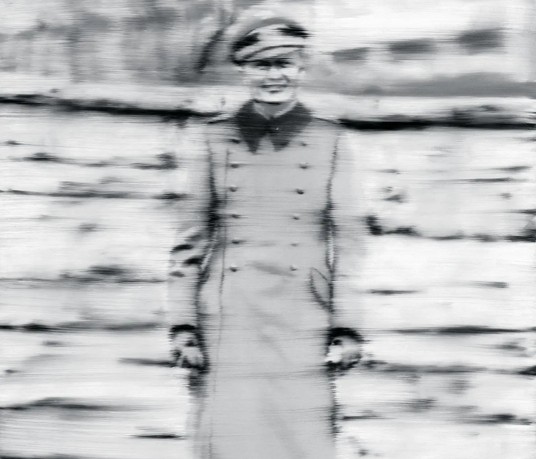
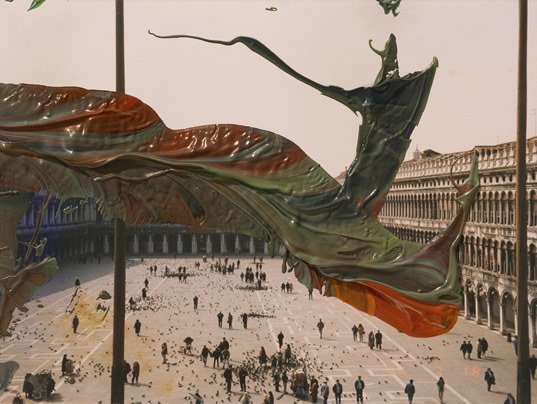
Onkel Rudi (Uncle Rudi), Gerhard Richter, 1965.
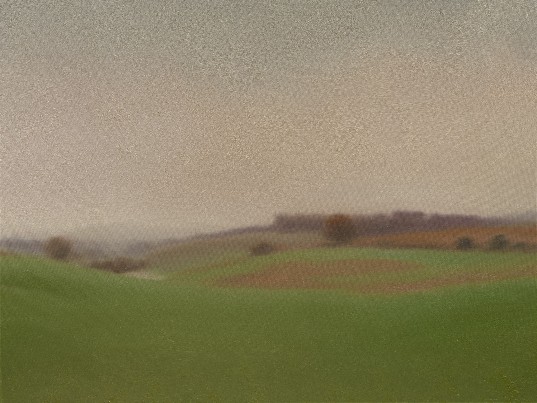
Grünes Feld (Green Field), Gerhard Richter, 1969.
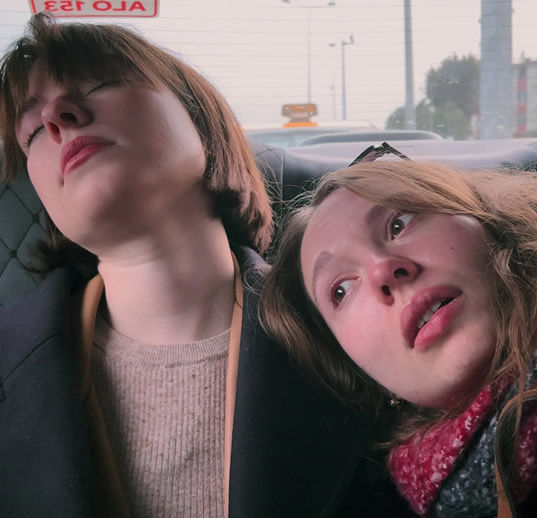
A still from My Undesirable Friends: Part II — Exile (2026)
THE SKY IS BLUE: A CONVERSATION WITH JULIA LOKTEV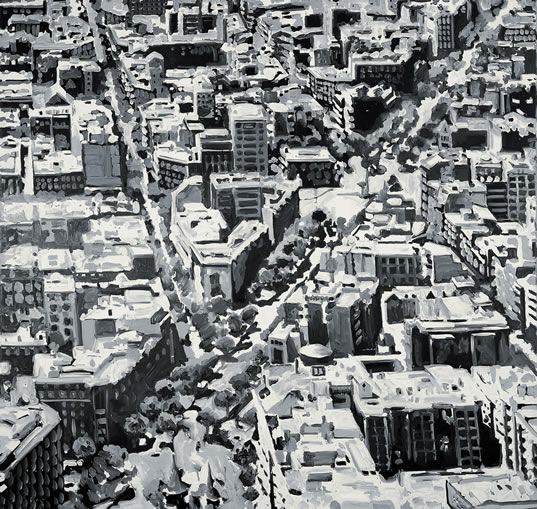
Stadtbild Madrid (Cityscape Madrid), Gerhard Richter, 1968.
INTRODUCTION: SYMPOSIUM ON CRITICAL THEORY
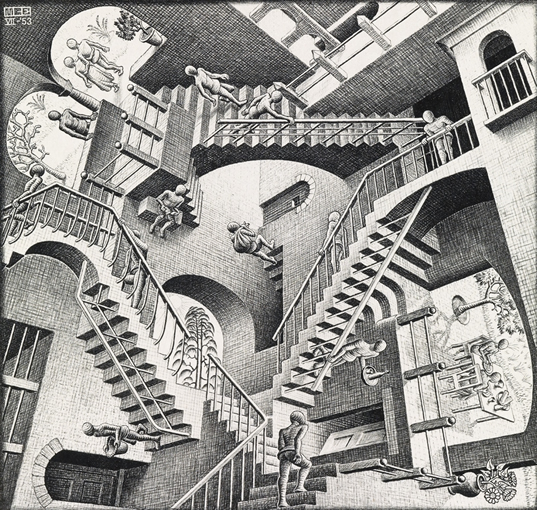
Relativity, M.C. Escher, 1953.
Cage 6, Gerhard Richter, 2006.
5. Jan. 98, Gerhard Richter.
|


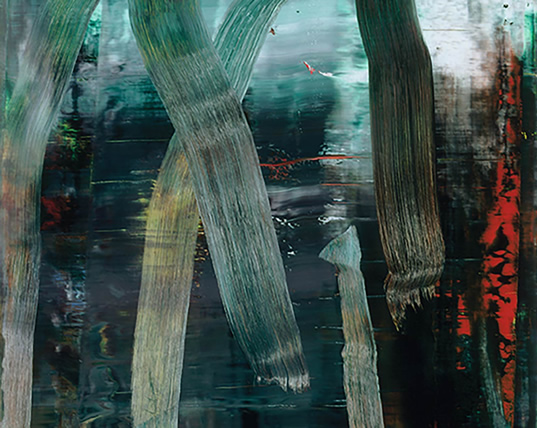
Art Note: Wald (7), Gerhard Richter, 2005. Dense vertical strokes that read, from a distance, as tree trunks in undergrowth — nature rendered so abstractly that it dissolves before it resolves. Richter began photographing the forests near his home the same year he painted this series; what he kept from the photographs wasn't their likeness but their density, the sense of something present that refuses to be looked at directly. That is close to what Adorno asks of art: not a picture of nature, but the trace of a nature repression has already gotten to. Oil on canvas, 197 × 132 cm (Catalogue Raisonné 892-7), from the twelve-part Wald series, 2005. Collection The Museum of Modern Art, New York. © Gerhard Richter, courtesy of the artist and Gerhard Richter Archive.