
PART THREE THE DEADLY SICKNESS OF OUR CIVILISATION By Darko Suvin *** The Montréal Review, March 2026 |
|||||
When the Kerensky ministers were being led out of the stormed Winter Palace in October 1917, the irate population wanted to beat one. “Do not beat him, he is nekul’turnyi”, said a Red Guard. (see Ulam, Bolsheviks 272) Nekul’turnyi (literally, not cultivated or uncultured) is a key and untranslatable Russian Enlightenment/intellectual/ populist term meaning roughly -- but also precisely -- a person unaware of the necessities of humanity. It was also a favourite of my New York friend in the 1960s, the late Lee Baxandall, who taught it to his little boy. 1. The Way out of the Fly-Bottle: Forms
My approach here is based on two axioms. To understand and agree with them does not mean we are immediately and magically liberated: liberation is a collective physical action guided by desires, a horizon, and organizational mediations. This book can’t be a physical subversion of the reigning system of immiseration, warfare, and humiliation. It merely (merely!) uses the freedom of assuming clear stances by its writer and for its readers. Yet any horizon is a product of some key cognitions-cum-stances, such as these two axioms. The first axiom is most memorably formulated by Wittgenstein’s aim “to show the fly the way out of the fly-bottle." He is often taken to mean simply helping philosophers not to bang their heads against false problems, but I take it as the starkest image of people’s predicament in the historical age of surveillance capitalism and its constrictive States. It fuses a bodily spatial impotence, leading to death, with an epistemological image: to see the world both as green glass and as a decisive obstacle. For oppressed people it is a recognisable metaphor. All too often, most working people are isolated by overbearing class rule from understanding how and what liberation could be; exhausted and depressed, our own interests are felt merely by contraries, the ills we are subjected to. This feeling might be, as Francis Bacon said, a good breakfast but it is surely an insufficient main meal. The second axiom is that all valid understanding (cognition, truth, knowledge) comes about by or as shapes or forms. True, philosophers from Plato on wish to persuade us notions or ideas are nobler and primary, stable and static anchorages forever. Symmetrically obverse, the early slogan of the English Royal Society “Nullius in verba” – meaning roughly “don’t rely on assertions in words” -- gave a perhaps decisive push to the dynamics of the Industrial Revolution. I have great sympathy for all cognitive endeavours and I do wish to promote both ideational understanding and a reference to matters beyond language. I also believe class society as a whole is the proper overall horizon for our work. However, I find that in all useful cases conceptualising is shot through by shapes. This as a rule increases the richness of meanings and lends itself to change and potentiality; for example, neither Plato’s cavern where the world flickers (in The Commonwealth) nor his slave boy who understands geometry (in Meno) is exhausted by the doctrine of celestial ideas it is made to serve. Hegel was right in stating that in all modes of cognition reality appears as a determined form (Phenomenology); thus cognition is not reduced to generalities but is inextricably also bound up with particularities. When forms do not co-shape understanding, the cognitive horizon is much constricted: it is either a nobler world in heavens -- in many philosophies and all religions -- or lately only too often, an atheist logomachy, a sterile battle of terms within given ideologies based on class interests. Perhaps most important, Hegel saw that to think of a form, which necessarily implies a shaping limit, is to be able to cross that limit or frontier. When a form is achieved, the achiever or poet-maker is simultaneously inside and outside it. Deleuze proposed that painting and music also think the concept in their own ways. I would unfasten his anchoring to the concept -- no doubt hard for a philosopher who doesn’t want to follow the latter Wittgenstein -- and say it’s quite clear that music, painting, and all the “arts” outside the word-art remain cognitive even without an exclusive focus on concepts, so why couldn’t (say) verse too be such? This book wishes to factor in an approximation to the experiences of the dispossessed, daily exploited, lesioned billions and to clarify it with help of a group of terms. It speaks to a new, deadly efficient imperialist hegemony:
The only way to formulate and guide experience is to consider three main material areas of human activity: the performing human bodies, the humans’ use of objects, and their understanding of interrelations – here exemplified in naming of words. Usually, the first area is called society, the second is economy, and the third is epistemology. Analytically, epistemology is to be the favoured initial approach, since without understanding how we may and do understand we cannot properly buttress assertions; so that I have been worrying at epistemology for a long time (see the discussion in Probe on Science above). This approach will of necessity take into account the politics of all-permeating exploitation and violence. I shall here, taught by experience, foreground that there are no descriptions wholly independent of prescriptions: "All modes of knowing presuppose a point of view. Therefore, [...we need] the responsible acknowledgement of our own viewpoints and the use of that knowledge to look critically at our own and each other’s opinions." (Levins 182) Of course, prescription can turn sour if it sticks to a single cause, as in Stalin's odinonachalie (autocratic rule according to a single will and truth) or Mrs Thatcher's phantom enemy „society.“ Instead it ought to have a compatible set or multiple of causes (see Probe on Hume above). The reason for this is democratic, let a thousand flowers bloom, but also historical. For, causation doesn’t merely exist within history, but it is intimately created, shaped, and limited by historical power politics. Therefore, I am sympathetic to the oppositional aspect of Deleuze’s image of the rhizome as against the rigid causation politics of classical philosophy, but find it ultimately too shoreless an anarchy for present-day use. This is quite evident in his opposition of the nomad (Zamyatin called him the Scythian rider) to the State – what, no third possibility of human association exists? I hastily add that Deleuze’s fold (pli) seems much more fertile, if properly developed. At the end, however, objections against prescription, of which I have received my share, imply as a rule a refusal, absenting, and often taboo on causality in favour of the rulers’ political contingency. Marx’s stance in Capital is constituted by a fusion of description -- precise politico- economic analyses -- and prescription -- an overriding value-system based on the needs of a great majority, the working people. This is radically opposed to the positivistic dichotomy between fact and value: Hume may be logically right to doubt that any ”ought” can be derived from an “is,” but he is psychologically and politically wrong. For my overarching example, the very concrete Fascism should, and often does, give rise to Antifascism. I would claim that any sufficiently relevant “is” necessarily gives rise to a sheaf of different “oughts.” True, this is complex: to start with either description or prescriptions may be potentially cognitive (though in very different ways) and either may on its own be non-pertinent or alienating. Working as a lone artisan with a phantom client or addressee, I must here concentrate on two approaches, which should strengthen each other: socioeconomical power pragmatics and epistemological semantics. The relevant categories or kinds of shapes seem three: the first two are pragmatic spacetimes and agents; the third is semiotically meaningful signs, from among which I can in this book only dwell on semantic shapes (words and meanings). I privilege the semantics since it is the only handy way to understand pragmatics too. Even the dyed-in-the-wool empiricists of early English Royal Society communicated its findings by words, accompanied by mathematical signs and at times illustrations. In what follows I shall focus on violence and naming. To preface them, I insert first my Probe on the devolving age we’re living in, which I call Capitalocene: an ugly name for an ugly bundle… 2. On Capitalocene 2.1. Approach “What may I hope?” was Kant’s famous third question in the Critique of Pure Reason, after asking “What can I know?” and “What should I do?” Indeed, what can we know and what may we hope in the capitalocene, this overwhelming antiutopian tsunami in which we are drowning, hoping to come within sight of an island, which, as John Donne told us, is “a piece of the continent/ A part of the main/ . . . For I am involved in mankind.” Atmospheric scientists proposed the term anthropocene at the beginning of the 21st century as our current geological epoch because human impact on ecosystems and climate on land, air, and sea had in the age of world wars grown so huge that its results in decades were equivalent to geological changes that took tens or hundreds of millennia. For example, the human species has significantly halted the growth of biodiversity by accelerating species extinction. While reasonable cases can be made that humanity’s “geological” impact began during the European mastery over the world six centuries ago and the Industrial Revolution two centuries ago, the favourite is the first nuclear bombs in Summer 1945 – though I have a residual fondness for the onset of class society and the State thousands of years ago, which should perhaps be taken as the ancestral sparking point. This use of anthropocene had the historically pioneering advantage of noticing that something quite major was afoot in the constitution of human habitat and that the responsibility lay with us. But who is this “us”? Is an Indian slum-dweller or a Latin American landless peon or a lone intellectual working at his PC equally responsible as the decision-making ruling classes and castes of our societies? Insofar as many humans use the anthropocene by multiplying and living longer, perhaps. But insofar as they/we might be decisive for the coming about of microplastics, heavy metals or the nuclear bombs, of genocides and ecocides, no. For the great majority of humans, I’d claim that we are not guilty, but we are probably responsible for not curbing or ditching capitalism. The term “capitalocene” pinpoints more accurately the causal guilt for eco-destruction: for its cause is production, consumption, and circulation of commodities by profit-driven dirty technologies plus the power structures created by capitalism to bomb into the Stone Age any alternatives (for example, the unceasing violence used against all attempts at radical social justice). The attendant destruction of wide health services for the working people is not the cause of the corona virus but it is a secondary and sufficient cause of the coronavirus pandemic: the virus of profit extraction from labour is more ancient and powerful but it can subsume secondary viruses. Capitalocene designs the blind and often irreversible exploitation and degradation of nature all over the world by capital’s economic and political power (cf. Daly-Farley). It is also the mark, the deep wound, that its unceasing profit-mania and speed-ups impose on all humans and on human metabolism with nature. Capitalocene has been well explained by China Miéville (who points to Jason W. Moore’s 2017 coinage of the term)
Historically, capitalist corporations engaged from the mid-1970s in a large-scale offensive to depress wages per unit of production and boost profits. Using the slogans of free trade and globalisation, the rich organised bundles of radical interventions by major states and organizations of international capital (GATT, WTO, IMF, and the World Bank) to make themselves vastly richer, while multiplying the poor in their nations, eviscerating the middle- class prosperity based on stable employment, and upping the income gap between rich and poor countries from 10:1 to 90:1. A large class of chronically poor was created, politically neutralised by creating fear of even poorer immigrants. In this top-down class warfare, ca. 3 billion people, the global reserve army of unemployed, vulnerably employed, and “economically inactive” struggle today to survive, failing fast, while more than half of them live in the most abject poverty, more or less quickly dying of hunger and attendant diseases. If we figure in also their hydra-headed marginalisation and exclusion, in turn causing individual and collective revenges as well as the “slow” structural violence caused by destruction of environment and the aftermath of war. Economic “growth” by now benefits only the rich, at the expense of everybody else (cf. Pogge and Rob Nixon). I shall here insist only on three foci of the perfectly sinful capitalocene: war, ecocide, and polluted affects. 2.2. War The Keynesian Welfare State of blessed memory finally succeeded only in tandem with “military Keynesianism”: the heavy rearmament that in the 1930s-40s primed the pump of business upswing and remained the precondition of a relative affluence. Its early price was the Nazi regime, World War II, and High Stalinism. Today too, imperialism is healthy and thriving. If radically anticapitalist and anti-authoritarian ways of counteracting this are not found, we shall have more shooting wars in the South (including northern ghettos) as well as refurbished fascism in the North. Since World War 2, armaments commodities are not only the source of greatest extra- profit but also a pillar of the capitalist system. The capitalist market systematically favours armaments commodities because of their uniquely high value-added price, their especially rapid rate of obsolescence and turnover, the monopoly or semi-monopoly position of their manufacturers, and their secure large-scale financing. This most profitable part of global trade is the strongest factor of colonising our lifeworld and ecosystem by the commodity economy (much more is in Suvin „Capitalism”). As a result, US$ two trillions (millions of millions) were spent in 2021 for preparing for multiplied military murdering; a sizable part of that sum is, no doubt, profit for the major US and other world corporations (SIPRI). E. O. Wright’s sociological verdict at the beginning of this century, when worse was yet to come, was that capitalist class relations with ever growing inequalities of wealth perpetuate eliminable forms of human suffering as well deficits in human freedom and autonomy, largely based on domination of work. As I have discussed at length (see Suvin “Capitalism”) and shall develop in Book 2, capitalism is inimical to both middle-class democracy and mass plebeian democracy, where people control the State. 2.3. Ecocide Our ecological balance is in and by the capitalocene sorely upset by overconsumption of energy; to prevent collapse we need a steady-state economy, with growth resulting from efficiency. Capital uses nature as dead matter to make more dead matter, rather than as Spinoza’s natura naturans, a permanently active and renewable ensemble of new potencies and potentialities. A UN Summary for Policymakers of the Global Assessment Report on Biodiversity and Ecosystem Services was published in May 2019. It was compiled by 145 experts from 50 countries, with input from another 310 researchers and authors, it draws on over 15,000 scientific and governmental sources, and it incorporates the wisdom of Indigenous knowledge. It should be taken seriously. It found three-quarters of the terrestrial environment has been “severely altered,” more than 40% of amphibian species and 680 vertebrate species have been driven to extinction; in the oceans, almost one-third of the reef-forming corals and more than one-third of marine mammals are on the edge of extinction. In sum: one million animal and plant species are now threatened with extinction, many within decades. The report identifies two main and related reasons for this catastrophe: the “current limited paradigm of economic growth” and “climate change.” The report’s language is cautiously nonpolitical, but the first syntagm means corporate capitalism, a system premised on private property and profit as the only reason and horizon for existence. Its reliance upon fossil-fuel emissions and most wasteful global supply-chains is what has led to global warming, ruining the climate. Massive changes are needed in the very design of our societies to reduce global greenhouse gas emissions to zero by 2050, and market-based action will not suffice even with a high carbon price. In other words, capitalism cannot solve the mass extinction of species and climate change, with ocean levels rising by meters or possibly dozens of meters soon (see K. S. Robinson’s still perhaps too optimistic SF novels New York 2140 as well as The Ministry for the Future). Quite different ways to manage life on the planet must be adopted and enforced. The only possible conclusion is that capitalocene is a structured whole, growing more and more capillary. Thus we need to insist on an equally totalising eco-utopian approach. The capitalocene bind too has a name: Rosa Luxemburg’s “socialism or barbarism.” Alas now this choice will be much more painful than when she wrote it, in the horrible but not hopeless year of 1916. 2.4. Dirtied Affects I see around me in our late capitalocene two opposed main affects: the officially required manic cheer on the road to success is always threatened by the much vaster reservoir of reactive fear, daily injected by hegemonic antiutopian pressures into the grey matter of subaltern brains, so that it becomes fear for naked survival and horror of the polluted present. At the genetic and structural core of antiutopia lies the rulers’ fear of radical change that would mean plebeian self-empowerment -- that is, revolution in and around production. Only the panic fear, rage, and loathing at the first attempt to realise this, in Leninist communism, can explain the last forty-odd years of finally triumphant capitalism, culminating in a swell of Fascism 2.0. Its allegorical emblem is the “terminator gene” introduced by mega-corporations into seeds to ensure they cannot be renewed, thus constituting the absence of thousands of years of human crop cultivation, of the utopian horizon of “bread for all.” Fear, as Bloch repeatedly explained, was the negative affect we share with animals, to which hope, only present in humans, is opposed; furthermore, hope “allows for logical and concrete correction and sharpening,” it is an “act of cognitive orientation (Richtungsakt).” Centrally, the whole emancipatory panoply of the radical bourgeois beginnings -- from humanist culture and Enlightenment through revolutions and Romanticism -- is being ruthlessly and systematically scrapped, up to the shark-like liquidation of traces of welfare for (the) people. As Marx piercingly observed: when events force upon the bourgeoisie a democratic constitution, this helps the proletariat “and threatens the very foundations of bourgeois society.” To give one weighty example: the abolition of torture, the favorite feudal and Church tool against rebelling lower classes, was the crown jewel of Enlightenment and bourgeois liberalism; it is now taken back. Rewinding history backwards, the revolutionary and liberatory citoyen (citizen) aspect is being thoroughly expunged. The result is the relentless deepening and broadening of the “zone of non-being” identified by Fanon for the racialised and colonialised subject. The horribly intensive and extensive penetration of the rulers’ hegemony inside our bodies and minds, rendering us prisoners of a consensus hammered into us by hunger and brainwash, was identified by Gramsci in his prison writings as a ”molecular transformation.” Perhaps the metaphor of molecule could for our times be bettered by the revolution in subatomic cognition gathering during and after Gramsci’s ten-years in the grim Fascist prison: we could speak of a psychic equivalent instilled unceasingly into almost all of us, down to the level of nucleons (protons and neutrons) – if not quarks – that spin around the wrong centres. This finally results in a poisoning of emotional balance in people. The deadly radiation from nuclear explosions by warmongers is a macro-effect surprisingly analogous to people’s psychic conversions from Love to Death (Eros to Thanatos) or creativeness to destructivity. As Le Guin’s protagonist in The Dispossessed, to my mind the best piece of utopian writing since Wells or More, tells the ambassador from a totally dystopian Terra: “You would destroy us rather than admit our reality, rather than admit that there is hope!”
***
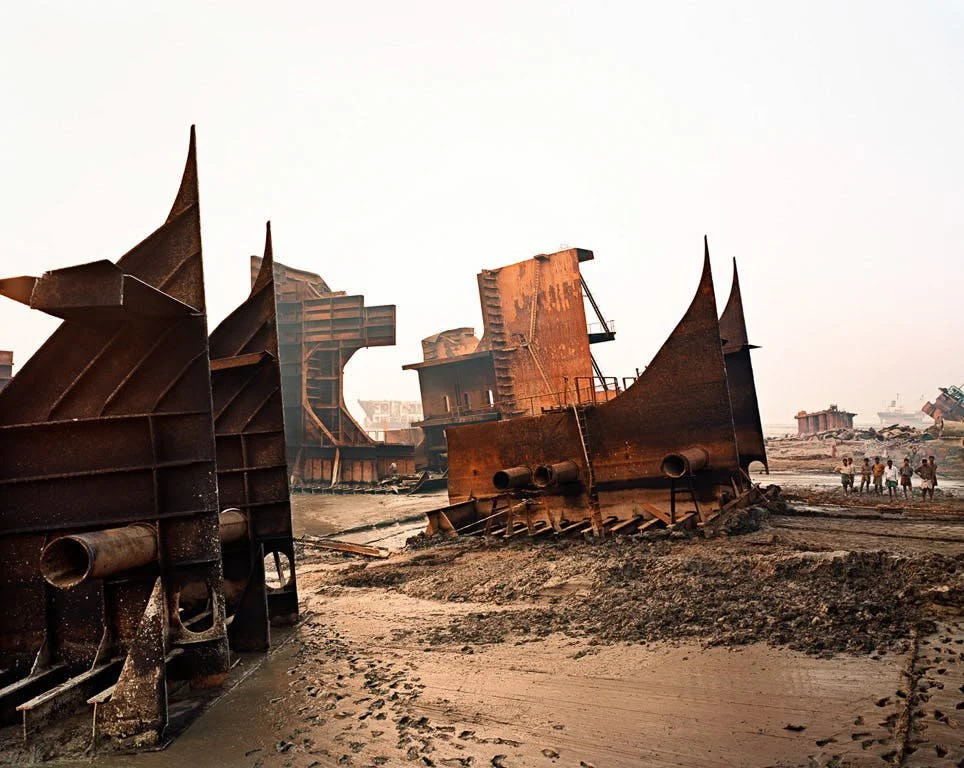
Darko Suvin presents a rigorous critique of our current ecological era, arguing that the planetary crisis is not a general human failure but a direct consequence of the "Capitalocene" and its relentless drive for accumulation. Through a blend of political philosophy, history, and social theory, Suvin dissects how the commodification of nature and labor has led to a systemic breakdown that threatens the very foundations of life. These articles, excerpted from Suvin’s book IT AIN’T NECESSARILY SO, challenge readers of The Montreal Review to look beyond surface-level environmentalism and confront the urgent need for a radical structural transformation. PART ONE: INTRODUCTORY POSITIONS PART THREE: THE DEADLY SICKNESS OF OUR CIVILISATION PART FOUR: OCCUPATION OF HORIZONS AND ORIENTATION: NAMING AND NOT NAMING This series of essays is paired with the work of Canadian photographer Edward Burtynsky. Born in 1955 in St. Catharines, Ontario, Burtynsky’s perspective was shaped by a childhood spent in a landscape dominated by the local General Motors plant and the massive shipping traffic of the Welland Canal. After learning the technical side of the craft in a darkroom his father built, he spent his early adulthood working in the very mines and factories he would eventually document. Over the last forty years, his career has focused on the human systems imposed on the natural world, with his work now held in major collections including the Museum of Modern Art in New York and the Tate Modern in London. The images featured here belong to his study of "manufactured landscapes." Rather than traditional nature photography, Burtynsky uses high vantage points to offer a bird’s-eye view of environments transformed by industry—from vast open-pit mines and quarries to sprawling oil fields and recycling yards. At a distance, these scenes can appear abstract and structured, often resembling painterly patterns of color and geometry. However, upon closer inspection, they reveal the minute details of industrial waste and labor. By showing the sheer scale of the systems that provide our modern goods, Burtynsky’s work provides a visual counterpart to Suvin’s text. Together, they invite us to look at the physical footprint of the global economy and consider the true cost of our way of life. *** |
PAPER EDITION
|
||

The Montréal Review © All rights reserved. ISSN 1920-2911