THE OTTOMAN PRINTING PRESS DEBATE HOW WESTERN REVISIONISTS BECOME USEFUL TO ISLAMIC APOLOGISTS By Ahmet T. Kuru *** The Montréal Review, November 2026 |
|||
Last year, while visiting the Delhi Book Fair, I discussed the problem of underdevelopment in the Muslim world with an Indian Muslim intellectual. When I mentioned the responsibility of the ulema—the class of Islamic scholars—for the three-century delay in adopting the printing press, he asked, “Isn’t that a debunked myth?” I was surprised because the delayed adoption of the printing press is one of the cases examined in my book, Islam, Authoritarianism, and Underdevelopment, which argues that the alliance between the ulema and the state played a major role in the long-term political and socioeconomic stagnation of Muslim societies. Since its publication, the ulema and their apologists have challenged its arguments in both the English original and its 15 translations. In some cases, they went beyond criticism: in Malaysia, the ulema banned my book, while in Uzbekistan and Somalia they blocked its translation. What is striking is that these Islamic apologists, who do not tolerate criticism of historical Islamic scholars or the ulema as a class, rarely rely on new historical research of their own. Instead, they repeatedly invoke Western revisionist historians. In history and the social sciences, revisionism has multiple motivations, such as challenging established interpretations in light of new evidence and distinguishing oneself by advancing novel interpretations. My focus here is on a particular form of revisionism shaped by postmodernism and postcolonialism, both of which reject modernist and Eurocentric narratives of historical progress. Edward Said's Orientalism (1978), a major intellectual contribution to postcolonial thought, has shaped the study of Muslim societies. Drawing on Michel Foucault's discourse analysis, Said showed how Western scholarship often portrayed Arab and Muslim societies through distorted colonial lenses. Yet his book has also been appropriated by Islamic apologists, who dismiss critical scholarship on Muslim societies as merely “Orientalist,” thereby shielding religious conservatism from historical scrutiny. More recently, the works of postcolonial scholars such as Talal Asad and Saba Mahmood have become highly influential in various disciplines, especially anthropology. Their emphasis on the deconstruction of Western representations of Muslim societies has profoundly shaped scholarship on Islam and Muslim societies. The impulse to protect Muslim societies from Western cultural and intellectual impositions became so strong that Mahmood even accused three leading, persecuted Muslim reformists—Nasr Abu Zayd, Hasan Hanafi, and Abdul Karim Soroush—of echoing the U.S. geopolitical agenda expressed in a RAND Corporation report. The debate over my book has unfolded within this intellectual environment. Critics unhappy with my analysis of the ulema have drawn on Western revisionist scholarship that questions the concept of Muslim decline and reassesses the legacy of Ghazali—the eleventh-century scholar who is arguably the most influential figure in Islamic intellectual history after the Prophet Muhammad. They have portrayed my book as an Orientalist work that argues Muslim scientific production ended in the eleventh century because of Ghazali.
Was Ghazali Like Hume?
My argument, however, is much more nuanced. I argue that Muslim societies experienced a golden age of science and economic development between the eighth and eleventh centuries, when a relative separation between the ulema and the state was associated with the flourishing of the intellectual and merchant classes. Nonetheless, beginning in the mid-eleventh century in Central Asia, Iran, and Iraq—and in the mid-twelfth century in Syria and Egypt—economic, military, and religious developments fostered an alliance between the ulema and the state. Over the following centuries, this alliance gradually marginalized philosophers and weakened the merchant class. Ghazali played a role in this process—one that was theoretically important but far from sufficient. No single individual can alter the intellectual trajectory of an entire civilization. Nonetheless, this limited criticism of Ghazali is too much for his admirers. For many conservative Muslims, Ghazali has long been an untouchable figure. In recent decades, influential Western scholarship has portrayed Ghazali in an overwhelmingly positive light, with some scholars even presenting his critique of necessary causality as a precursor to Hume's skepticism. Such reassessments have, in turn, been embraced by Islamic apologists. Yet the crucial historical question is not whether Ghazali was an intellectually sophisticated thinker. Rather, it is whether Hume ever declared dissenting religious views to be apostasy punishable by death, rejected the reliability of the five senses in favor of mystical knowledge received through the “heart,” or was revered by his followers as both a saint and the “centennial renewer” (mujaddid) of their religion. In Ghazali's case, the answer to all three questions is yes. In fact, the idea of decline was not imposed on Muslims by Western Orientalists. The renowned Arab historian Ibn Khaldun analyzed the decline of scholarly productivity in the Muslim world in his Muqaddima in the late fourteenth century, and Katip Çelebi, a great Ottoman polymath, criticized the decline of Ottoman madrasa education in the seventeenth century.
Should We Celebrate the Three-Century Delay in Printing?
Beyond the broader debate over Muslim decline lies a more specific and more recent controversy concerning the ulema-state alliance and the delayed adoption of the printing press. Instead of acknowledging the responsibility of this alliance, its apologists have sought to undermine my argument by relying on the work of a group of revisionist Western scholars. The pioneering article that offered a revisionist interpretation of printing has been Kathryn A. Schwartz’s 2017 article “Did Ottoman Sultans Ban Print?” It largely absolves both the sultans and the ulema of responsibility for the Ottoman Empire's delayed adoption of the printing press. Recently, an edited volume has been published to reiterate and reinforce Schwartz's interpretation, with a new emphasis on the technical difficulties of Arabic typography. In a nutshell, Schwartz and her colleagues regard the very question of the Ottoman Empire's delayed adoption of the printing press as Eurocentric and ahistorical. They argue that the Ottomans did not adopt printing earlier because manuscript production continued to satisfy their needs, making an earlier transition to print unnecessary. They also emphasize the aesthetic superiority of manuscripts and practical considerations, including the livelihoods of manuscript copyists. They further argue that the principal evidence for ulema opposition to printing comes from unreliable European observers. Finally, they maintain that, because both the ulema and the sultan permitted the printing press in 1727, these authorities could not have sought to block it. They acknowledge that the 1727 ferman (sultan's decree), which incorporates the fetva (religious opinion) of the head of the ulema, authorized İbrahim Müteferrika to print books only on nonreligious subjects. Yet they argue that this restriction reflected his own request rather than opposition by the ulema. Since the authorities granted Müteferrika a personal permit rather than a general authorization for printing, they contend, the restriction applied only to his individual license and did not constitute a general prohibition on printing religious books. This revisionist interpretation correctly points out the lack of evidence for a formal ban on printing but then advances broader and speculative claims. It turns the search for a written ban into an opportunity to construct a straw-man argument, reducing the complex debate over belated Ottoman printing to a simplistic claim that can then be triumphantly “debunked.” The oversimplification becomes even greater when this academic interpretation is appropriated by bloggers to attack a caricature of my argument. One blogger even used an AI-generated comic accusing me of spreading the “rumor” that the Ottoman sultans and ulema had banned the printing press—a ban that “never” existed. My argument is much more nuanced and rests on institutional constraints rather than a formal ban. I attribute the delayed adoption of the printing press primarily to the Muslim world's already stagnant intellectual, scientific, and socioeconomic conditions. By the sixteenth century, the ulema-state alliance had become deeply institutionalized in the Ottoman Empire. It had weakened the merchant class and marginalized philosophy and the natural sciences, with only a few notable exceptions, such as the Istanbul Observatory, which survived from 1577 to 1580. Earlier, when Muslim societies had dynamic merchant and intellectual classes, they eagerly adopted Chinese papermaking technology beginning in the mid-eighth century. They used paper on a massive scale to build libraries containing hundreds of thousands of volumes. Europe, by contrast, lacked equally dynamic merchant and intellectual classes at the time and did not establish its first paper mill until the thirteenth century. By the age of printing, however, the balance had reversed: Europe possessed the more dynamic social classes, while the Muslim world no longer did. As a result, Ottoman intellectual and economic life lacked a social class capable of demanding the establishment of a printing press. In this sense, the ulema-state alliance blocked the diffusion of printing not only through debatable legal restrictions but, more fundamentally, by creating institutional and religio-cultural conditions that suppressed intellectual curiosity and innovation. Restrictions do not always need to be written down: informal norms can be just as effective. That is why roughly 274 years separated Gutenberg's first printed Bible (1455) from İbrahim Müteferrika's first printed book in Ottoman Turkish (1729). Whether a formal legal ban existed before is therefore secondary to the broader institutional explanation for that extraordinary delay.
How the Ulema-State Alliance Hindered the Printing Press
Now let me explain why I disagree with specific parts of the narrative advanced by Schwartz and her colleagues. First, asking why Muslim societies adopted the printing press so late is a legitimate question for comparative-historical analysis. It cannot be dismissed as Eurocentric because printing transformed literacy, education, and communication across the world. The historical significance of printed books, newspapers, and magazines—until the recent rise of social media—should make that clear. When the Soviet Union surpassed the United States in space technology after the Second World War by launching Sputnik and sending Yuri Gagarin into space, Americans did not respond, “Do not judge us by Soviet standards; we will develop our space technology when we need it.” Instead, they asked what had gone wrong with American science education and made landing on the moon a national goal. Asking why one society falls behind another in adopting a transformative technology is not cultural prejudice; it is the beginning of serious inquiry. Second, Schwartz and her colleagues argue that the Ottomans simply did not need printing for three centuries. Yet this claim can be questioned in light of both the transformative power of printing and the intellectual and socioeconomic conditions of Ottoman society. Scholars such as Benedict Anderson, Elizabeth Eisenstein, and Marshall McLuhan have documented the revolutionary impact of the printing press in facilitating the transition from an oral to a print-based culture. In Europe, the estimated number of printed books increased from more than ten million in the second half of the fifteenth century to roughly half a billion by the seventeenth century. By dramatically reducing the cost of book production, printing helped create a virtuous circle of growing supply and demand for knowledge. The Ottoman Empire, and much of the Muslim world more broadly, experienced the opposite dynamic: a vicious circle of illiteracy, weak educational institutions, and declining scientific innovation. Revisionist historians often ask us to overlook these disparities revealed by comparative analysis. A recent history book, for example, states that in the seventeenth century “books in the Ottoman Empire were quite plentiful.” But what does “plentiful” really mean? We need comparative quantitative data to understand. Ottoman presses produced fewer than fifty thousand books during the eighteenth century. By contrast, European presses printed roughly one billion books during the same period. The contrast was also reflected in literacy. By 1800, literacy among Ottoman Muslims is often estimated at around 1 percent, compared with an average of about 31 percent in Western Europe. Why, then, did the introduction of the printing press fail to revolutionize book publishing and literacy in the Ottoman Empire? The answer lies in both the continuing barriers imposed by the ulema-state alliance and the empire's broader socioeconomic stagnation. In Europe, one of the principal purposes of the printing press was the mass publication of vernacular Bibles and other religious works. In the Ottoman Empire, however, permission to print religious books was withheld for another century. This was a major constraint in a society where religious texts dominated education and law. Moreover, although Müteferrika received permission to establish a press for nonreligious books, he continued to serve the empire as a diplomat rather than devoting himself full-time to printing. After his death, the press remained idle for many years. A century later, Ottoman printing and literacy had begun to improve through educational reforms, but the gap with Europe remained substantial. According to the first Ottoman statistical yearbook, published in 1897, the empire had 324 public libraries containing only about 193,000 books. By contrast, in 1880, France’s 505 public libraries had more than 7.2 million books. Besides the number of books, their contents also reveal the Ottoman Empire's intellectual conditions. The Ottomans, for example, showed little curiosity about the Americas—a whole new continent for them. In 1580, an anonymous Ottoman author produced the first Ottoman book on the New World, The History of the West Indies (Tarih-i Hind al-Garbi). Remarkably, no alternative Ottoman work on the New World appeared for the next 150 years. Müteferrika therefore selected it for publication in 1730, and it was reprinted again in 1875. The book's significance lay not so much in its quality as in the absence of any comparable Ottoman work on the Americas for centuries. The Ottoman delay was evident beyond books. Nearly four centuries after the voyages of Christopher Columbus and Vasco da Gama, the first Ottoman voyage to the Americas occurred only by accident, when two naval ships from Istanbul reached Brazil before continuing to their original destination of Basra by rounding Africa in 1866. Together, these examples illustrate how the Ottoman ulema-state alliance created conditions of underdevelopment. Similar patterns appeared elsewhere in the Muslim world. The Ottomans in fact established a Muslim-run printing press earlier than other Muslim societies, partly because of their sustained military and diplomatic engagement with Europe. Muslim-run presses appeared even later elsewhere: in Iran (Tabriz) in 1817, India (Lucknow) in 1819, Egypt (Cairo) in 1821, Russia's Muslim regions (Kazan, lithographic) in 1844, and Indonesia (Surabaya, lithographic) in 1853. Central Asia, once one of the world’s greatest centers of scholarship, had no printing press until the Russian invasion that began in 1864. Underdevelopment in the Ottoman and other Muslim societies becomes clear not only when these societies are compared with Western Europe, but also when they are compared with the Muslim world’s own golden age between the eighth and eleventh centuries. Of course, there were philosophical and scientific productions during the Ottoman Empire's six-century history. Yet when these achievements are compared with those of Muslim societies during the preceding six centuries, the Ottoman period appears to have been one of relative intellectual stagnation. The delayed adoption of the printing press was therefore part of a broader pattern. The same question can be asked about other major innovations. Why did Muslim societies lag behind in adopting the telescope, embracing the heliocentric model, building clock towers, conducting dissections of human cadavers, or accepting the artistic representation of human figures? Today, no Muslim society considers these developments unnecessary. Their delayed adoption reflected the institutional constraints imposed by ulema-state alliances and cannot be explained simply by claiming that Muslim societies did not need these innovations.
The Printing Press as Part of the Ottoman Reforms
My third and final disagreement with Schwartz and her colleagues concerns the political context of the first Muslim-run Ottoman printing press. The sultan's ferman and the head of the ulema’s fetva were not merely permits granted to Müteferrika as an individual entrepreneur. Rather, the 1727 authorization and the printing project itself formed part of a broader reform movement within the Ottoman state. A series of military defeats, beginning with the failed siege of Vienna in 1683 and culminating in the Treaty of Karlowitz in 1699—the first treaty under which the Ottoman Empire ceded substantial territory to European powers—had convinced many Ottoman statesmen that their institutions were no longer adequate. Following a peace treaty with the European powers in 1718, the sultan and his bureaucrats launched a series of reforms aimed at learning from Europe. Among these reforms were the dispatch of ambassadors to several European capitals and the founding of a translation committee. Müteferrika was a Hungarian convert to Islam and an Ottoman diplomat, while his collaborator, Said Efendi, was the son of the first Ottoman ambassador to Paris and later became grand vizier. The reform movement ended in 1730 with a rebellion driven by multiple economic and political grievances. The rebels, who invoked religious discourse, deposed the sultan, exiled the şeyhülislam (the head of the ulema), and executed the grand vizier, a leading patron of Müteferrika's printing press. Seen in this broader context, the first Ottoman printing press became possible thanks to a brief but pioneering reform movement. Even during this reform period, Müteferrika's caution is evident in his decision to seek permission only for the publication of nonreligious books. Although he began his petition by emphasizing the importance of preserving religious books, he strategically requested permission to print only nonreligious ones. In his petition, Müteferrika defended the printing press by listing ten reasons for its usefulness. He emphasized that books were scarce in the Ottoman Empire—not plentiful. He also explained that, compared with copying manuscripts by hand, printing would produce books more cheaply, with longer-lasting ink, fewer copying errors, and useful features such as indexes and tables of contents. He noted that Europeans were already exporting inexpensive printed books in Arabic, Turkish, and Persian to the Ottoman Empire, but these editions were often marred by spelling and other errors, which could be avoided by establishing a properly managed Ottoman press. Interestingly, neither his petition nor the ferman nor the fetva discusses the alleged resistance of manuscript copyists or the technical difficulties of Arabic typography. Instead, beyond emphasizing the practical virtues of printing and the importance of careful proofreading, the principal issue addressed in all three documents is whether printing nonreligious books was compatible with Islamic law. Both that discussion and the very fact that a religious permit was required suggest that the principal controversy surrounding printing was religious. A recent book chapter by Radu Dipratu shows that Müteferrika continued to seek endorsements from leading ulema in the prefaces to his books to protect the printing press during these politically precarious years. Dipratu argues that explanations for the belated adoption of printing based on the technical difficulties of Arabic typography overlook the fact that Arabic-speaking Christians in the Ottoman Empire had already been printing Arabic books without provoking comparable aesthetic objections. He concludes that the primary concern remained religious opposition. Although the Ottoman ulema endorsed Müteferrika’s printing of non-religious books, they continued to impose additional barriers on printing religious materials. Islamic religious books could not be printed until 1803, while the printing of the Qur’an in Arabic had to wait until 1873. Despite their declining political power, the ulema were able to disallow the printing of a complete Turkish translation of the Qur’an until the collapse of the Ottoman Empire. Şemseddin Sami—the author of the first Turkish dictionary—completed a Turkish translation of the Qur’an and submitted it to the office of the şeyhülislam for permission; the ulema not only refused permission but also destroyed the manuscript. The first printed Turkish translation of the Qur’an was published in 1924, a year after the establishment of the Turkish Republic. I should note that the Ottoman ulema’s attitude contradicted that of early Muslim scholars, who were remarkably open to translating the Qur’an. The founder of the largest Sunni school of law, Abu Hanifa (d. 767), is reported to have permitted the recitation of Qur’anic translations in daily prayers. The oldest surviving Persian translation of the Qur’an dates to the tenth century and appears in interlinear form within a Persian translation of Tabari's Arabic exegesis. Translations into Eastern Turkish and Anatolian Turkish also appeared in the fourteenth and fifteenth centuries, while historical sources mention an even earlier Turkish translation of the Qur’an dating to the tenth century.
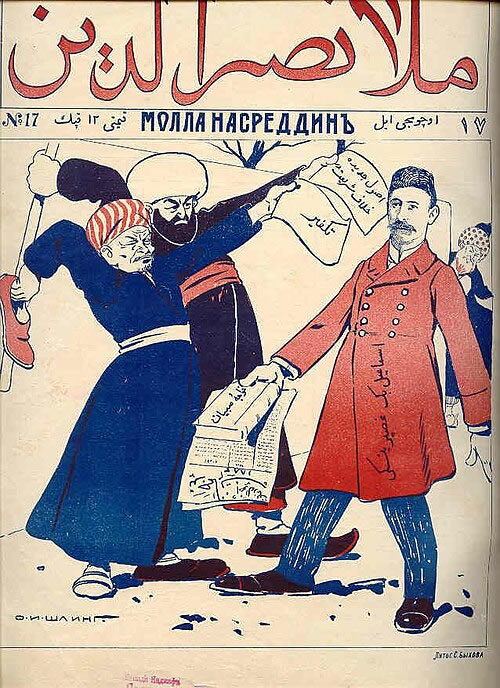
Art Note: Ismail Gasprinski, a Crimean Tatar Muslim reformer, stands at the right of the composition, holding Tercüman, the newspaper he published, and his schoolbook used by the Jadid movement he inspired, while two clerics lunge toward him. They display signs declaring his Jadid “New Method” contrary to Sharia and him an apostate. Published in the Azerbaijani-language satirical magazine Molla Nasreddin. Political cartoon, Molla Nasreddin, no. 17, Tiflis, April 28, 1908. Artist: Oskar Schmerling. Public domain; image via Wikimedia Commons.
Critical Thinking, Not Apology, Is the Way Forward
To sum up, the Ottomans made a historical mistake. The ten reasons Müteferrika offered in support of the printing press were not unique to 1727. They could just as well have required the establishment of a Muslim-run printing press in the late fifteenth century, when the first Jewish-run press was established in Istanbul. Trying to justify that historical mistake in the twenty-first century by arguing that the Ottomans adopted the printing press only when they truly needed it discourages us from learning from history critically and comparatively. This essay reveals a particular irony in the Ottoman Empire for postcolonial historians who try to defend the Empire to avoid stereotypes rooted in European colonialism. The Ottoman sultans and ulema who ruled for three centuries without showing interest in adopting printing technology were not colonized subjects but could be considered colonizers of Eastern Europe all the way to the gates of Vienna. Hence, postcolonial scholars should reconsider the Ottoman case as well as their own broad tendency to shield all non-Western societies to avoid Orientalist perspectives. The broader lesson of the essay extends beyond the Ottomans’ delayed adoption of the printing press and the question of Muslim underdevelopment. It is a reminder that postmodern relativism and postcolonial revisionism can unintentionally provide intellectual resources for religious apologists. In an age of populism, scholars should be especially attentive to the political consequences of their ideas. Populist leaders increasingly appeal to pseudo-postmodern claims about “alternative truths,” while their religious allies invoke legitimate critiques of liberalism to defend authoritarianism. Postcolonial critiques of secularism, the separation of powers, and other Western-initiated institutions may enrich debates within democratic societies. Yet once translated into authoritarian settings, the same arguments can become tools in the hands of anti-secular and anti-democratic propagandists. I share postcolonial scholars’ concern about essentializing Islam or portraying Muslim societies as uniquely prone to authoritarianism and underdevelopment. Indeed, my forthcoming book examines how right-wing populists in the United States, Israel, Russia, and India similarly undermine liberal democracy through alliances with religious forces. The problem, therefore, is not Islam but the political instrumentalization of religion. Societies flourish when
independent intellectual and economic classes generate new ideas despite
resistance from religio-political alliances seeking to preserve the status quo.
Technologies such as papermaking, printing, and the internet develop in such
environments. The Ottoman experience therefore offers a lesson to any society
in which political and religious authorities try to subordinate intellectual
inquiry and technological advancement.
|

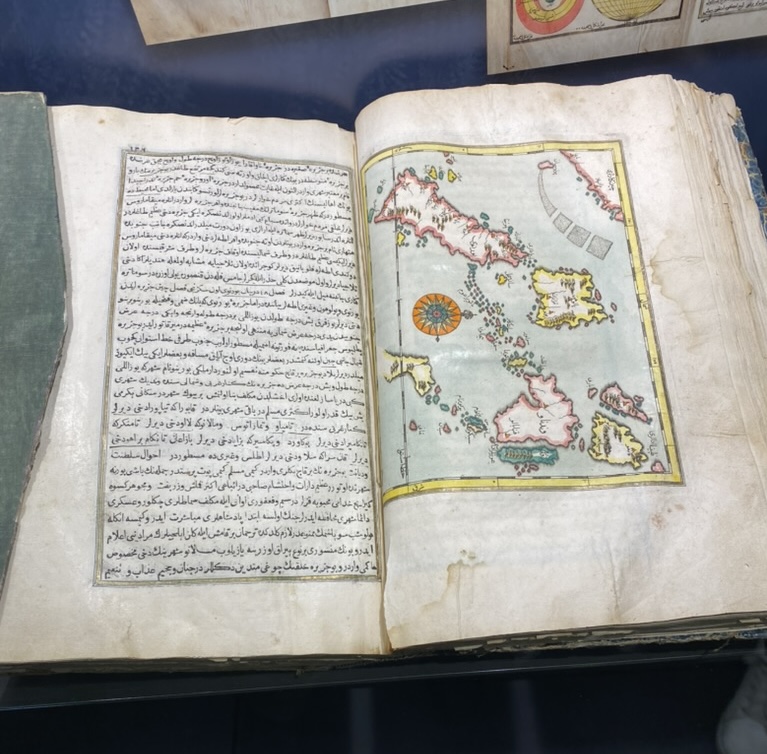
Art Note: Katip Çelebi’s Cihannüma, a seventeenth-century geography, in the 1732 edition printed in Ottoman Turkish at İbrahim Müteferrika’s press in Istanbul, the first Muslim-run press in the Ottoman Empire. It appeared three years after the press’s first book. Gazi Husrev-beg Library Museum, Sarajevo. Photo by the author.