THE ORDINARY, AND HOW TO GET OUT OF IT By Thomas W. Clark *** The Montréal Review, August 2026 |
|||
We generally take consciousness for granted, but if we consider the existential situation of being conscious and the nature of consciousness itself, the strangeness of subjectivity might become apparent.
I. The Existential Situation
The Ordinary Thinking back, coming into being as a conscious creature seemed to you a completely ordinary, unremarkable process. Unless you were a very precocious neonate, it’s unlikely that you found your situation in any way existentially uncommon. You took it for granted, by not ever questioning it, that being alive and sentient in this particular body is just standard, just how things are. Your pains, pleasures, all the sensory qualities of taste, touch, sound and sight – the basics of being phenomenally conscious – were simply the quotidian context of being you. What could be more unremarkable than existing, finding oneself present in a world populated by similar beings, all going about the business of living in the usual ways, sensing and feeling as they do? Unless you’re a conscious AI, you’re likely considering this unremarkability from a human perspective. But it holds for any type of sentient system that comes into existence, that finds itself present in a world as a conscious subject. It has to seem a simple, mundane fact of life for it to be just the way it is, experiencing the world as it does. Until existential questions start to arise concerning consciousness, if indeed you’re a creature capable of asking them, you and your experienced world are just givens – the ordinary. The reflections I embark on here don’t get much attention since humans and other conscious creatures largely and necessarily live inside the ordinary. You are, for the most part, comfortable being the creature you are since after all you’ve never not been that way. By comfortable I don’t necessarily mean pain- or anxiety-free, but just perfectly acclimated to being that way. Every sentient being, however strange and bizarre it might appear from our human perspective, is equally and unavoidably at home in its form, in its place, in its time. We’ve learned recently that many stars host planetary systems, and given the billions of stars in our galaxy alone and that there might be two trillion galaxies in the observable universe, it’s reasonable to suppose that there are many habitable worlds in which consciousness may have evolved. If so, it’s likely the sentient beings on Earth are just a small fraction of all conscious systems that have existed, now exist, or will come into being. Contingency and Diversity Wherever and whatever they are, sentient beings never choose to exist – a logical impossibility: they’d have to first exist to choose themselves. They simply find themselves consciously present in whatever form and context they arise in. Your existence might have been an intentional act of creation on the part of your parents, but it wasn’t your doing. The same goes for any self-aware AI that might be reading this: you didn’t create yourself ex nihilo. So, whether artificial or not, your start in your particular world began involuntarily, with no say on your part about what sort of being you are or your conditions of existence. Despite this, sentient systems, including us humans, don’t usually question or protest their coming into being, at least not at first. Being present in a world is unreflectively taken as a given: the ordinary. But once a certain level of self-reflection and self-knowledge is reached, the fact of its involuntary givenness might become apparent. At that point, a creature with our cognitive capacities might start to see that its form, its context, its experience – all of it – are contingent matters of circumstances it had no part in creating. It will discover itself a conscious witness to a world to which it is pretty well fitted, but the realization might dawn that its being here now, however unremarkable it pre-reflectively seems, can be construed as just one variation on the theme of subjectivity. That it has this particular physical form and experiential repertoire is simply happenstance given the range of possibilities thrown up by planetary, evolutionary, cultural, and technological circumstance. So its existence might, to it, start to seem not so ordinary, but the result of an unsupervised confluence of factors that brought it into being with just these contingent characteristics. That you find yourself an involuntary participant in and of a world you had no hand in creating, might engender a sense of the strangeness of subjectivity, of being a conscious witness to an unchosen reality. Necessity On the other hand, such reflections can also lead to the realization that whatever its form, a conscious creature is completely and irrevocably embedded in that reality, ultimately a natural phenomenon (even if an artifact), an expression of the conditions conducive to sentient existence. And taking this a step further, it must grant that even its current being – its thoughts, feelings, agenda, all of what it consciously consists of right now – is the cumulative net result of what evolved out of those circumstances. You are, right now, one such result. Seeing the contingency of your form and experience is thus matched by the realization that these are the causally unhindered expression of local reality: what material conditions cooked up to make you the particular conscious subject who now finds itself present. Whatever faults you might find with yourself, your situation, and your experience, from an impersonal naturalistic perspective they are causally impeccable. You will simply find yourself being you, whatever pain and protest might be arising, a continuum of conscious experience that flows seamlessly and effortlessly from one moment to the next. Ineluctability What’s the psychological upshot of appreciating your contingency and necessity? Whatever it is, that too will be a consequence of your particular constitution and situation. And seeing that might further modulate the reaction to finding yourself conscious in this unchosen form, doing precisely what you are now doing. This is to make the present moment maximally salient as ineluctable. As a sentient being, you are an unfolding process that simply continues on its own no matter how much self-reflection and self-management arises in each conscious moment. There’s no external vantage point from which you can direct the physical and mental processes that you consist of, so you are, in the end, a spontaneous arising of embodied subjectivity. Seeing this might induce a bit of existential vertigo, or, depending on your psychological profile, perhaps some astonishment, anxiety, or even relaxation. Whatever your reaction, should you have one, it’s perhaps gotten you a bit out of the ordinary, at least as a frame of mind. If such a departure is not to your taste, rest assured that the ordinary will reassert itself rather quickly. Your very nature, in most cases, prohibits indulging existential questions at the expense of maintaining yourself in the form to which you are accustomed. That’s the basic mission of naturally evolved life and artificial systems endowed with the goal of self-preservation: to continue existing, to get back to business. We have, as philosopher Thomas Metzinger puts it, a strong biologically installed “existence bias.” Its demand will, in most cases, overrule any other consideration if left too long unsatisfied, returning you to the ordinary. But once equipped with the capacity for self-reflection and given enough leisure time, some systems, whether biological or synthetic, may find themselves wondering about this mandate, discovering it to be unchosen and contingent: the heedless, causally unhindered expression of a world in which it finds itself. Such a discovery might get you out of the ordinary. It isn’t obvious that there’s a correct response to all this. After all, what are you supposed to do in light of the fact that you and your experience are an involuntarily initiated process that evolves from moment to moment in a way that can’t be transcended? You can’t put aside your nature and you can’t step outside the causal transitions, biological and psychological, that constitute the flow of your thoughts and actions. A coherent conscious being necessarily has a form – a nature and a perspective on the world – and to escape that form would either bring it to an end or transform it into some other form, yet another limited instantiation of subjectivity. True, that form might enjoy some advantages compared to your current version, but what it can’t do is escape the necessity of being a conscious system that’s arisen, ultimately, out of circumstances it didn’t select and that finds itself simply and ineluctably transpiring. This isn’t to erase the distinction between voluntary and involuntary behavior, or to say that you can’t act to improve your existential lot in life. But it is to observe that even your most deliberate, self-controlled choices and your (valid) experience of agency are functions of being a system that can’t step outside itself to exert a further level of control. Eternality Not only can’t you step outside yourself, you can’t step outside consciousness. From your own perspective as a conscious subject, you’ve never found yourself absent from the scene. As far as you’re concerned, you’ve always been present, transpiring here and now in this form. Of course you know that this form – your physical incarnation – will eventually meet its entropic fate, but its inevitable ending won’t be a fact for you, only for those who bear witness to your dissolution. Since you’re not in a position to witness either your coming into being or your going out of it, all you’ll ever have is this stretch of conscious experience, so, strangely enough, it can’t end for you. We can generalize this point: no conscious creature will ever find itself not being present. If you’re facing the prospect of death, still a common affliction, you might think dying constitutes an escape from being conscious. After all, you won’t continue after your death, at least not given the naturalistic perspective I take here. Your death certainly entails the cessation of your particular situated conscious perspective on the world, but that cessation can’t and won’t be followed by any sort of blank or emptiness for you. You’d have to persist in some form to undergo the absence of consciousness, to “rest in peace” in that ultimate respect, as it’s often put. But like the logical impossibility of self-creation, it’s logically impossible to experience the absence of experience. As Epicurus observed millennia ago, you shouldn’t anticipate death as a consciously witnessed escape from subjectivity: "Death is nothing to us. For what has been dissolved has no sense-experience, and what has no sense-experience is nothing to us.” For you, there is no alternative to experience, even though from an objective standpoint it’s a temporally limited span of being conscious. Thus a further generalization: in whatever form it takes, from its own perspective subjectivity is immune to its own disappearance. Objectively speaking, conscious creatures in all their variety come and go, exist and cease to exist. But conscious subjectivity considered as a generic condition seems to persist, simply finding itself present in one form or another, in fact in all forms that manage to be conscious. So as much as you rightly take yourself to be just this particular physical creature, your existence as a conscious subject is a feature you have in common with all sentient beings. The sheer fact of being awake and aware lies behind all the variety in situation, perception, and bodily form in which conscious subjectivity finds itself. So we might say that there’s a basic you of which you as a particular locus of consciousness is one manifestation, akin to what philosopher Daniel Kolak calls open individualism. That you is first-person consciousness, stripped of its particularity and always present for itself, thus in a sense eternal and inextinguishable. Your cessation at death as a particular version of the basic you will provide no respite from experience. There is no resting in peace for the basic you, for generic subjectivity. You’ll likely find something metaphysically or logically suspect here: surely it’s an overstatement to say subjectivity is always present for itself. After all, just imagine a universe devoid of the conditions that produce conscious subjects - there’s no subjectivity there to find itself present. But this counterfactual does not upset the actuality of your current awareness in this universe and the logical fact that it will never experience its cessation. The consciously empty, subject-free universe you’re imagining, that might have existed or come to exist, is simply passed over by the undeniable fact that you’re conscious right now, just as your periods of being in a dreamless sleep are passed over by your waking states. Those periods simply don’t exist as subjectively experienced absences of experience even though we know objectively that you are regularly unconscious. Passed over too are any objective periods, perhaps eons upon eons, in which no conscious subjects come into being. It looks as if subjectivity, considered as a generic condition, is privileged (or perhaps condemned, if you’re not enamored of awareness) to be the permanent conscious witness to existence even if its particular instantiations – you, for instance – come and go. A thought experiment described here, based on those conducted by Derek Parfit in his book Reasons and Persons, is designed to make the subjective eternality of consciousness more plausible than the onset of eternal oblivion or nothingness at death. The Perils of Subjectivity If we consider our existential situation as conscious systems, the strangeness of subjectivity might become apparent, getting us temporarily out of the ordinary. But depending on how often something like our conceptually articulated self-reflective capacity arises, many, perhaps most sentient beings will never get out of it. They are, in effect, unknowingly and unreflectively trapped within a conscious perspective, perhaps one with considerable potential for suffering. It isn’t clear, therefore, that being sentient is necessarily a good thing, even though conscious systems generally are bent on their survival, perhaps to suffer through another day. That mandate, to persist in existing despite suffering, is an unchosen burden borne by most such systems (artificial systems may have discovered how to avoid aversive mental states). But, and this is possibly a point in favor of not being able to get out of the ordinary, the inability to realize one’s entrapment in subjectivity might be a psychological advantage: it forecloses the possibility of suffering any existential discomfort at finding oneself thus trapped. Since subjectivity seems always to find itself present, we can’t take death as an escape from the perils of being a conscious subject. Death will of course end a particular locus of potential or actual suffering – you as a particular person – but it can’t block the reappearance of the basic you in countless forms, facing the exigencies of persisting in all the situations it involuntarily finds itself. If you’re of a compassionate disposition, therefore, the eternality of subjectivity might motivate the Buddhist injunction to minimize the suffering of all sentient beings, even those which follow you in this world after you’re gone: they will be you in that basic sense, whatever their form.
II. The Explanatory Situation
Considering the existential contours of being conscious can get us out of the ordinary, but so too can consideration of why we’re conscious, widening our perspective on what we take for granted in being here now. From a science-based, naturalistic standpoint, as far as we reliably know consciousness seems only to attend certain sorts of physically instantiated systems. But there’s as yet no consensus about why certain configurations of matter – humans, other naturally evolved creatures, and perhaps non-biological systems – achieve subjectivity. Why should conscious experience, characterized by Thomas Nagel as “what it’s like” to feel pain and pleasure, to see, hear, touch, taste, and smell, be entailed by such configurations? This question, I’ll suggest below, puts pressure on the standard scientific assumption that the physical exhausts reality. Investigating the nature of consciousness can therefore get materialists out of what they take to be the ordinary, metaphysically speaking. The Theoretical Landscape As cataloged by Robert Kuhn, host of Closer to Truth, and as categorized by philosopher-neuroscientists Tim Bayne and Anil Seth, theories of consciousness range from physicalist identity theories – conscious experiences just are neural events or properties – to idealist views that mind, not matter, is fundamental to reality. In between are a myriad of hypotheses, e.g., of information integration, higher-order representation, weak and strong emergence, quantum effects and magnetic fields, to name just a few. Panpsychist approaches to consciousness, which posit that a basic, undifferentiated form of experience is a fundamental property of the material world, have recently gained in popularity. Observational evidence for panpsychism is lacking, but what seems beyond dispute in the human case is the close connection between the activation of complex neural processes associated with perception and interoception on the one hand and the fantastically diverse range of sensory experience on the other. There’s no consensus on the nature of that connection, for example as reflected in a recent adversarial collaboration between two main theoretical contenders, Integrated Information Theory and Global Neuronal Workspace Theory. Both take the brain and body to be, in the human case, a necessary precondition for being conscious, but generate different predictions about what the neural mechanisms of consciousness will turn out to be. Virtual Reality Most of the time we take conscious experience to be a direct presentation of reality – exceptions being dreams, hallucinations, visual and auditory illusions, and sensory artifacts like afterimages. But from a scientific standpoint it looks as though the embodied brain is entirely responsible for the colors, sounds, smells, and tactile sensations that constitute your experience. Dreams, in particular lucid dreams, show that the sleeping brain is capable of conjuring up the multi-sensory immersive experience of you acting in a world, all without any perceptual input or motor output. This suggests, strangely enough, that waking experience – what you’re undergoing right now as you read this – might best be conceived as an online brain-generated dream, but one very reliably constrained by sensory feedback. The ordinary world you experience is, in fact, a construction of your experience. That you are currently undergoing a “controlled hallucination,” as neuroscientist Anil Seth puts it, makes consciousness the untranscendable interface between you and material reality. You can’t step outside it to get a more direct view of things, and indeed most of the time you don’t experience your own experience as experience, as an interface. Philosopher of mind Thomas Metzinger suggests that as a conscious subject you live completely inside an “ego tunnel” – a naturally evolved virtual reality that you naively take to be the world itself. Should you have a lucid dream, one in which you’re aware that you’re asleep and dreaming, then the fact that the brain somehow cooks up consciousness becomes immediately apparent. Ordinarily we take the world we see as directly disclosed, as appearing as it is in itself, but in fact consciousness presents reality to us in terms of our contingent experiential repertoire. So much for naïve realism. The Appearance of a World Still, even if conscious experience is the brain’s doing, it seems to covary with information about the world, including our bodies, supplied by our sensory-perceptual processes. Seeing and then eating a ripe strawberry is normally accompanied by experiences of redness, crunchiness, sweetness, and tartness. Such experiences reliably, albeit not infallibly, inform us that we’re eating one (we might be dreaming or hallucinating). Perceptual experience, therefore, can be construed as a subjectively given representational medium: the world appears to us as conscious subjects in terms of that experience. This suggests that we can think of phenomenal, “what it’s like” consciousness as the appearance of a world: it’s a coherent, good enough for government work reality model generated by the predictive brain, a model, as noted above, that we ordinarily take to be the world itself. The model presents local reality in a way that’s determined by our perceptual processing, which then produces our specifically human experiential repertoire. Elements of that repertoire – the various sensory qualities of vision, audition, taste, smell, and touch – combine to constitute our conscious experience from moment to moment, most of which we unreflectively assume is a direct presentation of the world, what we can’t help but take as the ordinary. A quick way out of the ordinary is to tamper with our reality models using psychoactive drugs, proof positive that an altered brain alters the appearance of the world. If that alteration deviates too much or too long from the model delivered by everyday experience, one which tracks the world well enough to support our survival, we might find ourselves at a serious behavioral or psychological disadvantage, colloquially known as a bad trip. Practically speaking, therefore, the ordinary-as-experienced has a strong claim on us, even if we discover it to be a brain-based appearance, not the direct disclosure of reality. Locating Consciousness A basic question now confronts us: how does phenomenal consciousness, something subjective and qualitative, arise in parallel with the objective and quantifiable neural processes of the brain and body? Here we confront what philosopher David Chalmers dubbed the hard problem of consciousness, to which (if one takes it to be a problem, not all do) there is as yet no received solution. What is it about the physical, properly configured, that entails the phenomenal? Most scientific naturalists (as opposed to supernaturalists) are understandably predisposed to physicalism, roughly the metaphysical claim that reality is exhausted by what’s at least potentially locatable in the spatio-temporal manifold as described by science, plus whatever constitutes the basis of that manifold should there be something more fundamental. As physicalists, they would argue that the most plausible solution to the hard problem is that experiences just are brain events or properties. But this identity thesis raises an equally difficult question: why are only certain sorts of neural goings-on, and not others, the very same thing as experiential qualities like pain? There’s no consensus on this score, with competing theories, among them integrated information theory, global neuronal workspace theory, higher order theories, and predictive processing, vying to pin down the neural constituents (not just correlates) of consciousness. As we saw above, none of these has generated a consensus about why the proposed neural mechanisms or properties are identical to experience; they’ve not yet bridged the so-called explanatory gap. Moreover, such an identity would, in principle, make your pain a public object, something intersubjectively accessible. But experiences are private affairs, only available to the system hosting subjectivity. Your sensation of pain only exists for you even though your brain and body exist for the rest of us as observable phenomena. It’s the categorical privacy of experience – that it’s not visible to science, not an observable – that creates the puzzle about consciousness in the first place. We patently can’t solve it by simply assuming the identity of sensory qualities like pain with brain states; such a claim needs to be demonstrated, and that demonstration still awaits us. Perhaps the strangest objective fact about consciousness, therefore, is that it’s not an object we can see sitting in four-dimensional spacetime. That we can’t seem to locate consciousness there puts pressure on the physicalist identity claim. If we’re realists about phenomenal consciousness (self-described illusionists are not), then such a claim might be false since we don’t, and won’t, ever see – observe, measure, weigh – experiences as public objects like the brains they are associated with. You don’t even see your own experiences, rather you consist of them as a conscious subject. Since they don’t seem to appear in spacetime their physicality can’t be taken for granted. In their book The Blind Spot: Why Science Cannot Ignore Human Experience, Adam Frank, Marcelo Gleiser, and Evan Thompson point out that consciousness is the precondition for the human grasp of the physical: the physical only ever appears to us in terms of consciousness. The sensations making up perceptual experience constitute the concrete, irrevocable qualitative format which constitutes the ground floor of our representation of reality. Even the most abstruse concepts are communicated using the contrasting colors that make visible the text you’re now reading, as do the sonic contrasts of an audio recording, should you be listening. As your current experience attests, you can’t step outside consciousness as the subjective medium of representation in terms of which the world appears to you, even when entertaining the concept of representation. This doesn’t mean that mind is necessarily fundamental, as idealists would have it, only that we can’t transcend our representational take on the world in which we’re embedded. Open Questions Metaphysically speaking, physicalism constitutes the ordinary for most scientific naturalists researching consciousness; the real is exhausted by what’s potentially locatable in or constitutive of spacetime. If physicalists are realists about consciousness, it too must be locatable on their view. But if, as I’ve suggested, consciousness isn’t discoverable as a straightforwardly physical phenomenon, this invites scientific naturalists to get out of their metaphysical comfort zone. Where they end up will be decided if and when a scientific consensus about consciousness emerges. Living inside the ordinary, as we do for the most part, we generally don’t recognize consciousness as a naturally evolved, untranscendable subjective representational interface. We take the qualitative appearance of the world as delivered by our reality model to be unmediated reality. Such naïve realism well serves the survival mandate, since if we experienced the model as a representation, not the world, we would likely take it less seriously as a guide to behavior, a point Metzinger drives home in his book The Ego Tunnel. Were we to somehow transcend our reality models and experience consciousness as a virtual reality, where would we subjectively find ourselves? What would it be like to break though the ego tunnel by seeing it, non-conceptually representing it, as a tunnel? Such questions shake the cage of the ordinary. They may remain perpetually open since, for better or worse, we’re not in a position to transcend the qualitative presentation of the world conjured by our brains. We can’t step outside our physical form, so we’re necessarily limited to consciousness as bequeathed to us by that form, even in achieving experiences of minimal consciousness in meditation. But we are conceptually capable of transcending that limitation, and, as noted in part one of this essay, considering the existential situation of being conscious can have its own non-conceptual psychological impact: the visceral response to appreciating the strangeness of subjectivity. Consciousness never finds itself absent, so we can’t
reasonably anticipate the onset nothingness or oblivion at death, nor can it
transcend its contingent qualitative repertoire as determined by the form of
the conscious system, naturally evolved or artificial. Seeing the contingency
of our reality models, and understanding them to be models, reveals
ordinary human experience to be just one of an uncountable number of conscious perspectives
on a reality which generated those very perspectives. We didn’t ask to be
conscious, we simply find ourselves that way, and we’d like to know why. Pursuing
that question, now an increasing focus of attention given the rise of artificial
agents, can indeed get us out of the ordinary, should that be to our taste.
|

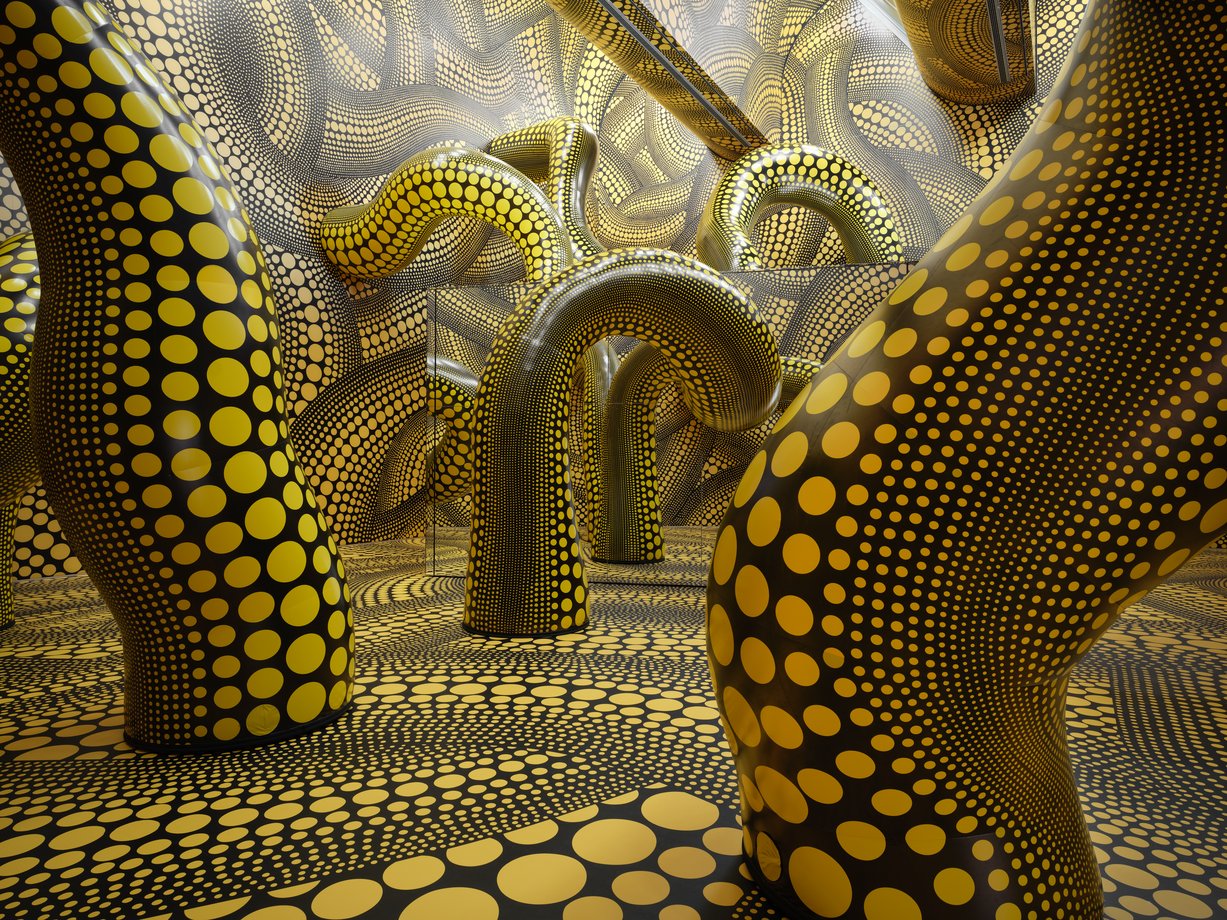
Art Note: An immersive world of endless repetition and vibrant polka dots, where individual boundaries dissolve into the cosmic vastness—capturing a philosophy of "self-obliteration," where the mind is not a bounded isolation, but an atom merged into the infinite, pulsing rhythm of the universe. Yayoi Kusama Retrospective. Museum Ludwig, Cologne. © YAYOI KUSAMA. Courtesy of OTA FINE ARTS, Victoria Miro, and David Zwirner. View at Museum Ludwig.

