NATIONAL MELANCHOLY AND ITS EXPRESSIONS By Kristjana Gunnars *** The Montréal Review, November 2026 |
|||
But we are also distant from the “melancholy” which makes itself indifferent to the world and whose immobility—alongside books and a globe—indicates the profundity of thought and the diversity of knowledge.1
It is not unusual for cultures, or entire nations, to have a word which both defines the people’s experience and also their understanding of the world. Japan has the concept of Mono no aware, for example, which is about having an awareness of the transience of life. It is a more gentle concept than Korean Han, but it contains a similar depth of sadness and emotion. In Portugal there is the word Saudade, which is about a deep longing for something that is lost or gone. The prevailing tenor of Saudade is nostalgia and longing. Shoshana Zuboff writes about Saudade that it is “a word said to capture the homesickness and longing of separation from the homeland among emigrants across the centuries.”2 In Germany the word Weltschmerz is aligned as well, but here the idea is more that the world is basically tragic and unrecoverable. There is also an individuality about the German word and it is not so much tied to the community as a whole. The Russian word Toska as well has an existential sense of anguish and longing, but is also connected to individual experience more than to community sorrow. China has the word Yuan which actually does connect to historical grievance but is not as diverse a concept as the Korean one. All these words portray something all members of the community recognize and which describes something important about life and culture where those in the community live.
National Melancholy and its Freudian Background
Russia is known for its tradition of mystical suffering, which is deeply embedded in its historical thought. As Julia Kristeva points out in her discussion of the writer Fyodor Dostoyevsky, there exists “the old Russian mystical tradition that glorifies suffering as a sign of one’s humanity.”3 In fact, suffering is “the essential feature of his outlook on humanity”4 and that derives directly from Dostoyevsky’s culture. She provides the following quotation from Notes from Underground:
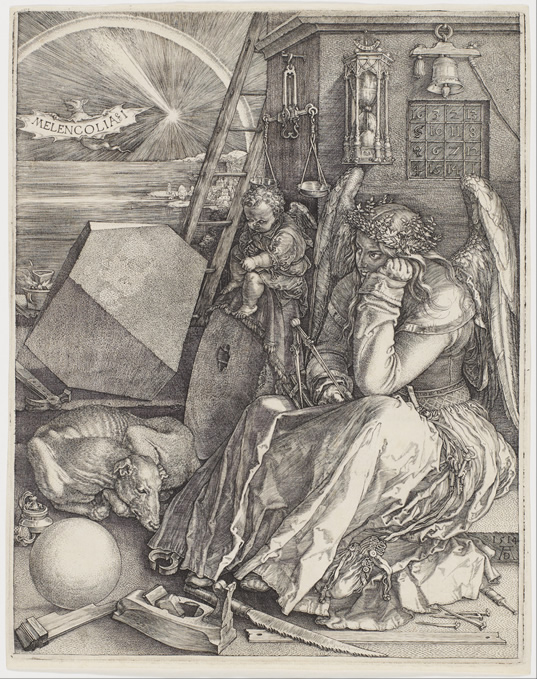
In this novel a certain psychological truth is given attention, which is that suffering may create a feeling of distinction in the one who suffers; a sense of being special. She writes that “suffering appears as the ultimate threshold…of distinction or separation.”6 Here also there is ample reference to Holbein the Younger’s painting of the Dead Christ in his Tomb. The European Christian fascination with the suffering of Christ, and with suffering in general, is marked for special pathos throughout the continent. Holbein the Younger’s painting shows “absolute solitude” and absolute abandonment.7 Such emptying out of the psyche is both terrifying and ironically soothing, since suffering itself excuses the sufferer from all commitments and there is a kind of deathly freedom in that. Other cultures have their own forms of melancholy which give rise to poetic works of literature and film,8 like Duende in Spain, often thought of as “emotional darkness.” We can consider the Portuguese word Saudade, which refers to melancholic grief, loss and longing for what may be forever lost, and Portuguese Fado music, which depicts an anguish of grief at times not unlike p’ansori in Korea and which has been popularly described as “the saddest music in the world.” A Nordic form of melancholia occurs in Scandinavia, seen for example in the films of Swedish director Ingmar Bergman, which are loaded down with a hard sadness that is impossible to be relieved of. A good example of Nordic melancholia is the Icelandic early 20th century poem “Bikarinn” (“The Goblet”) by Jóhann Sigurjónsson,9 which, like the poem “Azaleas” in Korea, is known to most Icelanders and captures a deeply held cultural spirit. The poem expresses the way the individual is burdened by his own life, and there is an inability to forget the sadness of it. Anne Anlin Cheng has talked about something she calls “American melancholia” which exists because “America is founded on the very ideals of freedom and liberty whose betrayals have been repeatedly covered over.”10 The more classical conception of European melancholy as defined by Sigmund Freud is that melancholy is “a state of unfinished mourning. Freud suggests that the subject can’t or is reluctant to replace the lost object; rather she internalizes it as part of her ego, so that the self emerges from and is constituted by loss.”11 Throughout Western history, melancholy has been depicted variously as both mental sloth and mental genius, creative power and creative paralysis, and it has associations with both beauty and geometry. The ideas propounded by Sigmund Freud are critical to an understanding of the conceptualization of melancholia and mourning in the 20th century in the West, and those ideas have exported themselves around the globe. The fact that Freud pathologizes melancholia has been immensely powerful in the Westernization of the rest of the world. Freud claims in his essay “Mourning and Melancholia” that mourning is a natural state suffered after an important loss, while melancholia is a pathological state that needs curing because the melancholic person is trapped in a tangle of transferences without end. The person in mourning, while not “sick” that way, is nonetheless caught in “clinging to the object [that is lost] through the medium of a hallucinatory wishful psychosis.”12 There is a condition of “pleasurable pain” or “painful pleasure” or, as Freud puts it, “painful unpleasure.”13 The main difference between mourning and melancholy for Freud is found in the issue of self-regard. The melancholic suffers a diminution of self-respect or self-regard, while no such thing happens to the mourner. The melancholic therefore experiences “an impoverishment of his ego on a grand scale.”14 It is this bruising of the ego that makes melancholia dangerous to the 20th century eye. The self-criticism that follows the onset of melancholia extends to the past, so the sufferer’s entire past becomes contaminated by the present state of mind. This melancholic person is continuously in need of reinforcement from others, and is caught in a tangle of needs he himself cannot fulfill. One interesting argument proposed by Freud is the splitting of the ego that takes place for the melancholic person. In the loss of self-regard, the melancholic ends up attacking himself, so one part of the ego splits away in order to attack the other. Freud calls this the splitting off of the “critical agency” from the ego.15 In the West this is conceived of as grounds for a kind of paranoia, where the “enemy” is actually within and self-criticism runs through Western culture like a thread, with the purpose of eliminating all traces of melancholia at all costs. The idea of having a “conscience” is tied into this, because the self-criticism involved is a moral act. Freud argues, in fact, that conscience itself can become “sick,” so even the moral framework is unstable and you can have a “bad conscience” as well as a “good conscience.” Among the transferences that occur in this uncomfortable situation is the reality that the melancholic may transfer his self-criticism to a criticism of the loved object instead, so what the other is criticized for is really the melancholic’s criticism of the ego-self. There is a confusion of love-hate, in that what the sufferer criticizes most harshly may be a transference that signifies love instead.16 Pathologically, however, the self-criticism of the melancholic may become so severe that it leads to suicide.17 Here we find the whole notion of suicide aligned with being “sick,” or with the pathologization of suicide itself, which takes away any and all relation to poetic justice or sacredness which we find in the discourse on suicide in many places in the East. Or else, if not suicide, the Freudian melancholic will transfer his self-hatred to others and it may become a form of sadism and turn violent. Therefore the melancholic may end up “tormenting their loved one through their illness.”18 These psychic movements are what Freud calls “transference neuroses.” At the bottom of those neuroses, he asserts, is “the fear of becoming poor,”19 so there is an economic background to melancholia which helps explain things like “greed” and “hoarding” and the general admiration for wealth which in the West has even been sacralized with the Calvinistic idea that the “chosen” know they are chosen by their personal wealth, which has been bestowed upon them. But in fact, this admiration for wealth is a product of unwanted melancholia which has become neurotic. So while melancholia is characterized by a muted emotional state, it may also change into a mania as a result of the intensity of the neurotic needs that develop. This situation Freud calls a “circular insanity”20 and it is circular because it has no end. Therefore an explanation of melancholy has to include an explanation of mania. The manic person has in fact liberated himself from the lost object that caused the melancholy in the first place, but is now “ravenously hungry” for a new object.21 Melancholia is therefore more complex than mourning, and is caught in its own contradictions of needing to be rid of the attachment to what is lost and at the same time needing to cling to it. The trauma surrounding the lost object in the first place also reawakens all sorts of other repressed material, so melancholy is a site of all manner of sins and diseases and suffering. The anger at the self that is transferred to the loved object results in all manner of judgmentalism and violence, and we have a treasure chest of ambivalence, regression, libido, ego and narcissism to contend with. As we can see, the 20th century notion of melancholy in the West in general is highly charged with negativity and pathology, which kills off and negates more nuanced and aesthetic or spiritual views of this state of mind. There is, as a result, a serious anti-Freudian movement in theorizing melancholia that has since arisen, and the present essay may possibly be part of that trend. One of the traditional focal points for European historical melancholy, both its symbolic, metaphysical and rational, allegorical presence, is Albrecht Dürer’s 1514 engraving Melencolia I. Volumes have been written on this engraving, which depicts a “woman with wings” sitting sadly among a multitude of carpentry tools and instruments of geometry, mathematics and engineering, while a bat-like figure flies past above. All the symbolism and allegorical significance has been studied, but on a simpler level you could state the obvious, which is that this is an angel among the instruments of human knowledge. She is sorrowing because the path of the “fruit of the tree of knowledge” has, like a bat out of hell, taken us down the wrong highway and towards the destruction of creation. Another iconic work of art that depicts the depths of melancholy in Western art is, again, Hans Holbein the Younger’s (1497–1543) painting The Body of the Dead Christ in the Tomb. This painting depicts Christ as a corpse enclosed in the tomb, which is long and narrow and dark. There is nothing about this figure which indicates divinity or impending resurrection; this is just another corpse. Julia Kristeva has written about this painting that it shows the “isolation…that endows the painting with its major melancholy burden.”22 He is “inaccessible and distant”23 as are melancholy people in general. Holbein here “forces upon the picture the weight of human grief”24 and it is an “extreme manifestation[s] constituted by pain and melancholia”25 which shows “the coldness and emotional paralysis of the melancholy person.”26
Albrecht Dürer, Melencolia I, 1514
Hans Holbein the Younger, The Body of the Dead Christ in the Tomb
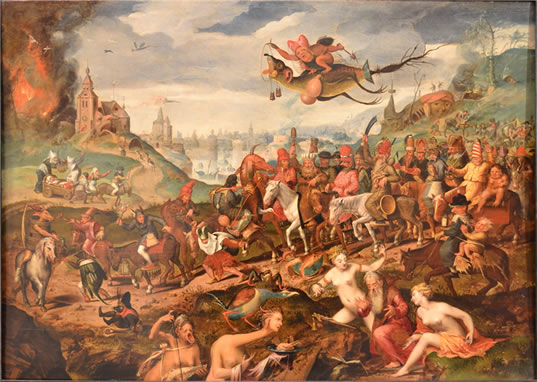
A third work of Western art that depicts a form of melancholy which resembles Korean Han more than the other works is Pieter Brueghel the Younger’s painting La Tentation de Saint Antoine, from 1600. Here Saint Anthony is seen kneeling before a large open book while around him all the torments of humankind, and possibly his own past, play out in full detail. He is surrounded by monsters and he clings to his reading of Scripture to stay focussed and detached and unaffected by memory and guilt and sorrow. There is quite a lot of suffering evident through the depiction of the surrounding monstrosities, and consequent sorrow, because it looks like the bestiary around him has taken over the whole canvas. At the same time, while “sins were in his heart and sorrows in his mind,” he has effectively extracted them from himself, or objectified them, and turned them into objects of contemplation.27 Michel Foucault, in his discussion of this painting and of Gustave Flaubert’s The Temptations of Saint Anthony (1849–1857) in his essay “Fantasia of the Library,” traces a line of thinking that can be seen in the writings of Nicola Masciandaro:28 Foucault suggests that Saint Anthony, by objectifying the monstrosities of the mind and turning them into material visions, is descending “to the very depths of matter, to become matter.”29 What is in the mind, that which causes grief, pain, sorrow, melancholy and also Han, is materialized and therefore removed from the thinker. At the same time, sadly, that movement of transferring thought to matter is not enough: “neither a living grave nor a walled fortress are sufficient protection.”30 So what will protect Saint Anthony from his sorrows? This remains an enigma. Perhaps his mistake, as Foucault suggests, is that “he wished to be a saint through a total deadening of his senses, intelligence, and emotions,”31 and that is not the way, the painter is suggesting.
Pieter Brueghel the Younger, La Tentation de Saint Antoine, 1600
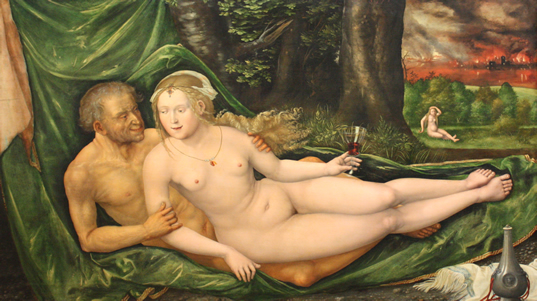
Germanic Romantic anguish and melancholia are the most visible of Western forms of sorrow, and are delineated in part by Freud’s analysis. Western melancholia has its roots in individualism rather than collective thinking, which may constitute the greatest difference between European and Asian forms of depression and sorrow. The most iconic image of Germanic melancholy is still the figure of young Werther in Johann Wolfgang von Goethe’s 1774 novel The Sorrows of Young Werther.32 This novel is important in the German Sturm und Drang movement of the late 18th century, characterized by extreme emotion acted out with severe subjectivity and often motivated by greed. Germanic Romanticism is invariably anti-aristocracy, anti-nationalist, anti-rationalist, and it focuses on the emotions of the individual only. Interestingly, there is a connection between Sturm und Drang and the American Revolution, and it could be said many of the characteristics of German Romanticism are present even in contemporary American anti-authority movements which are also highly individualistic.33 Goethe’s Werther is a talented young man of good education and intelligence, who is caught in his own emotions to an extreme degree. He is emotional to the point of despair and gives himself over wholly to his feelings so he is unable to see a world outside his own emotional bubble. He finds himself in a distressing love triangle, being in love with another man’s wife, and in his despair decides one of the three has to go, so he sacrifices himself in a dramatic way. But in killing himself he also destroys those who love him, which he is unable to consider in his emotional narcissism. He is fundamentally and totally alone in this mixture of passion, despair, longing and emotional insanity. In fact, Werther counsels complete apathy when he says “there would be less misery in the world if man were not so ever ready to recall past evils, and instead put up with an apathetic present.”34 Ultimately his selfishness is foolish, and he knows it, saying “If I were not such a fool, I could be leading a happy and delightful life here,”35 but he is driven by personal demons—“a demon that pursues and harasses me wherever I go”36—to self-destruction. German Romanticism is also a desire for risk; Werther confesses “what is the use of precaution? We can never be on guard against all possible dangers,”37 and it is also a view of death, in that death is preferable to personal sorrow of a certain severity: “For it is certainly easier to die than to stand up to a life of torment.”38 Reality itself becomes for him, and only him, “nothing but an eternally devouring monster.”39 There is also a heavy fatalism in this Romanticism, such that you are destined to follow your fate regardless of where it leads you, and all of nature will conspire to take you there. The Romantic movement in Europe, which started in the 18th century and is to some degree still around today, is heavily focused on human emotion rather than reason. Emotions are also subjective, so Romanticism is a philosophy of individualism that rejects the intellect in favour of feeling. Sam Han draws a link between this emotional focus and the Han of the minjung in Korea. Han is often described as an emotion, and it is also not something that can be dealt with through reason alone. There needs to be ritual and even spirituality to confront Han. Here we come across the idea of what “the Age of Reason” has given us, which is that Reason is put on a higher plane than Emotion. But Sam Han refers to Lauren Berlant when arguing that feelings are “not less than thought.”40 There is no reason to think feelings are less valuable “because of their seemingly expressive immediacy.”41 We can think of this in relation to what has been seen as the excessive emotionality of Korean people—the tendency to cry, the overt expression of grief and sorrow—and consider the way in which we have signed up for the “denigration of feelings” in favour of Modernity’s reliance on rationality (Sam Han 2021, 4). So emotions become part of the paradigm that critiques Modernity, progress, neoliberalism, capitalism, individualism, in favour of collective thinking and a spiritual existence that allows for the presence of Han. On the more universal side, Andrew Sung Park42 points out some of the major figures in the history of pan-human Han, in his effort to make a case for Han being associated with Sin and therefore being everywhere. He talks about Elie Wiesel, a survivor of the Holocaust; Violet Masuda, interned with the Japanese-American community during World War II; Soe-Ryoeng Kang, victim of the A-bomb in Japan, where many Koreans were located (about 667,000 Koreans were in Japan at the time); and an American incest victim named “Virginia.” All these people suffered serious trauma in different places in the world, which to Park amounts to Han. In saying this, Park makes Han and trauma almost interchangeable. Park is also suggesting that the Korean word Han could actually cover all the different forms of melancholy we find across the globe. Perhaps the most iconic figure of Modern times in the West as far as historical melancholy goes is the German-British writer W.G. Sebald. His four novels, The Emigrants, Vertigo, Austerlitz and The Rings of Saturn are studies in melancholy and historical trauma. The narrator in all these books is despondent as he observes landscapes, city scapes and people who have been ruined by war and genocide but lived on in a kind of “death in life.” There is nothing the narrator can do about anything he sees, so he is a helpless observer who takes on the sorrow of others and the shame of belonging to a nation of people that has tortured and ruined entire communities and colonized entire countries and regions, taken slaves and traded in stolen treasures. The narrator listens to the stories of ruined people, living among ruins in their ruined lives. The novel Austerlitz concerns a man who had been part of the Kindertransport of Jewish children sent from Prague to Britain at the time of the Second World War. Later in life he learns who he is, his real name, and what happened to him, which makes him unrecoverably sad. He tells the narrator: “I have always felt as if I had no place in reality, as if I were not there at all.”43 It is a sick and ruined world in the eyes of the Sebaldian narrator who goes through all four of his major works. He travels in a meandering way through Europe and England visiting locations that relate to some aspect of his own personal search, and the answers he finds to his questions are inevitably sad and tragic. At first glance all four narratives seem unhappy and joyless, although many have pointed out the frequent instances of humour and there are also a few instances of joy. But these are buried under what is the rubble of Western civilizations after a tumultuous century. In the narrative of Paul Bereyter in The Emigrants, the speaker expresses the psychological impasse of late 20th century Europeans: he confesses that “day by day, hour by hour, with every beat of the pulse, one lost more and more of one’s qualities, because less comprehensible to oneself, increasingly abstract.”44 Firm ground is gone; certitude is gone; identity is gone. Nothing remains of the characters and the narrator but a vast chasm of sorrow for what the European civilization has come to and the disorienting burden of guilt that follows. Such is the case when reality is looked straight in the face. When you do not deceive, fantasize, project or mythologize your relationship to the past and to the damage done either to you or by you, you get a Sebaldian tone. Readers themselves become affected by Sebald’s writing and a dark cloud hovers when his work is read with sincerity. If Andrew Sung Park’s theory that Han belongs to the victim, and Sin belongs to the perpetrator, is brought to bear on all these forms of melancholy, when considering Sebald it seems clear that the binary of victim/perpetrator may be too simple. What we learn from the world of Han and related worlds of depression and melancholy when seen against the backdrop of history is that none of these categories are pure. Perpetrators of traumatic situations themselves become victims of what they have done. You can be your own victim as well as your own agent of harm. Likewise, you can as a victim commit harm in return, which is what revenge is all about. Han and Sin are intertwined in unexpected and also unlikely ways. As is often quoted from the New Testament, because of its enduring truth value, “He that is without sin among you, let him first cast a stone at her” (John 8:7). A couple of stanzas from W.G. Sebald’s poem “Dark Night Sallies Forth”45 might serve well to end this reflection on the conflagrations of history, the need to forget and the need to remember, the connections we have down through the generations to the suffering of other people, and the sorrow that threads through the centuries which are inherited by later generations without knowing what it is they are feeling. That is how historical melancholy crawls its way through the centuries, driving us mad in the process, and that is how something like Han accumulates. When the poet sees a painting by Altdorfer depicting Lot and his daughters, with a large city in flames in the background, he recalls:
Albrecht Altdorfer, Lot and His Daughters
Here the narrator has discovered that his parents have obliterated all memory of what was done during WWII. Any acknowledgement of complicity or responsibility is absent. He understands this means there will never be an actual “recovery” from what happened and therefore it is likely to happen again. There emerged at the end of 2022 a large volume on trauma and its effects on the health and well-being of individuals and communities living in Neo-liberal Modernity and under the umbrella of Globalization. This is Gabor Maté’s book The Myth of Normal,46 which I see as a late-Modern answer to Robert Burton’s The Anatomy of Melancholy (1621–1651). Burton’s volume is ostensibly about melancholia and medical knowledge, although it is regarded as a literary work in its own right as well as a treatise which sees all of history up to then through the lens of melancholy. Gabor Maté’s book has a similar focus but a different method and is entirely intersectional in that it looks at depression and trauma in relation to history, environment, economy, psychology and medicine. The interesting thing about Maté’s conclusions is that he calls for a renewed regard for traditional healing methods and ways, especially solutions of traditional indigenous peoples. It is as if he acknowledges that Western medicine has reached its satiation point and can go no further with the practice of separating mind and body, environment and health, and viewing human physical life in a mechanistic way. The human mind and body is not a machine; it is a living organism which is part of a larger living organism that comprises the entire earth—if not the universe. How we heal from trauma and its destructive effects is very similar to how Korean discourse has conceived of healing from Han. It is not possible to avoid, deny, suppress Han; instead, as I have tried to show in this essay, it is necessary to go through the experience of suffering and melancholy and come out on the other side with renewed, deepened wisdom. As Gabor Maté would readily agree, and as Francisca Cho has described Buddhistic thought, out of which Han largely springs, “the real view of Buddhism is that mind and matter cannot be independent of each other. Mind is itself matter (emptiness is form), matter is itself mind (form is emptiness).”47
Kristjana Gunnars, Mountain Rain
Conclusion
Reasons for bringing up the “spectre” of Sigmund Freud in the context of national melancholy and its linguistic signs are that Freud’s conjectures provide a frame around which we can better understand forms of extremism. National melancholy can produce beautiful cultures and languages, but there are also extreme outgrowths and byproducts that cannot be overlooked. The argument is that on an individual level, a person experiences melancholy when there has been a loss, but it is not clear what the lost object is. Since the object is unknown, it cannot easily be replaced so melancholy endures indefinitely. Instead of replacing a loss with something equivalent, the melancholic person sublimates with other things or objects or behaviours. This loop happens on a community or national level as well. A whole nation of people who have experienced an important loss will develop cultural ways of acting out the resultant melancholy. As Freud has shown, such acting out can be both violent and unreasonable. Combined with the series of mental loops that produce forms of fetishism, such melancholy can be both romantic, sentimental, violent and dangerous. There is a strong desire to “return” to times past even though no one knows what those times were. There is a fear of contamination from outside forces even though no one knows what or why contamination is perceived that way. “Purity” as such, both historical and racial as well as cultural, becomes a fetish. This kind of desire can never actually be fulfilled, so the melancholy sets in as a cultural phenomenon and linguistic and creative signs are produced around it, such as dance, music, and plastic arts that express a human longing for something better and cleaner than what there is. As such, cultures can cling to their melancholy with more ardour than they could show for a project of seeing reality for what it cannot help but be: insecure, mixed, hybrid, uncertain, and mysterious.
|

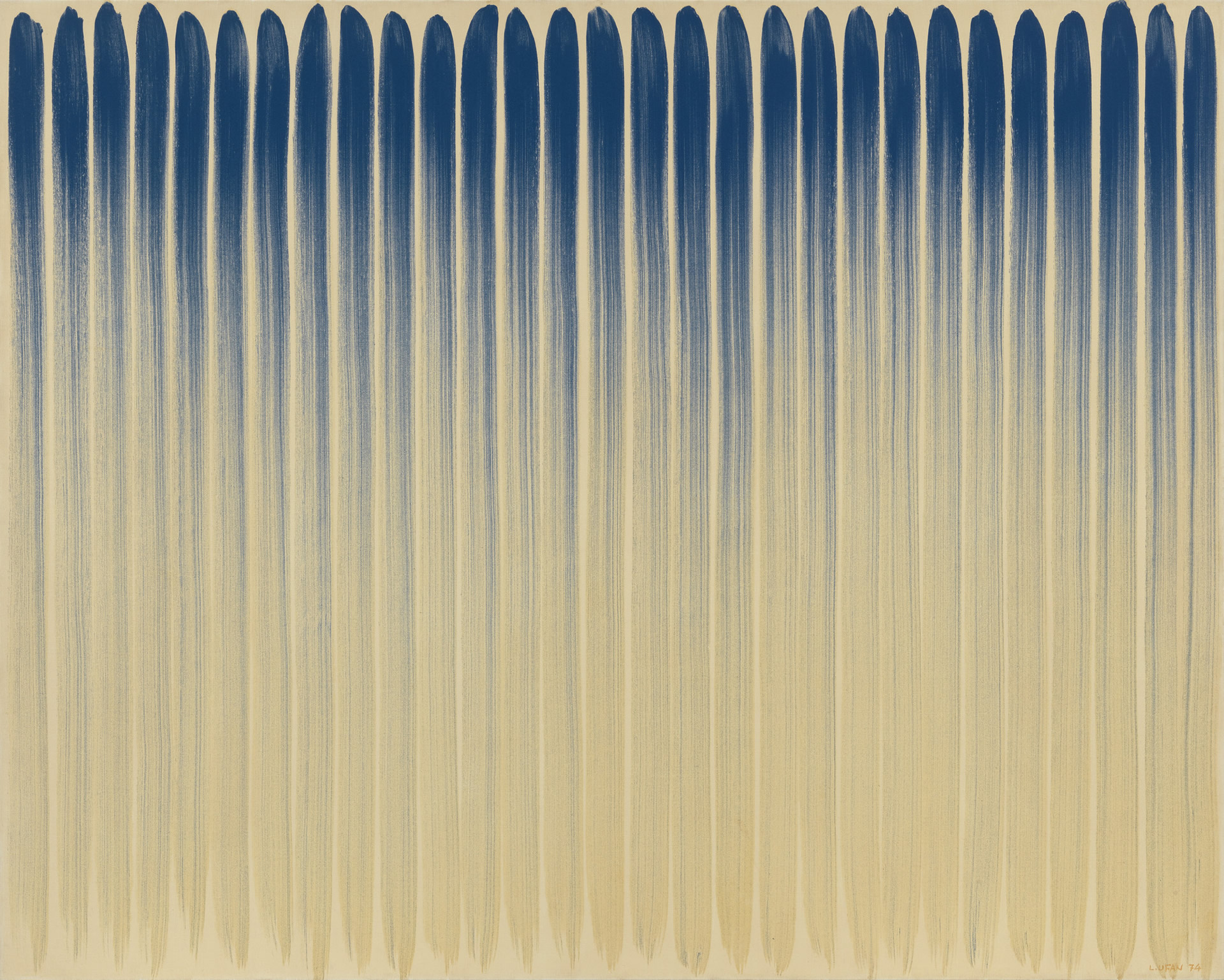
Art Note: From Line, Lee Ufan, 1974. Twenty-nine strokes of blue, each pulled once down a canvas laid on the floor. The brush is loaded a single time, and every line ends where the paint does. Lee Ufan, winner of the 2026 Wolfgang Hahn Prize, is showing new work at Museum Ludwig in Cologne until April 4, 2027. Oil on canvas, 181.6 × 227 cm. Collection The Museum of Modern Art, New York.