WHY THE IRAN “STRATEGY” HAS FAILED By Christopher Thornton *** The Montréal Review, August 2026 |
|||
It wasn’t supposed to be this way. If we return to February 27, the day before the first joint U.S.-Israel attacks on Iran, a rosy prognosis from the American administration went something like this: after two days, maybe three, a week at most, the Iranian people would take to the streets, and under the pressure of overwhelming bombardment from above and an upswell of revolution from below a brutal regime that had been firmly in place for 47 years would breathe its last. A moderate, Western-friendly government would replace it and usher in a new chapter in Iranian history, welcomed with unending gratitude from the Iranian people. We might recall the Russians’ predictions of how the invasion of Ukraine would go: within three days Russian troops would march into Kiev and be greeted with flowers by mobs of jubilant Ukrainians. A neo-fascist government would be toppled and President Volodymyr Zelensky would be handed over to the Russian occupiers. That was over four years ago. When the U.S.-Israeli strikes on Iran didn’t quite turn out the way they had planned there was much speculation over what might be needed to “complete the mission.” The mention of a ground assault raised sceptical eyebrows, and efforts to draw in European allies were met with stern and cold rebuffs. Five months later the war has devolved into a frozen chessboard with neither side with a decisive move. There is no doubt that the U.S. and Israeli forces have severely crippled Iran’s military, yet it still continues to fire missiles into Israel and at “American interests in the region,” shorthand for the sprawling military presence the U.S. has maintained with its Arab allies and only expanded over the years. The Strait of Hormuz has been closed, though some ships have slipped through during brief interludes, yet rising oil prices have thrown the global economy into disarray. “Iran has always had a nuclear option, and now it’s using it,” Marwan Bishara plainly, simply, and accurately commented on Al Jazeera. To make matters worse, from the American perspective, the Islamic regime is still in firm control of the country, with even harder hardliners holding the levers of power, and they represent a younger generation that came of age after the Islamic Revolution and lack the basic understanding of the West that many of their predecessors had: former president Hassan Rouhani took up postgraduate studies at Glasgow Caledonian University in Scotland and earned a PhD. Former foreign minister Mohammed Javad Zarif holds a PhD in international law and policy from the University of Denver. The head of the Atomic Energy Organization, Ali Akbar Salehi, earned a PhD in nuclear engineering from MIT. Mahmoud Vaezi, the Minister of Communications and Information Technology, studied electrical engineering, earning degrees from California State University, Sacramento, and San Jose State University. Finally, Mohammad Nahavandian, Hassan Rouhani’s chief of staff, earned a PhD in economics from George Washington University. In a withering irony, when Hassan Rouhani was in office there were more cabinet members with PhDs from American universities in his administration than in Barack Obama’s. Finally, to return to the prognosis: rather than taking to the streets, the “Iranian people” gathered on bridges and surrounded electrical facilities to prevent them from being targeted by missile strikes. Whether they support or oppose the regime, all were proud defenders of their country and willing to respond to apocalyptic rhetoric that “an entire civilization will die tonight, never to be reborn.” An Iranian friend of mine who has been an American citizen for more than 30 years said to me, a few minutes after I first met him, “I’m absolutely revolted by this government”—meaning the Islamic regime— yet at another time he said that if Iran were attacked “I’d go back and fight, not to defend the regime but the country.” How did we get here? First, it had been long believed by any astute observer that Iran’s first response to any attack would be the closing of the Strait of Hormuz. And despite the mismatch in weaponry, Iran had sufficient armaments and military sophistication not to strike the U.S. directly—its leaders are far too savvy for that—but any of its “assets” within easy range, which means the military bases that were placed, in another dark irony, to police the oil-rich region and serve as a bulwark against—Iran. In the beginning it was often said, but now needs reminding—Iran is not Iraq or Afghanistan. The reasons are several and substantive. It is rarely mentioned that Iran is one of only a handful of countries anywhere—Turkey and Thailand among the others—that were never colonized, a distinction that sets it apart from virtually every one of its neighbors, from Morocco in the west to the Philippines in the east. This has had a profound impact on the Iranian mentality: Iranians are not conditioned to being dominated by another. Iran has succumbed to several invasions and occupations in its long history, but colonization? Never, and all the foreign powers that have invaded and occupied Iran have come and gone. Unlike the Arab world, historically linked through networks of tribal groups and allegiances that predate nationhood, Iran has always been a solitary island. It has never had what might be called “natural allies.” It is not part of the “Arab brotherhood,” nor is it culturally tied to India, Pakistan, or any other country in South Asia. To the north, Russia is as culturally alien to it as any country in the West. Farsi leaves Iran linguistically isolated, except to the east, where Dari, strikingly similar to Farsi, is the common language in Afghanistan. But aside from that, Farsi ties Iran to the Indo-European world, a unique branch in a sprawling linguistic tree. Faith also distances Iran from its neighbors. Zoroastrianism first appeared in Iran as early as the second millennium B.C., and though it did spread further afield it was eventually dwarfed by the rise of Hinduism, Buddhism, and eventually Islam—brought by a foreign invader. Consequently, Iran has always been a rather solitary outlier in a contentious region with no one to call on in times of trouble. During the Iran-Iraq War only two countries backed Iran—Libya and Syria, then under Alawite Baathist rule—but to little effect and only for symbolic effect—to thumb their noses at the West. Commenting on the war, a former Iranian colleague once told me, “We were begging the world for one anti-aircraft missile, and no one would give it to us.” Former president Akbar Hashemi Rafsanjani was more succinct, “What can I say—we were all alone.” To view Iran accurately is to recognize that it is not merely a nation. True, it is an independent nation and a full member of the United Nations, but culturally and historically, and to the Iranian consciousness, it is civilization, with an empire that at its time was the largest in the world. Therefore, nationalism doesn’t describe the loyalty of the people to their land, or their identity. For Iranians today, any attack is viewed as not an attack on the Iranian nation but Persian civilization, a monolithic and multilayered entity that extends deep into human history, far transcending the current regime. What has occurred in Iran in the last half century is hardly reflective of Iranian culture or history. Take one point—media images aside, Iranians have never been a deeply religious people. In the Arab world the concept of "culture" is almost inseparable from Islam, the Christian minority and a few others being exceptions. Not so in Iran, where Islam was imposed through the Arab invasion, eclipsing Zoroastrianism, which had been the dominant faith for 3,000 years. In Iran there has long been a running joke: Mosques in Saudi Arabia are crumbling blocks of stone but full on Fridays. Mosques in Iran are magnificent works of art but empty on Fridays. Also, unlike many countries, Iran has not shown the passion or interest in military adventurism at any time in recent history. MIT linguist and political commentator Noam Chomsky has said: "This country has not behaved aggressively beyond its borders for centuries. Israel invaded Lebanon with the blessing and help of the U.S. five times in thirty years. Iran has not done anything like this." Direct invasion, at least; its proxies, bankrolled to the tune of billions—Hamas, Hezbollah among them—are another matter entirely. Yet throughout its long history it has often borne the brunt of attacks and invasions. Most recently, the 1980 invasion of Iran, led by Saddam Hussein, involved U.S.-supplied chemical weapons and bombardments of almost all of Iran's major cities, including Tehran. The result was the deaths of hundreds of thousands of Iranians and many more injured or maimed for life through chemical weapons attacks. Memories are long in the Middle East, and today there are many Iranians who lived through the war, in which all of the Western nations supported Iraq. But to begin with the history of invasions of Iran we have to return to the 4th century B.C. In 330 B.C. Alexander the Great drove his Greek army through Persia, finally pillaging and torching the capital at Persepolis. The Arab invasion in 640 A.D. was arguably the most consequential in Persian history. Armies from the Arabian Peninsula crossed the Persian Gulf and imposed not only Islam as the new religion but the Arabic alphabet, negating the Pahlavi script in which Farsi had long been written, and attempted to impose other Islamic strictures, such as forbidding the depiction of living beings in artworks, which failed to take hold. Yet the Islamic regime failed to erase all signs of Zoroastrianism from the Persian culture. Iran still adheres to neither the Islamic nor the Gregorian calendar but the Zoroastrian, and the major annual holiday isn’t Eid al-Fitr, as in the rest of the Muslim world, but Noruz, or “new day” in Farsi, which begins on the spring solstice. A few centuries after the Arab Invasion, from 1030 to 1035 A.D., the Seljuk Turks, led by chieftains Toghrul Beg and Chaghri Beg, invaded from the northeast and drove westward across Iran and into the south, quickly seizing major Iranian cultural centers—Nishapur, Hamadan, and Esfahan—where they established a new capital. Two centuries later the Mongols, under Genghis Khan, invaded from the east, pillaging and destroying cities throughout Persia. In the northeastern city of Nishapur an estimated 200,000 residents were slaughtered in six days, and the Mongols erected a pyramid of 20,000 decapitated heads as a monument to their victory. During World War II, fearing Iran would supply oil to the German army, even though Iran had declared neutrality, the Russian and British forces seized control of Iran’s northwestern oil fields. The reasoning was simple: Iran had supported Germany in World War I, and its long linguistic ties to central Europe were enough to raise suspicion. (“Iran” is actually a variation of “Aryan.”) Also, Reza Shah, Iran's ruler, had maintained cordial relations with Germany and refused to expel German citizens working in the country. And so the last few months of bombardments don’t rankle the government or the people as the U.S. and Israel believed they would. They have been there before, many times, and faced much worse. In the beginning fears were expressed in many quarters that the fall of the regime could lead to a Syria-like civil war, owing to Iran’s complex ethnic makeup, but—so the planning went—the chaos could provide an opening to unify the surviving “majority” under a new, Western-friendly leadership. Chance of success? Little to none. Once again—Iran is not Iraq or Afghanistan, or Syria. It does have a complex ethnic makeup of Persians, Azeris, Balouchis, Turkmen, Arabs, Kurds, Christian Armenians, and others. It also has the largest Jewish population in Middle East outside of Israel. Yet ethnic-religious conflict in Iran has never been a serious concern, even since the Islamic regime took control. Since its territory was never colonized it was never subject to the divide-and-rule strategy of colonial powers—to keep the population competing amongst itself to prevent it from uniting against the ruling power. Over time all the many ethnicities that have formed Iran for centuries have been gradually woven into the fabric of Persian/Iranian society, avoiding the ethnic and religious divisions of other nearby countries. In terms of religious harmony, there are exceptions. The Bahai, seen as apostates from Shiite Islam, have long been persecuted by the regime. In terms of ethnicity, the Kurds in the northwest, off and on seeking a “Greater Kurdistan” in parts of Syria, Turkey, and Iraq, have long been suppressed, as in the other countries where they count in significant numbers. A statement of national-religious unity was expressed shortly after the Joint Comprehensive Plan of Action, or Obama nuclear deal, was signed in 2015. Chaldean Iranian priest Hormoz Aslani Babroudi stated, "We are all happy with this result, we do not consider ourselves foreigners, but Iranians and we are proud of it . . . We pray our Lord Jesus Christ and give thanks to Him for this good news. We ask Him to protect us. We also ask Him to bless and give strength and courage to all the people and all our beloved Iran.” Then there is the barrier of communication, almost never mentioned when Iranian-Western relations are discussed. The untangled knot here is Farsi, a language in which the delicate choice of words and phrasing can result in many interpretations. And so Hafez, the 14th-century poet (and arguably Iran’s greatest) is almost impossible to translate with anything more than a whisper of accuracy. The full meaning of the verses—and their layers of meaning—is woven within the nuances of Farsi. It should then come as no surprise that in any negotiations with Iran what lies between or even within the lines can often be “lost in translation,” and that there have already been misunderstandings in the U.S. and Iran Memorandum of Understanding. But the disconnect lies deeper than mere language. In the Western world languages, in fulfilling their basic purpose, are intended to be literal, which generally reflects a Western way of thinking (“One says what they mean”), metaphoric flights of fancy being confined to literary language. This is all rather alien to the Persian mindset, and especially in delicate political dealings. The alternative is what the Persians might call flexibility, not to be confined to a fixed position, to adjust to an ever-changing political landscape. The nature of Farsi is partly the reason for this, but also Iran’s (or Persia’s) history of invasions and its need to negotiate with much more powerful invaders. “Straight talk” is something that negates alternatives, confines one side to fixed ground, and therefore limits negotiation. Or to put it more simply, “Who would be so stupid to say exactly what they mean?” an Iranian friend told me. In many ways this war could be described as a failure of expectations, which were cringingly shortsighted. After the first rounds of bombardments failed to cripple the regime and the Supreme Leader was assassinated, the people didn’t surge into the streets to overthrow it. Ali Khamenei’s son took his father’s place. The chatter not only in Washington, D.C., but around the world was that only a land invasion (and occupation to follow), could finally end the Islamic regime. But even if this succeeded, after a lengthy bloodbath, with urban warfare tearing through Iranian cities, it would leave many unanswered questions. First, who would be the successor? Reza Pahlavi, the son of the Shah Mohammed Pahlavi? This has been supported by many Iranians both inside and outside Iran but condemned by as many others. And transition to what? “We don’t really know what kind of government we want—I don’t know what I want,” another Iranian friend in Tehran told me. Yet Iranians are almost fully united in what that they don’t want: any hint of Islamic rule. “We just want to be a normal country,” like everyone else,” a young woman told me in Esfahan. I wanted to tell her there is no such thing as a “normal” country, but she had made her point. But the larger point remains. A large majority of the Iranian people know what they don’t want—another religious government that has distorted, even corrupted, the Iranian/Persian identity through decades of hardline Shiite Islamic rule. But since the prospect of a land invasion has bubbled up again (or even a limited one, of only the offshore islands), just for a moment consider what that would mean. Could any invasion be confined to the offshore islands? The next phase is quite clear: endless warfare with regime loyalists supported by those who are no friends of the regime defending not only their country but their civilization from another conquering army, with American troops facing an adversary they little understand. The next phase can be foreseen: hundreds if not thousands of American casualties and widespread protests throughout the U.S. against another “endless foreign war” that the administration, from the beginning, said it would avoid. With just an inkling of foresight, what has transpired since the attack on February 28 could easily have been foreseen. By now it should be clear that there never was any “strategy” when Iran was attacked. Any true strategy, taking into account Persian history and Iran’s cultural mentality, not to mention the true strength of the Iranian military, could have prevented the widespread destruction and waste of military resources of the last six months. And then there is the cost to the global economy. A few facts were hiding in plain sight: even without nuclear weapons Iran has a very sophisticated and powerful military, and it has a very long history of fighting “asymmetrical” battles. The people are Iranians first, regardless of their opposition or support of the regime—that battle can be saved for another day. The territory is enormous, with an extensive countryside crossed by two mountain ranges—the Alborz to the north and the Zagros angling across the west, ready-made hideaways for resistance forces to make life miserable for any occupying army—and for a long time. “There is no greater misfortune than underestimating your enemy” the Chinese philosopher Lao Tzu stated, and yet Iran—its people, culture, society and evolution—has been largely sealed off from the U.S. for almost half a century. Anything that has been said here in no way absolves the Islamic regime of its crimes, both domestically and internationally. Few would doubt, especially in Iran, that it has been brutally oppressive and cares first and foremost about not the Iranian people but retaining power, and the economic benefits that power brings. Its legendary corruption and mismanagement have prevented it from becoming the prosperous nation it could be. It is no secret to anyone inside or outside of Iran that it has stolen billions of dollars from the country through the many economic tentacles controlled by the IRGC (Iranian Revolutionary Guard Corps), and then there are the many disbursements, such as those to the paramilitary basij forces, to suppress dissent when it rises to the level of public demonstrations and violent protests. Add to that the billions in payouts to Hamas and Hezbollah, which most Iranians don’t support—so much better that all that money be spent on Iran. During my three trips to the country I often asked average Iranians how many, in their heart-of-hearts, actually support the regime, and the highest estimate I received was 10%. I relayed that to an Iranian-American colleague and her reply was telling: “Oh, it can’t be that high!” To return to the question of strategy: the origin of chess is in India, so the historians tell us, where it emerged in the sixth century A.D. It soon spread to Persia under the Sassanian Empire, and there the rules were refined, transforming what had been simple boardgame into one requiring complex strategy. Ever since, the Persians—Iranians—have been consummate chess players, never acting impulsively, always thinking five or more moves ahead. Even master chess players make blunders, but they rarely, to quote former president Barack Obama, "do stupid stuff." He was referring to the costly invasion and lengthy occupation of Iraq under former president George W. Bush. I’ve
long believed that the invasion of Iraq would forever be viewed as a textbook
case in what to do wrong when invading another country—politically,
diplomatically, militarily. The war in
Iran might add another chapter to those lessons, and it is still being written.
|

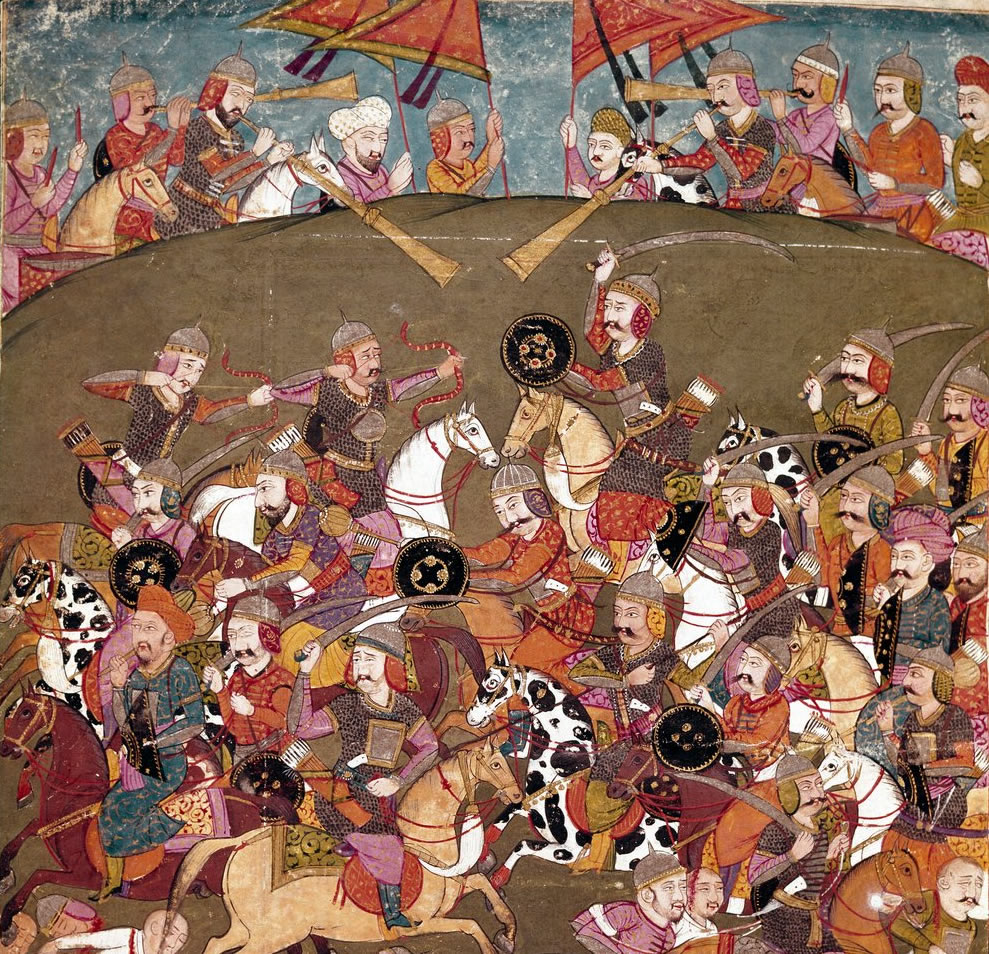
Art Note: Battle Scene from the Shahnameh, Persian school, artist unknown. Riders collide across a gilded field, spear crossing spear, an empire's long memory folded small enough to fit on a single page. Opaque watercolor, ink and gold on paper. Manuscript folio, artist and date unrecorded — Meisterdrucke.

.jpg)