UNUSUAL THOUGHTS PROMPTED BY THE HAMAS-ISRAEL WAR *** By Rabbi Anson Laytner *** The Montréal Review, December 2023 *** |
|
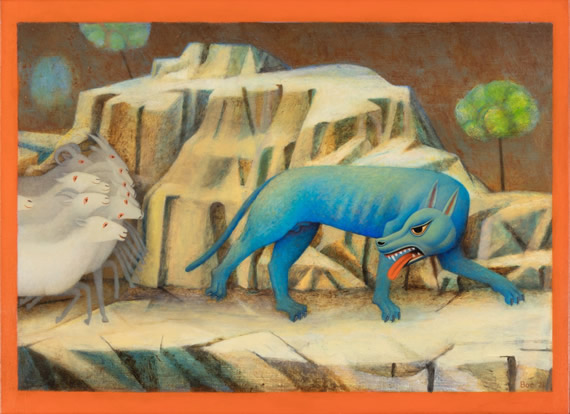
Toward Dark (2019-2020, oil on linen ) by Brett Bigbee, Alexandre Gallery *** It is a curiosity of the human social DNA that we like to clump together in groups, be they ethnic, religious, ideological, or territorial. This thought came to me as I listened both to survivors of the Hamas massacres in Israel and to survivors of Israel’s bombings in Gaza, and to their shared refrain: “We’re just trying to live our lives. Why did they do this to us?” But on the occasion of this war I found myself asking, “What is an Israeli?” “What is a Palestinian?” “Why do we even make these distinctions? Human suffering is human suffering.” Fear is one reason. Many Israeli Jews believe that the Palestinians want to wipe them off the land, and many Palestinians are certain that Israel wants to drive them from their homeland. Recent events certainly prove that both these fears are justified. Fear can lead people to band together against a perceived threat. When people band together, a sense of collective identity is born. Identity is formed in various ways. Sometimes it comes in response to a shared ideal, like a revolution, religious or political, which promises radical change; sometimes it is the result of persecution, like the African American experience. Jewish identity has been formed over centuries while Israeli identity has been developing only in the last 75 years. Both came to be through internal processes, creative responses to challenging situations, and external forces, usually threatening or destructive—think the Holocaust and Arab hostility. So too the Palestinian identity, which was formed as part of the great Arab nationalist movement in the 20th century and in part due to hostile actions by Zionism and Israel. But what prevents one group of people from seeing that “just living their lives” is really all most people want for themselves? What leads people to choose to prioritize a collective identity over a shared human one? Israelis just living their lives, raising their families; Palestinians doing the same. Do these people really have a conflict with one another? How do people go from recognizing their common humanity to living in a state of conflict? What is the motivation for doing so? Obviously, if there is competition for food or water or even land, that is one thing, but when there is enough of the basic elements for life, what is it that divides one group of humans from another? Is it something that is felt innately, or something provoked by political and religious leaders? Regardless, how can it be overcome? I think we need to look to the role that women can potentially play in overcoming this unfortunate human quality (not that women are immune to the lures of chauvinism, prejudice, and hatred). In Northern Ireland, back in the late 1990s, the Northern Ireland Women’s Coalition (NIWC), was formed by Catholic and Protestant women who came together, transcended their differences, and ultimately were successful in breaking the political deadlock and helping to end the war that had plagued their country. Beginning in early 1996, a number of these women convened to discuss the upcoming peace talks and lamented the fact that women’s voices would not be heard or considered by the politicians negotiating plans for Northern Ireland’s future. They also wanted non-party organizations to be included in the peace talks since women were primarily active in community-based groups and their voices and experiences would be of value. Notably, the NIWC declined to take a position at the outset on whether Northern Ireland should be part of the Great Britain or Ireland and instead declared that the task of peace building should involve participants from beyond the traditional political parties. Controversially, they believed that any agreement should seek input and approval from all parties. Consequently, the NIWC stood against the expulsion of the loyalist Ulster Defence Party (UDP) and the exclusion of the republican Sinn Féin, even though both groups had broken the ceasefire. The NIWC maintained that if a group was not given the opportunity to have their views heard and included, it would be ‘much less likely that they would sign up to the outcome, let alone support any eventual agreement.’ The NIWC’s delegates to the Belfast/Good Friday Agreement talks were able to secure very important aspects to the peace agreement, namely integrated education, restitution for victims, and the creation of a civic forum rather than just a concentration on decommissioning and disarmament. These aspects were key to the successful approval of the Agreement, which 72% of the public voted in favor of. To date, the Belfast/Good Friday Agreement has held firm. It is obvious from the current conflict that it is Israeli and Palestinian civilians who bear the brunt of their leaders’ ineptitude and lack of vision for a peaceful future. I believe that real political change will begin when ordinary people on both sides clamor for an end to the ongoing violence and an end to the status quo in Gaza and the West Bank, and for the commencement of a real peace process. Grassroots organizations like Parents’ Circle/Family Forum, which brings together families who have lost loved ones to the conflict, and Standing Together, a movement mobilizing Jewish and Palestinian citizens of Israel in pursuit of peace, equality, and social justice, show that this human-to-human effort is possible on a smaller scale. I hesitate to apply specifics from the case of Northern Ireland to that of Israel/Palestine but I think that the call of Israeli and Palestinian women, working together, and supported by like-minded men, might be enough to tilt the region from rejection, war, and bluster to serious, heart-felt negotiations. Men have had their turn to run things for the past seventy-five plus years and failed to make peace. I’d like to believe that Israeli and Palestinian women might offer a different perspective, they who continually offer up their spouses, siblings, and children as cannon fodder for this seemingly endless conflict.
***
*** MORE FROM RABBI LAYTNER
CHOOSING LIFE AFTER TRAGEDY AND HELPING TO HEAL THE WORLD The Montréal Review, October 2023 *** |
PAPER EDITION
|
||

The Montréal Review © All rights reserved. ISSN 1920-2911