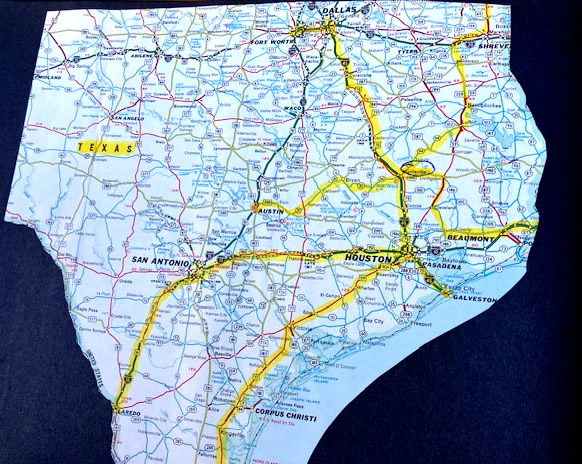
About sixty years ago I became a temporary, Lone-Star-Beer-loving Texan. What I knew about Texas in 1965 before hauling myself at age 22 out to Sam Houston State College, as it was then: (1) my parents nurtured fond WW2 memories of Dad’s AAF service with the Ferrying Command at Love Field, Dallas; (2) I almost grew up Ohioan/Texan instead of Ohioan/Floridian. Over the past fifty-odd years I’ve turned out to be an Idahoan.
Family lore has it that a cousin, perhaps second cousin, connected with Texas oil saw to it Mom and Dad, then a shavetail—officer and gentleman, 2nd lieutenant, an OCS 90-day-wonder—acquired comfortable accommodations in the Dallas area. Decent family housing near military bases in 1943/44 was not readily come by.
Second, my father had a fine tenor, and he sang when we traveled, and when we drove to the Texas Hill Country in 1949 thinking we might relocate there from eastern Ohio, where our family had lived for several generations, he and Mom sang “Deep in the Heart of Texas.” More than once. The song had risen to the top of the charts in 1942, and Dad recalled its popularity at the Officer’s Club, where people would clap three times after each couplet preceding the refrain. Think of it like a poem:
The stars at night
Are big and bright [clap-clap-clap-clap]
Deep in the heart of Texas!
The prairie sky
Is wide and high [clap-clap-clap-clap]
Deep in the heart Texas!
The sage in bloom
Is like perfume [clap-clap-clap-clap]
Deep in the heart of Texas!
Reminds me of
The one I love [clap-clap-clap-clap]
Deep in the heart of Texas!
That’s the gist of it, but I favor lines added in the version sung by that Texas native son, Orvon Grover “Gene” Autry (1907-1998) including these:
The cactus plants
Are tough on pants [clap-clap-clap-clap]
Deep in the heart of Texas!
That’s why perhaps
They all wear chaps [clap-clap-clap-clap]
Deep in the heart of Texas!
Plausible family lore claims Gene Autry served in the same outfit as my father when he was transferred to Hollywood later in the war. Dad described it as a technical unit that dealt with reconnaissance films of airstrips captured from the Japanese.

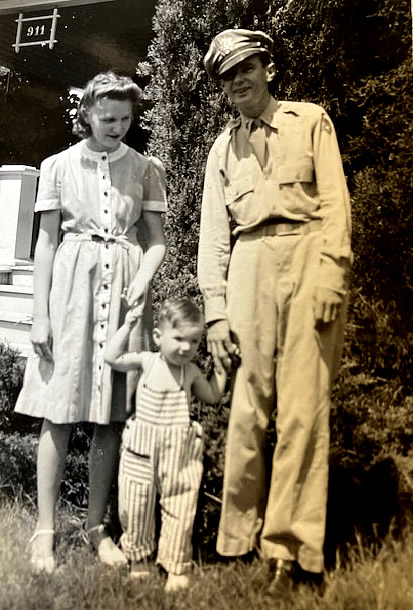
While I’m told I was a big hit at the Officers’ Club at Love Field when I was an infant and would nibble cocktail olives from the fingers of young officers (apparently sanitary standards were lower during the war), I have no personal memories of Texas till that summer of 1949, when Mom and Dad took me (age six) and my brother Tommy (age four) to the San Antonio area, the Hill Country, where Dad thought he might open a hardware store. Mom and Dad were particularly attracted to New Braunfels. But nothing came of it, and we ended up in Florida come the summer of 1950. I’ve always wondered how my life would’ve gone had we ended up in New Braunfels. Perhaps Dad’s hardware store would have flourished, and we’d have become prosperous Texans.
***
Leap ahead to the spring of 1965, when I take a job as instructor of English at Sam Houston State in Huntsville (then a town of about 15,000, today about three times that number), about 70 miles north of Houston. I turn up in hot and humid August, Piney Woods, center of the state prison network and home to the maximum-security unit, The Walls, which dates to 1848. The Texas prison system is the top employer for Huntsville, easily doubling the number who work at the university. Perhaps some enterprising con might create a parody of that Forties hit:
The lifer bawls
Inside The Walls [clap-clap-clap-clap]
Deep in the heart of Texas!
Locals tell me if the lights suddenly go out one evening it likely means another execution at The Walls. Bluebonnets in the center strip of I-45 and death in The Walls.
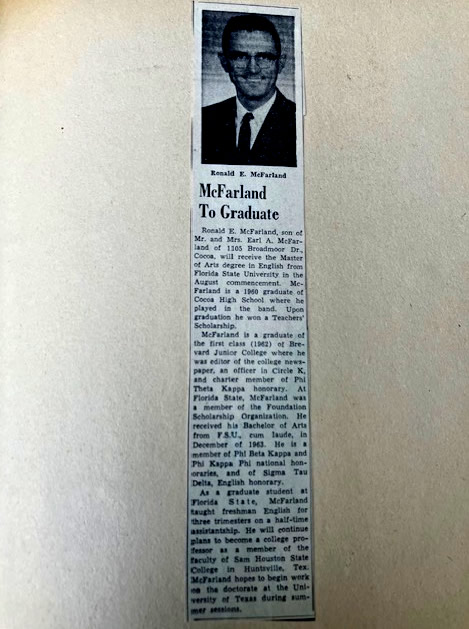
First person I meet in town is a huge guy I’ll call Ray, former SHSC Bearkats offensive lineman, working at the Western Union office, in a Western Auto store. Nice guy, Ray—married, couple kids—took a job as a prison guard the next year. Second person I meet is a former student named Jimmy S who drives a plum-colored ’65 Pontiac GTO convertible. He lives in an apartment near mine and for some reason takes right to me. A quondam student at SHSC, he likes it that he’s connected with an English “professor.”
I tell him “instructor,” as in “mere instructor,” possessor of no doctorate, just a master’s degree. But that doesn’t take. Jimmy is married to a beautiful woman with long dark hair and fair skin that I think of as Bavarian, and they have a sweet infant daughter, but his favorite pastime is girl-watching, or as he puts it: “Let’s go out and scope us some hides!” In east Texan, that word is pronounced “hads.” Betty Friedan’s The Feminine Mystique had yet to make it big in the Lone Star State.
After I got hitched in Florida in late January, Jimmy and I parted ways, but my bride and I double-dated with Ray and his wife at the drive-in a couple times. My wife, who’d earned a degree in social welfare, got a job as a secretary in the alcoholic ward at The Walls, so with my modest instructor’s salary, we did well over those two years. We almost prospered.
On the other hand, when we arrive in Huntsville following our one-day honeymoon in the Big Easy, we find our modest rental flooded, the pipes having burst due to hard freeze. My wife is a farmer’s daughter. She takes it in stride. We move to a garage apartment nearer campus where we’ll live for the next year and a half. Elegant simplicity—a single bedroom attached to what would now be called a stylish “open floor plan”: living room, dining room, and kitchen all in one. Although we both grew up in Florida without AC (my wife was a native Floridian), neither of us are prepared for the heat and humidity of the east Texas summer that slams us come June of ’66. My apartment the previous summer was air-conditioned. On bad nights we lie a-bed with the fan on us a few feet away, each of us equipped with a personal sweat towel.
***
Before she arrived, I acclimated myself to my new world, which included hunting squirrels in the Sam Houston National Forest, my first genuine success, not counting the single mockingbird (mea culpa) and various frogs that fell prey to my BB gun. The first time I dropped a squirrel with my father’s old single-shot 16-gauge I found myself confronted with the realization that while I’d cleaned fish over the years, I had never processed the carcass of a squirrel. What to do? Turns out it was no problem: chop off the legs and tail, pull off the hide, lop off the neck, eviscerate. Not having a cookbook on hand, I decided to dredge the critter in flour and panfry the thing. It came out just fine, but I confess my culinary standards were low.
One afternoon while returning from my one-man safari I come upon what I suppose might be a desert kingsnake, and I think fleetingly as I prepare to pick it up how odd that such a reptile would show up here in eastern Texas. That snake is typically black with narrow white bands. At the last second, I realize it’s a sizable coral snake, quite poisonous, its venom a deadly neurotoxin akin to a cobra’s though its small fangs limit its capacity to penetrate dense fabrics like leather.
I managed to get off a quick shot with my 16-gauge Stevens Favorite and blew away a chunk of its head. This proved fortuitous, as I was able to preserve the 39-inch specimen, large for a coral snake, in a jar of alcohol, which I displayed on the desk in my office, thereby sharply limiting student enthusiasm for lengthy conferences during which they hoped (in vain) to convince me to raise their grades.
Fishing was good at a small lake a short drive from town, where you could use minnows to haul in surprisingly large crappie, and to the west, across I-45, you could nail some hefty largemouth bass on the lake at Huntsville State Park, or you could head east and fish your heart out on the Trinity River. There one sultry afternoon I came under fire for the only time in my life when a couple of good ol’ boys plinking with a .22 rifle fired some rounds in what they assumed to be the void. I hit the ground and yelled, too startled even to command an appropriate string of profanities. The boys were apologetic and made it up to me with a bottle of Lone Star.
***
In the mid-1960s Walker County was bone dry unless you belonged to the country club, but two ramshackle bars were situated across the river in Trinity County a dozen or so miles northeast. The first featured an old codger who hobbled about on a single crutch and a gorgeous one-armed barmaid (Allison maybe?) who’d challenge college students and cowboys at bumper pool, propping her cue on the crook of her left elbow below which her forearm was only a memory. She was raven-haired and alabaster-complexioned, reminiscent of Jimmy’s wife. As I recall, a round of pool cost fifty cents, and it was worth the price to lose a game to sweet Allison. No one I knew ever asked how she lost her arm. We were gentlemen. Sort of.
Lone Star in longneck bottles was my go-to beer. Period. I had no higher aspirations. Today, Walker County is semi-dry, beer being acceptable, liquor not.
And if I was going to live in Texas, I figured should buy myself a pair of cowboy boots, whether I ever intend to saddle up or not, so I bought a pair of natural leather boots, no fancy colors or designs. Acmes. They weren’t pricey, and they never fit well (pinched my toes), and after I bought the darned things, I felt downright silly about it and never tried to wear them in public till I went off to Illinois in ’67 and then on to Idaho in ’70. Sold them at a yard sale sometime in the ’80s when that B-movie cowboy became president: Law and Order (1953), Cattle Queen of Montana (1954).My mother used to claim I was named after Ronald Reagan. Or maybe after the British actor, Ronald Colman.
For the record, I never bought myself a Stetson, having vowed not to become anything worse than a semi-faux Texan. The two years I lived in Huntsville the town boasted no shopping mall and only a single indoor theater on the square that surrounded the county courthouse, a pattern common throughout the Old South. Stetson men seemed generally disinclined to remove their chapeaux when watching a movie. We came to prefer the drive-in.
Road-trip to one of the bars near the Trinity one evening, when I was still single. I had recently turned 23 and was accompanied by two of my male students, of age I guess, which would’ve been only a couple of years younger than I. We quaffed a round and bought a couple of 6-packs apiece and set off back to Huntsville. But we encountered a DPS roadblock a few miles from the bar, where one of my students had lost a dollar to Allison. The highway patrol in Texas goes by the congenial euphemism, “Department of Public Safety.”
Suddenly I feel “guilty as charged,” even though I haven’t been charged at all—yet. What if one of my students is underage? It’s not like they’ve been carded at the bar. If I had access to a stick of peppermint gum, I’d pop it into my mouth and hope to cover any telltale evidence of lager. A hefty Stetson-bedecked officer approaches the car.
“Hey, Eddie,” the officer says when he sticks his head in the car, which almost certainly reeks of Lone Star. “You boys headed back to campus?” He doesn’t ask if we’ve been drinking, doesn’t even ask me for my license or proof of insurance. Turns out the guy is Eddie’s cousin. Eddie introduces me as his English “prof.”
“Y’all take care now,” the officer says as he pulls back from my window. “Professor,” he nods at me. “You from Florida,” he says, noting my out-of-state tags.
“Yessir.”
“Drive safe now, heah?” He winks. Texas hospitality.
At the time I almost corrected him: No sir, I’m not a professor, I’m an instructor, lowest of the lowly, teaching five classes a semester, freshman comp and surveys of both American and British lit. And loving it, my first full-time teaching gig after a year and a half as a teaching assistant at Florida State, where I handled two sections of freshman composition per trimester, typically numbering 30 to 35 students per class, while taking three or more graduate courses. Being a TA amounts to a nifty juggling act. If you’re married, that entails having three balls in the air; if you’ve got kids, as my pal Jim did, add another ball. Two more in his case.
***
Thinking back to that pullover, I’ve reflected how lucky I was not to have been black or brown. Race relations in east Texas in the fall of 1965 were not exactly cordial. Soon after I arrived in Huntsville one of my colleagues told me there’d been a KKK rally in town that spring, or maybe the previous summer. Like the Florida schools where I grew up, the Huntsville schools were firmly segregated. The number of African American students at Florida State when I got my master’s in 1965 was zero. My FSU yearbook for ’65 features several Confederate battle flags, at least one in full color being waved from a crowd at Doak Campbell Stadium.
A group calling itself HAYOU (Huntsville Action Youth) arranged a few protests the two years I lived there, the local newspaper blaming “outside agitators,” which meant folks from Houston. Was it true that Huntsville’s first effort at integrating the public schools involved placing white teachers in black classrooms? Maybe, maybe not.
I was told the brother of a senior instructor in the SHSC English department, a kind elderly lady of the Old South, was the county judge and that a couple years previous, to keep Blacks from sitting on the park benches around courthouse square, he took a sledgehammer to them. Urban legend? Maybe so. Anyway, I suspect Judge G would’ve had some city maintenance workers swing those sledges, probably African Americans. The upshot was that you could find Blacks sitting on the steps to the grand old 1880s edifice almost any time of day. The courthouse has been replaced by a modern and to my mind much less elegant edifice.
In May of 2021, the Sam Houston State University Bearkats won their first ever Football Championship Series title in a last-second victory over the South Dakota State University Jackrabbits. Well over half that SHSU squad was African American.
Where was I in all this back then? Not at the barricades. We did not think of ourselves as “racists,” but that didn’t mean we weren’t. One of my dear colleagues, an elderly belle of Dixie, referred to the women who cleaned for her as “darkies.” I believe she meant that term affectionately, but I doubt she called them that to their faces.
***
Two years after my two years in Texas, pursuing my doctorate not at UT, per my initial intent, but at the University of Illinois, my students for three semesters were all African American brought in as part of the school’s Special Education Opportunity Program. The world changed that radically. And that rapidly.
Mind you, I wasn’t totally naïve. My major achievement as a writer, was the writing and editing, with my colleague Paul K. Dempsey, of a freshman composition textbook, American Controversy: Readings and Rhetoric, published in 1968 by Scott, Foresman and Company. The book produced royalties for me when I needed them most—in the middle of my first year as a doctoral student at Illinois.
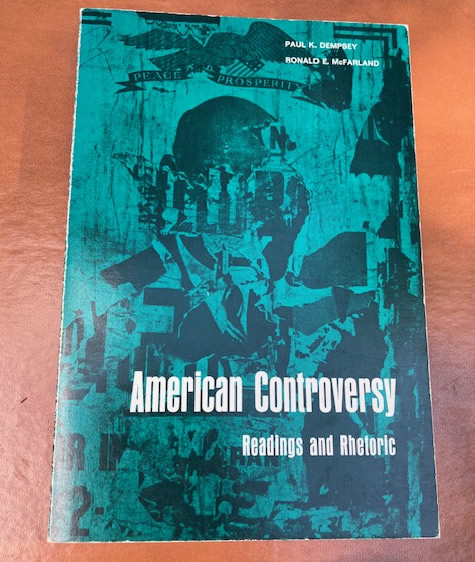
Paul deserves credit for the genesis of the book. He was a bright and goofy sort of guy who would show up at the office some days with a large safety pin doing the job of a broken zipper for his fly. We set up the book topically in six thematic sections: The American Dream, The American Dilemma (racial issues), Youthful Dissent, The New Morality, The Affluent Society, and What is America? Anyone in the field of rhetoric and comp theory today could tell pronto that we scarcely had any idea what we were doing. But the big word then was “relevance,” and our text was relevant with a vengeance.
Long out or print now, our book might qualify as a period piece, a relic. But some of those essays we assembled still resonate for me: Marvin Caplan’s “The Last White Family on the Block” (my family’s project house in Cocoa, Florida, very nearly qualified); William Faulkner’s “Letter to the North,” published in 1956, a valiant(?) effort to present a moderate Southern perspective on enforced integration. We extracted a chapter from The Negro Revolt (1962) by Louis E. Lomax (1922-1970), then a “pioneering black journalist” according to the website blackpast.org.
Teaching at what some scorned as a cow college were such notable colleagues as Martha Anne Turner, whose monograph on “The Yellow Rose of Texas” she expanded into a small book in 1976. From an author’s note I learned she’d taught at Sam Houston since 1946, introduced creative writing into the curriculum, and taught a popular course on literature of the Southwest. Professor Turner made a small splash in 1966 when her Sam Houston and His Twelve Women came out. I recall a painfully stiff party at her home during which we all sat in a circle in the middle of her brightly lit living room struggling to sustain polite conversation. I was deeply grateful for the liberal pours of bourbon that evening.
Random House published my colleague Jewel Gibson’s novel Black Gold set in the oil fields of Texas, which she knew at first hand and a signed copy of which remains a favorite memento of my time in Huntsville. Random also published her first novel, Joshua Beene and God (1946), a religious satire that was assailed by a ministerial group in Conroe, about thirty miles south. She also wrote plays that were staged in Houston and Dallas and feature articles for the Houston Chronicle. At the time, I was too deeply self-involved to have properly recognized their achievements. Jewel was an “elderly lady” of 62, after all. Young we are quite full of ourselves; then, before we know it, we’re old and still full of ourselves.
***
Sam Houston State’s undergrads were not often high-end academically. Those students got siphoned off by UT, A&M, or University of Houston, not to mention costlier, elite venues like Rice, SMU, Baylor, and TCU. East Texas offers a dazzling array of options for higher ed. But my students at Sam Houston were delightfully open and without airs, no academic pretensions and posturing. For lack of a better term, they were “genuine.”
The president of SHSC speaking at commencement offered words meant mostly for the parents to the effect that Sam Houston was the kind of college where “good boys and girls could get themselves a college degree” at a fair price. My young colleagues and I bridled at this view. We detected a streak of anti-intellectualism among our students, and we were eager to reverse it. We interpreted the president’s remarks to mean: “Our goal is to offer folks a college degree but not necessarily a college education. We know you want your children to come back home with that diploma, key to a good job, but unaltered by their experience.” We hadn’t discovered the term “critical thinking,” but we were heading down that road: Teach them to think critically; turn them into inquiring young skeptics. I’m not confident Texas was keen on that.
We saw ourselves as rebellious Young Turks, although we never actually rebelled. I did get in trouble once for reading “disturbing” passages from Cotton Mather’s diary to my American lit class. There was a passage about him having “elevated thoughts” while pissing against a wall. My students were titillated by his adventures in witchcraft prosecution, of course, and there were suspicions about him and a certain lady in his congregation. An apparently disgruntled coed ratted me out, and the dean called me on the proverbial carpet to inform me my students didn’t “need to hear about that sort of thing.” I felt duly chastened and righteously indignant.
We enjoyed our life in Huntsville, including the prison rodeo, where the announcer liked to wisecrack after an inmate got tossed from a bucking bronc, “Too bad, pardner, but you’ve got you another ten years to improve on that ride!” Or, “Now, here’s ol’ Billy Bob Smith on a old bramer bull called Kickass. Billy Bob done got himself into trouble with the law when he found his old lady with a preacher up to Texarkana. Plugged ‘em both. He’s a-gonna be here a while. Ride ’em cowboy!” Didn’t we watch Johnny Cash perform there one October weekend?
***
Once I taught summer school, which met six (6) days a week. No AC that I recall, and east Texas gets a tad sticky of a summer’s day. It was the day of the double dactyl:
Higgledy-piggledy, Arleigh B. Templeton,
Classes will meet daily six days a week.
So, I will lecture on qua phonographically,
Do not expect me to think when I speak!
Templeton was president of SHSC. My colleague Tom Cameron penned those lines, but he chose not to share them with the president.
One momentous summer day I acceded to popular demand and agreed to meet one of my American lit classes outside. Across the street from campus stood Sam Houston’s homes and a museum. It was hot, the natives were restless, and we were dealing with Thoreau, so why not harken to their pleas? In addition to Woodland and the Steamboat House, the site featured a pond shaped in the outline of the state. It took only minutes once we crossed the street to the shrine for the Lone Star State’s most notable hero, the victor at San Jacinto in 1836 over Santa Anna, for my students to disperse over the property. Only a handful of loyalists remained to discuss where Thoreau lived and what he lived for. From seemingly out of nowhere a couple lads produced handlines and hooks, and before long they were emulating Thoreau’s visits to Walden Pond, catching not pouts, but small bream.
I also served as faculty advisor of the student literary magazine, Whetstone, and though I was beginning to consider myself a Democrat, advisor for the Young Republicans as well, which was just being formed there. Most Texans were Democrats back then. The SHSC chapter helped carry Walker County for Senator John Tower.
***
And poker. One feature of the half dozen of us who sat around the table once a month was variety: a colleague and I from the English department, an economics prof, a biology prof, and two majors from the ROTC program both of whom had served in Vietnam in years prior to or right after the Tonkin incident of August 1964. My 2-S student deferment ran out in the middle of my first year at SHSC, about the time “The Ballad of the Green Berets” hit the charts bigtime, March 1966. As U.S. troop strength leaped toward 300,000 and favorable kill-rates leapt off the charts, I managed to get myself reclassified 2-A. Presumably, my pedagogy qualified as essential to the well-being of the nation.
Anti-war protests increased in popularity all over the country in direct proportion to the unpopularity of the draft. The two ROTC majors related horror stories from the early months of the war, and they did not encourage me to hop right down to enlist. My younger brother Tom dropped out of FSU just in time to be drafted and packed off to Nam for the Tet Offensive. He emerged unscathed but with some painful memories.
If I’d enlisted, maybe I’d have gotten a direct commission and been shipped off to Europe. Or I might’ve been deployed to Nam in due course and gotten myself fragged by my own men. Dark accounts of that nature were making it back to the States by the spring of ’66. At Urbana a couple of years later I’d hold sit-ins, mostly listening to my students vent their feelings and confusions about the war, which resembled mine. My brother was “over there,” after all, and so were some of my students’ brothers and sisters, mothers and fathers, aunts and uncles.
***
One of my last Texas adventures involved the Western Diamondback Rattlesnake (Crotalus atrox), to be distinguished from its larger cousin, the Eastern Diamondback (Crotalus adamanteus), which I knew firsthand from Boy Scout camp and my in-laws’ farm in Florida. An English professor at FSU, an avid herpetologist, requested I provide him with a living specimen. Not having a clue, I mentioned my dilemma in class one day, and the son of a rancher in the panhandle offered to fill the bill, as he always joined in rattlesnake roundups in those parts. I assumed nothing would come of this, but late one spring afternoon Jack showed up at our apartment with a sturdy wooden box fitted with screened vents inside of which a healthy pair of rattlers snuggled up in a burlap bag. He spilled them out on the ground to the non-delight of my wife, who’d built up a healthy respect for rattlers based on chance encounters on the family farm.
Jack kept them at bay with a snake hook before redepositing them into the burlap bag and securing the latch on the wooden crate. I would send them on to Professor Morris at Florida State via railway express, which could not be soon enough so far as my wife was concerned. Until then, we kept the box at the bottom of the stairwell to our garage apartment and did not mention them to our landlord, who lived next door. Pets were strictly forbidden. Every time we passed their temporary den as we climbed upstairs these rattlers would set up an ominous buzz that, per Emily Dickinson’s poem, gave us that sensation of “Zero at the Bone.” I sent them packing within four days.
A few months later, when I stopped at the English department on the FSU campus, the secretaries suggested they had not appreciated the day those critters arrived. Not having Dr. Morris’s home address, I’d simply sent them to his campus address, and there they dwelt for a long day waiting for him to take them home. One secretary observed that visitors to the office that day did not linger.
***
Texas, Texas, Texas. “Deep in the heart of Texas” I cannot claim to have been, but that place still owns some claims on me. Maybe this essay amounts to an exorcism. In the part of the South where I grew up, a popular license plate and bumper sticker featured the icons of a heart and a jackass and read, “Put Your HEART in Dixie or Get Your ASS Out!” The heart featured a Confederate battle flag. You can purchase online a license plate or a bumper sticker bearing that sentiment. A similar view prevailed in Texas during my two-year sojourn. One might replace “Dixie” with “Texas.” I got my ass out to the Idaho panhandle. In recent years, however, I’ve noticed quite a few Texas license plates around town. Auguries of a relapse? 
***
Ron McFarland is an emeritus professor of English at the University of Idaho (Moscow) where he taught for nearly 50 years.
|
***