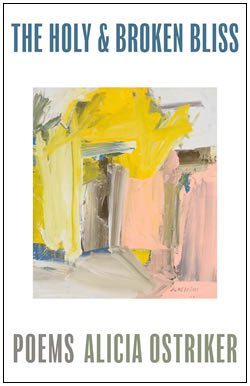
How can a human being maintain identity and sanity in the present world? It is not only the political and social morass that disheartens, but the individual decline in our own lives. As Samuel Johnson wrote in the eighteenth century:
Condemned to Hope’s delusive mine,
As on we toil from day to day,
By sudden blasts or slow decline,
Our social comforts drop away.
Johnson wrote of the decline of the individual, but the challenge of coping in today’s world is far more complex than in 1782, and we are all in desperate need of models and tools for surviving while maintaining our humanity. With incredible honesty and sincerity, with great literary and cultural intertextuality, but with no intellectual pretension, Alicia Ostriker has faced the world in all its uncertainty, with all the nightmares we face, weaves all the political, social, temporal strands into an intimate life, and teaches us to face forward.
Throughout the years, almost every book of prose or poetry written by Ostriker has affected my own concept of poetry, even her strictly academic work on William Blake that followed the then-imperative academic focus on the male literary canon. But it was Ostriker’s critical transition to the then-forbidden issues of women and literature in Writing Like a Woman (1983), and Stealing the Language: The Emergence of Women ‘s Poetry in America (1986) she opened paths to my own reading and writing. Her poetry too at that time took on subjects that were previously scorned by contemporary critics. These poems of the 1970s marked a distinct shift in American poetry: they centered the female body, the mother-child experiences, all in the context of a violent patriarchal society. And the intertwining of her own poetry with objective literary criticism about the period of Sylvia Plath, Anne Sexton, Adrienne Rich, and others made the shift defiant and clear.
Soon after, she developed her feminism to encompass religion by re-reading the Bible from the point of view of women. The books that followed, The Nakedness of the Fathers (1994), For the Love of God: the Bible as an Open Book (1994), Dancing at the Devil’s Party: Essays on Poetry, Politics and the Erotic(1997), and For the Love of God (2007) seemed like an obvious but brilliant development. All of her books of poetry in this period led the zeitgeist. Even the titles alone reveal her direction, from The Volcano Sequence (2002) No Heaven ( 2005) The Book of Seventy.( 2009), At the Revelation Restaurant and Other Poems (2010), The Book of Life: Selected Poems (2012), The Old Woman, the Tulip, and the Dog (2014), Waiting for the Light (2017). Each one described a new stage in her live and always gave me a new way to look at life and literature, one that existed in me from the beginning.
But I was afraid to read her latest book of poetry, The Holy and Broken Bliss (2024)– I
knew what it would say, what I myself feared thinking about, what I feared writing about
– the decline we all dread, our personal waning, and the intensification of that waning by
the medical, social and political situation in which we exist. It is a decline we try to escape, but returns in Ostriker’s poems in moments, in seconds, in fragments. They are spare, stark, moments of awareness, of the inevitable narrative, of death. The poems show these crucial flashes that flicker in our minds even when we are occupied with something completely unrelated, perhaps even trivial.
The suffering encountered in the past years by the entire human race, the additional suffering of isolation, of mistrust of leaders, mistrust even of language itself, leads to a starkness of language in Ostriker’s poetry here. Even though she declares that “poets thrive on disaster/ born as we are within the wound”(25) there is a resistance to complex language, a hunger for the simple truth, for familiar nature. Surrounded by fear and transience, the pull is towards austerity, “the voice demanding I choose life “(28)
The gradual disappearance of a self in the world, the individual identity, the environment, the shrinking is evident. She sees it in her personal life in her husband’s body: “he jokes that he will not die /he will grow smaller and smaller/ until I can carry him around in a teacup/ exhibit him to my friends.” And then she sees it her own life that is diminishing “My dream,” she writes, “shrinks to a dot/ it goes where my mother went/ unwillingly”
But the expansion in this book surpasses, triumphs over the sense of diminishment. In “Her Wishes to a Bat Mitzvah Girl” she chooses to lead the young girl to optimism and
love not by ignoring the pain of existence but through a clear view of reality. “May your
eyes see the beauty /and sorrow of the world /clearly and keenly oh/ and may light lead
you to love.”
This is what she wishes for herself:
I mean I need to love with the love that is like milk before
the pitcher shatters
The poems end with:
CODA
Let my poems be shards of the and broken bliss
that circles and shackles the earth
One can see in these poems the struggle and the triumph to which Ostriker leads us. I
finished the book with a wonderful sense that it encompassed all the achievements of
her earlier volumes, all the knowledge of her academic work, and all that I need to face my
own future. 
***
Karen Alkalay-Gut is a poet, professor, and editor who lives in Israel and writes in English.
|
***


