THE ARISTOTELIAN-LIKE MESSAGES OF HANNAH ARENDT'S POLITICAL PHILOSOPHY By Haim Marantz *** The Montréal Review, August 2026 |
|||
My principal contention in this essay is that Hannah Arendt's political philosophy can be characterized as a twentieth-century version of the classic Greek conception of politics, which Aristotle adumbrated in his Politics. In saying this I am not claiming that Arendt simply translated Aristotle into twentieth-century terms, for there are differences between them. Rather my claim is that, in broad terms, the conception of politics that Arendt adhered to is one which fifth-century BCE Greeks in general, and Aristotle in particular, would have had no trouble in understanding, for she shared with them a conception both of the essential public nature of political activity and of its centrality and importance in human life. For the ancient Greeks, what was private was at once not political, and so of far lesser value than that which was political and of public concern. In his classic study, The Political Ideas of the Greeks, J. L. Myers went so far as to claim that for the Greeks "if a man's conduct and discourse ceased to be political, it became idiotic — self-centered, disregardful of his neighbors' needs, inconsequent in itself as in the case of a rudderless ship and without consequence therefore in his neighbors' eyes." Myers' assertion was exaggerated, but he based it on two facts. The first is that the English word "idiotic" has its origin with the Greek root idiotes, which also translates into contemporary English in suitable contexts as "personal," "distinct," "separate," and "private." The second is that a recurring motive in classical Greek political thought was the opposition between the idiotes, or private individual, and the polites, or public citizen. The Greek polis, or city-state, was originally no more than a fortified camp on a hill. However, with the breakup of the Mycenaean civilization (c. 1200 B.C.E.) and the resultant disruption, each polis became the center of a distinct and separate community. To survive, each community had to fend for itself and rely on its own resources and energies, as well as on the willingness of its citizens to fight to the death for it. The independence and self-reliance fostered a deep sense of community, since there was nothing outside the polis with which an individual could identify. Each polis was not only self-governing, but also largely self-sufficient to the extent that, for example, many poleis had their own calendar. In addition, since their specific development was linked with their relative physical — geographic — isolation, it meant that most of their members were, in ancestral origin, largely an assemblage of kinship groups, with many married couples sharing distant common ancestors. Then again, the various poleis, indeed, were in their time more often than not understood to be less a location than a community of largely like-minded citizens, so that most individuals were usually identified as an Athenian or as a Spartan rather than as someone who came from Athens or came from Sparta. Aristotle expressed this idea when he characterized the polis as a compound made up of its citizens (politai). What I take to be significant for understanding the thought of Hannah Arendt is the conceptualization of the polis undertaken by ancient Greek thinkers; especially pertinent was that version of it outlined by Aristotle. There are two prime reasons for his pertinence. First, Aristotle wrote at a time when the polis had largely ceased to be a viable unit — i.e., just prior to the emergence of the Macedonian empire of Alexander the Great (whom, during his youth, Aristotle tutored). Aristotle self-consciously attempted to articulate the ideal structure of the polis. In accordance with his own philosophical prescriptions, he endeavored to delineate the essential nature of a typical polis community. To prepare himself he made the effort to study the constitutions of as many poleis as he could, so that out of this mass of empirical data he was able to distinguish the contingent local factors of any particular polis from the necessary definitional features it shared with all other poleis. Second, it was Aristotle's picture of the polis, above all others, that has historically informed much of later thought about the nature of what a political community is, as well as what it can reasonably be expected to become. For Aristotle, the polis was not simply the product of a convention or some other human artifact like a contractual agreement (the social contract of sixteenth- and seventeenth-century thought, or even the twentieth-century version of John Rawls). Rather, he regarded the polis as being "natural" in a special and distinctive sense: for Aristotle the nature of anything is its essence. This essence, however, encompasses within itself a principle of motion or generation, whereby inherent potential is actualized or realized. The nature of any X was, for Aristotle, always expressible as a potential which, if allowed to develop, could actualize — as its end — its specific goal or purpose (telos). In the familiar analogy, the nature of the acorn is only identifiable as such (and not as, say, an apple-pip), because of what it has the potential to become. The polis, for Aristotle, was a species of the genus community. The essence of every genus is some specific good. The specific essence of the polis, its end, is, in Aristotelian terms, to sustain the "good life." The good life Aristotle explicitly identified as a self-sufficient life, i.e., a life that is lived for its own sake and not lived instrumentally for the sake of something else. For Aristotle, the substance of the good life thus consists in reasonably well-off human males engaging solely in intrinsically worthwhile activities. Contemplation — the search for wisdom, to comprehend, to cogitate, to think about what must be, that is, thinking about that which is beyond human control — is the most self-sufficient activity. Then again, the activity of engaging in the politics of the polis was also identified by Aristotle as being a non-instrumental, intrinsically worthwhile pursuit. His principal reason for this finds expression in Aristotle's famous definition of man as being intended by nature to live in a polis (zoon politikon), for only in the polis can each individual even contemplate actualizing their full human potential. In other words, Aristotle believed that individual humans can only actualize their human development to their full extent, and so fulfill themselves, by engaging in political activity — that is, by participating in the affairs of the polis of which they are each citizens. Just as the oak must be conceptually prior to the acorn (in order that the acorn can be known to be such and not an apple-pip), so the polis must — logically must — be conceptually prior to the individual citizen. Each individual citizen is presupposed by a specific polis — as the notion of each part is presupposed by its specific whole. Thus, on an Aristotelian understanding, the typical modern liberal conception of the human individual as being discrete, and/or independent, and/or atomic, is a misconception. The modern liberals, in Aristotelian terms, are promoting the condition of idiocy, which is necessarily an inferior, and so "unnatural," condition compared with that enjoyed by those who are potentially able to realize their nature by participating in politics. The force of Aristotle's position can only be appreciated when the full context of his remarks is taken into consideration. The polis was not, for Aristotle, the sole sort or species of community, and so its nature can only be grasped in its full significance alongside the two other species of community he identified. First, there is the family or, more specifically, its household, the nature of which is the end that it serves; namely, the satisfaction of daily recurrent needs. Second, there is the village — a collection of households — the end of which is a slightly wider satisfaction of more than daily but nevertheless recurrent individual and familial needs. Aristotle effectively classified these two communities conceptually when he claimed that they each have "mere life" as their end, in contrast with the "good life," which is the end of the polis proper. The conceptual relationship is that both the household and the village are each instrumental to the attainment of the good life. Hence, both the household and the village each exist only for the sake of something other than themselves. The Aristotelian distinction between the two ends, mere life and the good life, was the inspiration of Arendt's conception of political activity as being the activity through which any individual human best expresses his or her humanity, which she set out most fully in The Human Condition, but which also informed all her subsequent writings on things political, social, legal, and cultural. The principal parameters of her conception of politics she spelt out in what was virtually an extended gloss on the Aristotelian distinction between life and the good life. This gloss centers on a number of dichotomies or oppositions which she drew. Arendt began with the household. As it is concerned with the satisfaction of needs, it could also be said that its prime function is to deal with what is necessary to sustain physical life. Arendt, after stating this, reminds us that the opposite of necessity is freedom. She then reminds her readers that, for Aristotle, the good life was the life of freedom, a life not continuously ruled by worrying about supplying the demands of material existence. Arendt reminds her readers that, for Aristotle, the sphere of economic activity — the sphere in which people were concerned with the provision of the necessities of life — was the household (oikos). To be able to fully take part in the life of politics, a man had to be consciously free from the concern of supplying himself and his family with the necessities of life. In consequence, a free individual, for Aristotle as Arendt understood him, could only be a male who was the head of a household. His household functioned to supply him and his family with their material prerequisites, so that he could be "free" to devote himself to pursuing the good life by engaging in politics. Another opposition Arendt identified in Aristotle was that of force and/or violence versus speech and/or persuasion. The former is located in the household, where the force in question is the mastery of necessity. Mastery is expressed in the command over those who mostly dwell — i.e., live and work — in the realm of necessity. It follows from this, Arendt claimed, that the Greek household was a hierarchical organization. At the head is the male citizen; beneath him his wife, whose prime function was to "manage" the household, to oversee its functioning on a day-to-day basis. Under the immediate control of the wife were the household's slaves. For Aristotle, there were individual humans whom he regarded as natural slaves, that is, slaves "by nature" — individuals whose "end" is both to serve and also to be dependent on others. These slaves realize and actualize their nature in helping to provide the necessary tasks of need satisfaction; these tasks are, to quote Aristotle, "useful for the necessary purposes of life." Aristotle did not think that all those who are slaves are such naturally. Arendt clarified this Aristotelian notion by reminding us of the fact that in Ancient Greece prisoners of war more often than not became slaves. To be a captive warranted enslavement, because these individuals had not chosen to die gloriously in battle, but had, by surrendering, opted instead for life. This option was virtually taken as tantamount to an admission that they were not prepared and/or unable to make the effort and perhaps sacrifice their lives in the hope, if they survived, of eventually living the good life. Accordingly, their proper station, their end, lay completely within the realm of life — the household and/or the village. The relationship of the master to the rest of his household was despotic in the strict sense of rule of a superior over inferiors. It is this superiority which, for Aristotle, marks off the realm of political and public life from the realm of mastery and force. The opposite of this — speech or persuasion — is a corollary of the fact that dealings between citizens, between free men, are dealings between equals. In contrast to rule in the household, rule in the polis (politics) is an expression of relationships not of hierarchy, but of equality. Aristotle himself was explicit on this point: the polis is an association of equals, and only of equals. For Aristotle, a citizen is one who both rules and is also ruled over. The only way that free and equal citizens can interact is through their common participation in reason and speech (the Greek word logos means both of these). It is because of this that Aristotle identified each free individual as a zoon politikon, who alone is furnished with the faculty of language (zoon logon). Hence, using force or mastery, which is appropriate when dealing with inferiors, is out of place when one is confronted by one's equals. The only humanly acceptable way to influence an equal is to appeal to his reason, in an attempt to persuade him to adopt a specific decision, support a specific policy, or undertake a specific course of action. It is symptomatic of this high valuation placed on speech that non-Greek speakers were identified by Greeks as barbarians, i.e., those whose speech to those who spoke Greek was unintelligible — ba-ba-ba. Given this unintelligibility, barbarians could not participate as political equals; therefore, traditionally barbarians were indistinguishable from slaves, namely, those fit to be ruled over. The fact that politics is an activity undertaken between equals largely dictated, for Aristotle, what is a permissible subject for politics. Matters that pertain to the household are inadmissible. These are not political issues, as the way in which one citizen deals with his slaves and other subordinates within his own household is — and so should be — of no concern to any other citizen. Similarly, the citizen as such should not pursue "private" household matters in public. Aristotle is particularly critical of those who use their economic independence to pursue economic ends. This is a corruption whereby an essentially instrumental activity — commerce — has become an activity undertaken for its own sake. Indeed, so strongly does Aristotle feel about this that he declares that in an ideal polis merchants would be debarred from citizenship. What then, positively, is the fit subject of political activity? The general criterion is that politics, as the engagement of citizens with one another, should be delimited to areas of their common concern. It thus includes such matters as defense (Aristotle makes the willingness to bear arms one of his criteria of citizenship), the execution of justice (in Greek practice only citizens were eligible jurors), and the observance of religious ritual. There is one final opposition in Aristotle's political writings that finds expression in Arendt's political thought that I want to draw your attention to: that between animality and humanity. This is implicit in the Aristotelian distinction between the realm of necessity (life) and the realm of freedom (the good life). Animals — especially animals in the wild — need to constantly occupy themselves with their own survival; they are constantly impelled to avoid their imminent mortality. However, for the free man the end of life is not simply life itself — i.e., to stay alive — but the good life. This had two corollaries for Aristotle, as Arendt read him. First, free men demonstrate their transcendence of the merely animal by consciously risking their lives. Hence, the major arena in which this is displayed is warfare. Humans fight not only for freedom from economic necessity and their immediate survival, but also for glory and for honor. In classical Greek culture the paradigm case was the Trojan War, which was occasioned by Menelaus' shame at his wife's elopement. Hence, the tradition — to which, as I have already noted, Aristotle himself subscribed — was that a fitting task for any citizen of the polis, and hence an ineliminable ingredient in the good life, was to be constantly prepared to participate in military matters. Second, and more generally, this opposition between animality and humanity also largely corresponds to the distinction between natural biological life and political life. The definitive characteristic of biological life is its transience, that is, its mortality. Nature is the cyclical realm of birth-life-death. Humans, however, are able to attain a measure of indirect immortality. The polis is the creation of free men, and it is the arena in which these free men live on by reputation beyond their own biological lives, in memory and history. In Arendt's own technical terms, men and women can be more than animals (who only labor to meet their necessarily imperious ends); individual men and women work to fabricate for themselves a world of artifacts and, above all, they act with each other to create a life with meaning. It was the Greeks, for Arendt, who first identified the act of creation — of something new — with the prosecution of the political life. The polis was for the Greeks, as she put it, "first of all their guarantee against the futility of individual life, the space protected against futility and reserved for the relative permanence, if not immortality, of mortals." In outlining these oppositions Arendt did a lot more than simply gloss Aristotle; she also began to articulate her own political perspective. Nevertheless, it was fundamental to her perspective that she expressed the Aristotelian distinction between life and the good life in terms of the opposition between the public and the private. It is important to note that Arendt's use of the words "public" and "private" was distinctive. This distinctiveness, in my view, stemmed from her reading of Aristotle, and especially from his insistence on maintaining the proper sphere of politics (or of public matters, that is, of matters that should be the concern equally of all citizens) as distinguishable and separate from the internal concerns of households (or private matters of concern only to those particularly involved). Arendt used the word "public" to refer to the domain in which humans can and are seen to act. These actions are public activities, which bestow, in virtue of themselves, some new meaning on the actors' own human existence. It is only on the visible public stage that individual men and women can demonstrate to others who they really are, since that demonstration necessarily requires an audience. The private, on the other hand, is that which is of its essence only of particular concern to particular individuals. Hence, love is essentially private, not public, since it necessarily concerns only the lovers themselves, and so should be a matter of indifference to all others. The private was, for her, the realm of intimacy. But, to express itself properly, this realm needs to exist as a distinct sphere. It requires — legally requires — that there be a non-private realm in order to throw it into relief. In one of Arendt's favored images, it is the contrast between "the darkness, the closeness and secrecy of the essentially private and with brightness, the shining-forth, of public appearance." According to Arendt, this coexistence of public and private was understood by the classical Greeks, and especially by those, like Aristotle, who wrote about politics. However — and this is one of the main themes that runs through all her political writings — most political thinkers after Aristotle have, in her view, tended to blur the distinction between public and private. In The Human Condition she attributed this blurring largely to the rise of the discipline of sociology, and so to the notion of a "social" arena, whereby many sociologists have tended to absorb the private realm of the household into the social realm. The consequence of this absorption of the intimate private into the social is that there now appears to be "no private place to hide," with the further effect of undercutting both the classical meaning and also the significance of the public (and so also the political). This can be illustrated by the change in the relationship between private property and politics. For Aristotle, the possession of private property was not a political issue. Rather, it was a prerequisite for engaging in political participation. However, in "modern" thought, from at least the time of Locke, property has itself become a political issue. This change reflects a shift from political involvement understood as an intrinsically worthwhile action to one in which involvement is also seen as an instrumental activity — an activity engaged in by some individuals for the enhancement and protection of their private interests. The Aristotelian citizen participated in the common affairs of the polis as a personal expression of his concern for the health of his polis; whereas the modern voter more often than not tends to treat politics as nothing but one more means to further some personal and/or private interests. Arendt lamented this development. But it is important to note that the basis of her lament was distinct from that which underlay socialist critics of privatization, such as Marx, and it was also distinct from those who, like Rousseau, claimed that political life itself is, somehow, worth more than private life. The basis of Marx's attack on capitalism can be expressed in the terms which I have been using in this essay by saying that it sustains an idiotic life, because it treats individuals precisely as that: separate, discrete — like social atoms and/or Leibnizian monads. Since the individual is the basic unit, it means that all social collectives are only accidental contingent aggregations, not holistic communities. Aggregations are only the sum of their individual parts, and so are often evaluated only in terms of individual goals or ends. Accordingly, within an aggregate each one of these individual components judges the other individuals and their actions only in terms of utility. The individualism that capitalism thus generates expresses itself typically in a conception of the individual as a self-interested actor, who will act cooperatively only if he or she believes there is some benefit to be gained by this cooperation. On this understanding, an individual joins a group like a political party principally to advance his or her interests; it is largely viewed only as a means to furthering their own individual ends, and they remain a member of the cooperative only as long as they believe it is profitable for each of them to do so. It is this conception of individuals that Marx attacked, as did the so-called communitarian critics of liberal society, such as MacIntyre, Sandel, Taylor, and Walzer, since the nineteen seventies. Then again, Arendt's position also needs to be distinguished from that of a thinker like Rousseau, who argued that political life is somehow superior to that of private life. Rousseau in The Social Contract distinguishes between "man" and "citizen." As a human, each individual male follows his own private will. This will is exclusionary; it is directed only to the individual's own private good, conceived of independently from the good of other individuals. As a human, each Rousseauian individual in the state of nature assesses other individuals only in terms of how useful they are to the furtherance of his or her own private ends. As a citizen, for Rousseau, the modern individual sees himself or herself as being an equal and reciprocal member of a community with his or her fellow citizens. An individual, for Rousseau, only becomes aware of the extent and nature of his or her citizenship if he or she participates in political activity. Political participation, for Rousseau, was thus an education in citizenship, where private wills are transformed into public wills, whose prime concerns are to further public goods. It is, therefore, no surprise that the modern advocates of what since the nineteen-sixties has usually been referred to as participatory conceptions of democracy, like Carole Pateman and Benjamin Barber, drew their inspiration from Rousseau. Pateman and Barber criticized liberal democracies because of what they each believed to be the relatively restricted and confined role that politics played in those societies. They, following Rousseau, believed that all men and women are potentially politically educable, because each man and each woman is a potential zoon politikon, and this is more important than their individual involvement in partial (private) pursuits. Pateman and Barber concurred with Rousseau that a real democratic community should not confine its political activity only to the mechanisms of administrative, governmental, and/or electoral politics, because democratic life should be co-extensive with both public and private life, with the total complex of relations which exist between people. Now, Arendt, unlike Marx and the modern communitarian critics of liberal society, wanted to defend a conception of the private and of the household as a necessary polar counterpart to the political. Then, unlike Rousseau and most modern defenders of participatory democracy, Arendt did not believe that the political arena was more important than the private arena. Both were important for her. In fact, for her, one cannot exist without the other. When the political is reduced to the private, Arendt argued, what we often get is idiocy; but when the private is reduced to the political, what we then often get is totalitarianism.
|

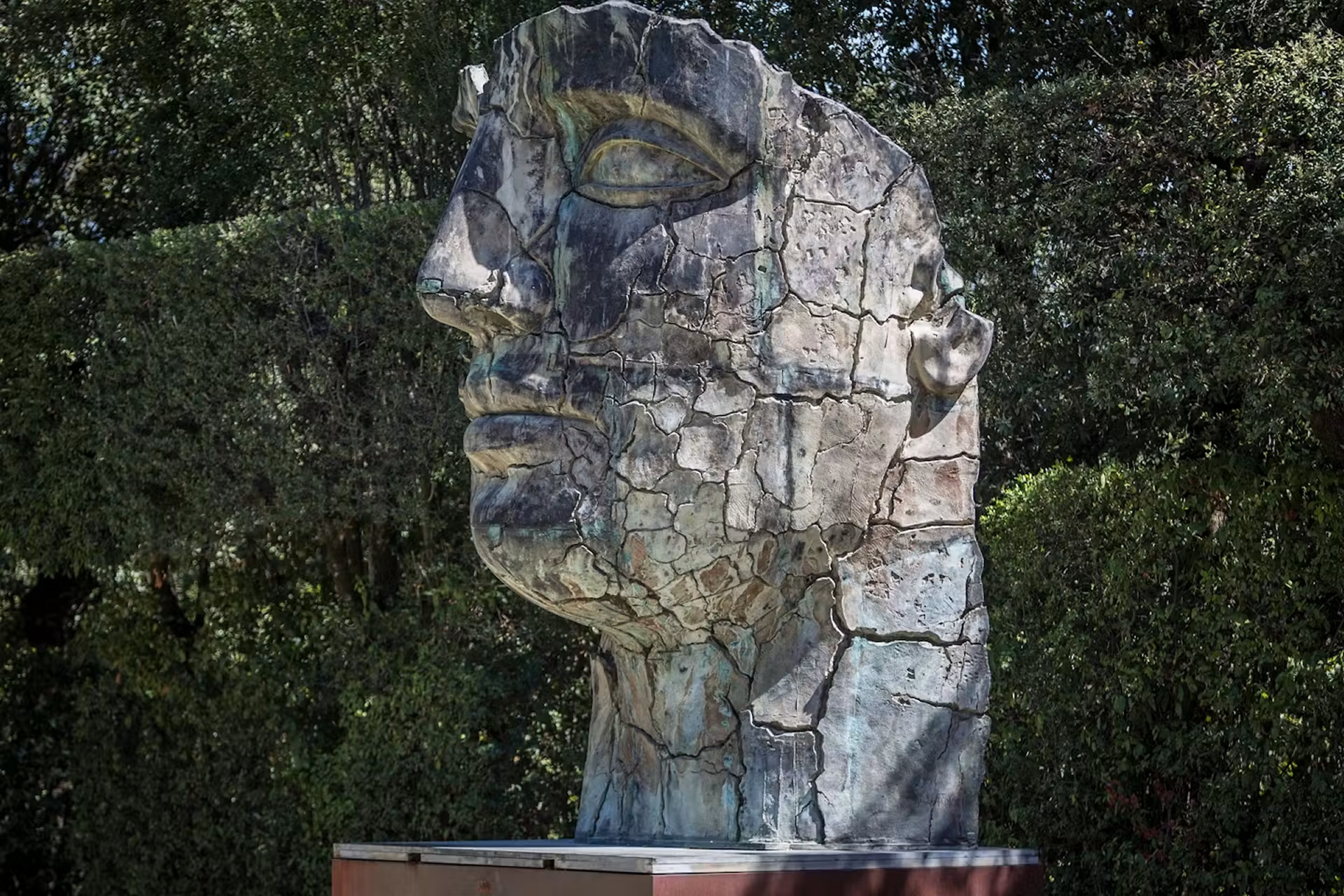
Art Note: Igor Mitoraj, Tindaro Screpolato (Tyndareus Cracked) (1997). Named for a king of Sparta, the face is cracked open along the line the Greeks drew between the citizen and the man — the shining public mask split to show the private darkness it was built to hold apart. Boboli Gardens, Florence — Gallerie degli Uffizi. Donated by the artist to the Uffizi Galleries.
