TEACHING CHARLIE CHAPLIN AMONG THE POETS THE IMAGE AS FORM AND INFORMATION By Stephen Tapscott *** The Montréal Review, July 2025 |
|||
I. The Solution
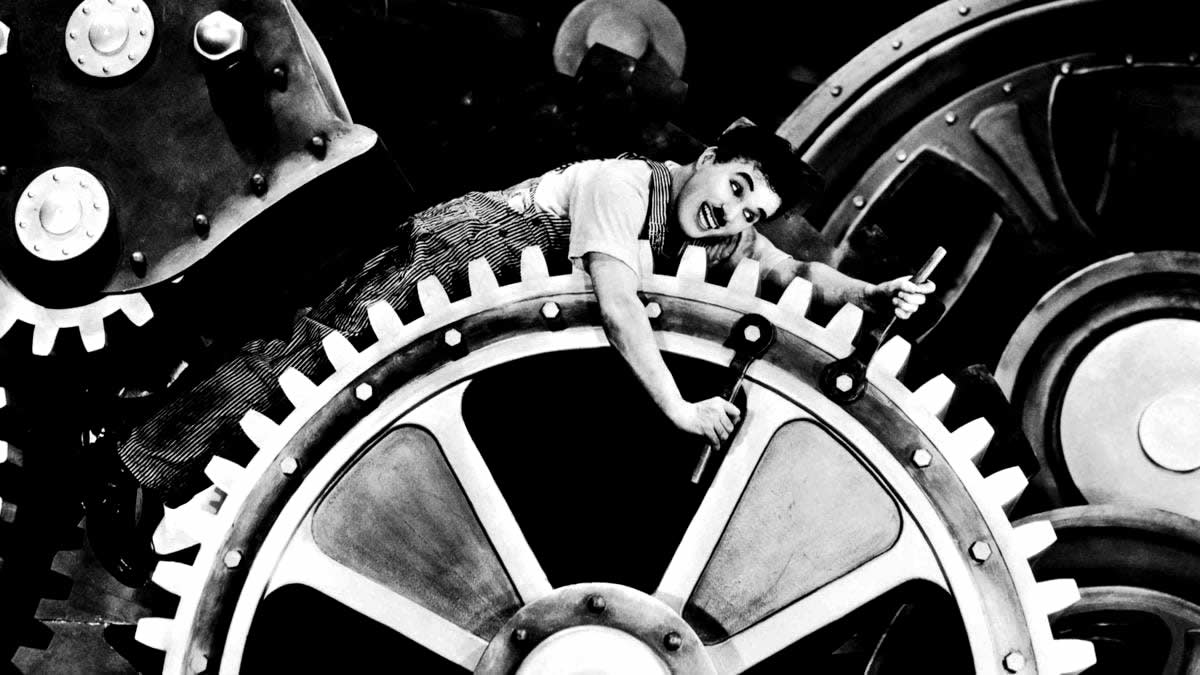
Admittedly, the solution preceded the problem. Or, at least, the practical solution did. This seemed at first provisional. But it helped me to define the fuller ideological problem. About three years ago I began to teach Charlie Chaplin in my course in Modernist poetics and aesthetics, at MIT. The course, which I'd taught intermittently since the 2000-aughts, had begun to wobble a little in my understanding of Modernism as a cultural context. The students hadn't changed substantially, neither in who they are nor in why they’d want to read these poems together. They represent(ed) a cross-section of MIT undergraduates: insightful, overcaffeinated, poorly prepared in general, well prepared for each class session, visually adept, comfortable with abstractions within symbolic systems, naive, goofy-lonely and grateful (therefore) for community, a little silly sometimes, lurchingly sentimental at the end of term. (Clearly, I had already been thinking of my students as personifying Chaplin-like qualities, before I'd asked why.) I had had a hunch that Chaplin films might be useful as a structure in the course. I followed the hunch. When I later asked the new structure why it had worked, the answers invited a new configuration of the field (20th century arts/creative writing), especially in the relations between verbal and visual forms and between high-culture and pop-culture energies. I realized that I’d been thinking for a while about Chaplin, the artist of articulate silence, as a kind of poet—and/or that at some point the techniques of poetry and of film had interpenetrated—and that understanding the Image, as the dominant stylistic mode of 20th-century poems and early film, required a new “spokes” person—a mostly-silent and visual and accessible one. In practical terms, I had been having trouble integrating several demands of our intermediate and advanced level classes on Modernism. The classes (I mean the needs of the class, also the preferences of the students!) wanted to read poems (English-language texts with occasional French and Latin American examples in translation) that were linguistically difficult (deriving from late-Symbolist aesthetic assumptions) but lacking full historical contextualization. Our method was mostly formal, straight-up close-reading with the advantages and disadvantages of that choice. After having acquired (ok, with some difficulty) some facility in reading these complex texts on their own terms, the students needed to distance themselves from the flattery of having accomplished that difficult task in order to read the ideological paradoxes of the poems' aesthetic positions. How could some of those experimental energies have been used in the service of conservative, even Fascist, energies? Or did the experiments come from those dangerous energies? And why did some writers trend radically right, while others, equally committed to modernist experimentation, didn’t? And how can we tell a poem’s diagnosis of a social malady from the author’s proposed “cure”? Some of the poems agreed in their analyses of social conditions, but some swerved right and some swerved left in their actual politics—and some maintained a commitment to the neutrality of literary form. This pedagogical difficulty repeated my own understanding of literary Modernism itself, which stands in an Oedipal relation to much of the rest of poetry in English in the last several centuries;1 the challenge to the generations of the Fathers has increasingly becoming part of the received "story" of Modernism. In general terms, I needed a way to contextualize these poems as interventions into their historical contexts (to hear vaudeville in the music of Eliot's "The Waste Land,” for instance; or to hear Mexican surrealism in early Langton Hughes poems; or hear suffering-on-the-home-front-in-London during WWI in Ezra Pound's translations of T’ang Chinese poems of longing). In practical terms, I needed a way to conceptualize the relation of text to cultural context in such a way as to make the students hear the echoes, the critique, and eventually the paradox of some Modernist poets' cultural conservatism braided into avant-garde experimentation. On a hunch, I tried showing some Chaplin films. I had hoped those films could allude to a popular cultural context, could open some discussion of the relation of image to cultural critique, and could take the place of some critical essays I'd been asking the students to read. And Chaplin is fun—and funny—, unlike some of the cerebral theory we’d been dutifully churning through. We started with Chaplin shorts, because their first appearances coincide with the theories and poetics of the Imagist poets, ca. 1912-5. Eventually I decided that the convergence of critical ideas was stronger if we'd use Chaplin's Modern Times (from 1936; the historical discontinuity was less a problem than I'd thought it might be—more on this later). In fact, Chaplin's 1936 use of the "older" form (the silent-comedy mode), like his adaptation of the vaudeville tradition from which he'd come, quickly became part of the argument, permitting discussion of the Modernists' own historicity (raising the question whether Modernist allusion is ipso facto historically conservative, for instance, or whether it anticipates a post-modern argument about collage and simultaneity). In any case, Modern Times is fun and fierce—and it summarizes aesthetic and formal values that Chaplin (or “Charlie” the Little Tramp) had represented for years. And by continuing to use using the earlier techniques, Chaplin was both extending and preserving his “tradition”—the dynamics of Modernist poetry from those years. Showing the Chaplin movies in the middle of the term-long course on Modernist poetry seemed to honor the imaginative and critical talents of my MIT students: their visual acuity, their comfort with dialectical thinking and with symbolic systems, their silliness and whimsy and kindness, their quick shifts from particularity to abstraction. Bringing Chaplin into our conversation, that is, invited the students into the interpretative process and into the historical conversation. After that expansion of the audience into the critical dialogue, the course seemed to expand. The Chaplin films took the place of both historical (viz., based in social class) context and of the literary theory that had entered the conversation through grim supplementary critical essays. (I’d tried to “dump” the theory on the table, but Chaplin embodied the theory.)
II. An Example
Here's an example (one of many, but I'll press it metonymically through this short essay). For a day or two, we considered the opening shots of Modern Times. A clock with Roman numerals on its stylish art-deco face gives the time during the opening credits. A placard, as for a silent film, reads:
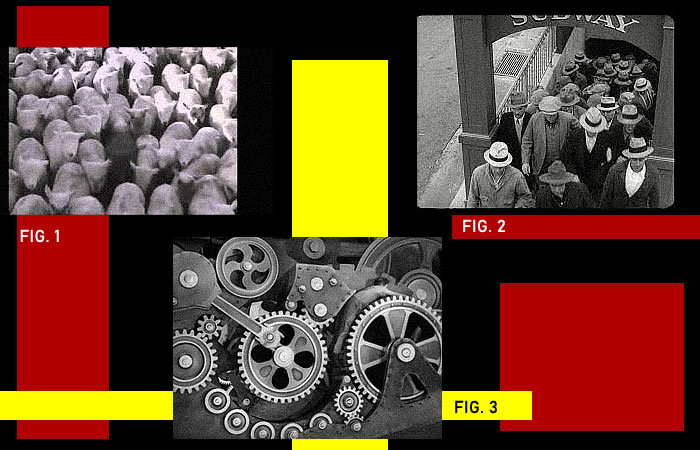
The music cuts from bombastic horns to a Puccini-like flowing melody to strings in pizzicato, in a parody of Gershwin. The first visual shot after the placard of "enterprise and progress" is a shot of sheep in motion, jostling a diagonal flow from upper right to lower left, apparently down the screen. (Figure 1) They seem to be on a ramp, as in an abattoir. (One black sheep bumbles through the middle of the crowd.) It’s hard to tell if the sheep are walking up or down... or else there’s an optical illusion involved, that they are walking up but the larger vision is down the screen. The students laughed at the first ironic dislocations-through-image. And we all were alert to the “black sheep” who is also profoundly one of the herd... Charlie as our black-sheep ironic hero, articulated and silent and democratically anonymous. In case we were not predisposed to identify with the black sheep, the movement of the herd on an apparent ramp leading into a slaughterhouse definitely pulled our sympathy in his direction....although he follows the flow of the crowd (or maybe because he does).
The next shot (Fig. 2) is a crowd of urban people, apparently at rush hour, moving on the same diagonal, at the same speed. They are climbing down an apparent subway ramp ("individual enterprise"), but the overhead camera-angle repeats the visual rhythm of the "sheep" shot: the more the workers seem visually to process up, the more they visually hurry downward. So much for “progress.” (After this shot comes a shot of the workers crossing an asphalt lot toward a factory.) Both the "sheep" and the "subway" shots have a rapid, jerky motion, slightly quicker than "real time" motion; apparently shot "cranking" at 16 or 18 frames per second, toward a projection-rate of 24 frames/second, the shots move with comic quickness that borders on the manic, the stressed... informative, interpretative, and silly... or else the workers are anxious about getting to work on time in the factory.2 The clock-face that had promised meta-progress is also a threat, the dreaded punch-clock. Similar composition and similar visual rhythms easily establish a relation between the two shots (sheep and workers) and so between the concepts the two images enact; the two visual movements overlap into a fade. The third element (the placard) had offered to unite the two shots but instead gives them a third term against which to test their convergence: at first the words (industry, etc.) fight against the "sheep" image, then that compromised image fights the ramifications of the "crowd" image. The interrelated images of doomed jostling sheep and harried, hurrying factory-workers makes an implicit argument about the exploitation of wage-capitalism, and then the ironic overlay of (the placard’s) positivistic rhetoric that that system uses to maintain itself (“progress”) makes the point even more strongly—and also implicates the (mis)use of language in the problematic system. Charlie may be silent, but there is language in the system—the problem is that the modes of speech, and even the rhetoric of the public discourse, belong to the people in charge. A poem/image-sequence can say little but suggest many significations. The students laughed again. We stopped the film and asked, what just happened? We described to ourselves what we'd seen, in as full an experiential account as we could. Someone in the room adverted to the concept of film montage. Some further questioning, and some timely hand-outs... I quickly sketched-in a little film history, through Serge Eisenstein's theories of editing, montage, and dialectic, at least enough for the students to have a vocabulary to describe what we'd already noticed, in the digression/parallel of the two visual images (within the ironic context of the positivistic/cynical public rhetoric).3 For the moment we set aside the verbal frame and, using Eisenstein, concentrated instead on seeing how, in the opening gag-like shots of the film, Chaplin ideologically/ironically locates the narrative eye of the film: the tone is both socially populist in its arguments (the workers) and elitist in its strategic vocabulary (the sheep), and yet critical of the received standard social rhetoric; both personal, democratic, present-tense (like Chaplin's choreography) and yet using as ironic referent a rhetoric of a slightly foreign, slightly nineteenth-century social diction. Like the Little Tramp's meticulous manners and his costume of seedy elegance (the “factory worker” dresses like a down-and-out aristocrat, and he has dainty manners), the combination suggests an argument about class, personified— both understated and objective in local strategy and yet blunt and subjective, even melodramatic, in its implications. As the students read the terms of this quick cut, they had already begun to evolve terms to discuss some of the recurrent paradoxes of Charlie the Little Tramp: his politics, his cultural positioning, his appeal, the rhythm of his jokes. (Film critics tend to call the recurrent Tramp character “Charlot”; the students and I felt more comfortable calling him “Charlie.” He was already both familiar and the black sheep whose individual fate anticipates a complicated social attitude. The film’s cast of characters calls him “A factory worker.”) At the same time, the work of addressing the question of "dialectic," especially through Eisenstein's theoretical relation between stylistic techniques and historical processes, prepared the students in the Modern Poetry class to read post-Victorian poems as systems of images in an historical process. Eisenstein was making a parallel between dialectical materialism and the changes enacted in film montage... that's how the opening shots of Modern Time work, and that’s how Imagist poems work, by abutting images in order to propose “mediated” further messages. It's not as if the Imagist aesthetic were wholly novel, in terms of literary or cultural history4, and yet in traditional terms, the sudden, consolidated, confident emergence of the Imagist aesthetic often seems (in the literary-historical narrative) like a bold, surprising innovation. Of course Ezra Pound cultivated that "shock," to advertise himself, to épater le bourgeoise, and to characterize the experimental nature of the new work (by D. H. Lawrence, Richard Aldington, Hilda Doolittle, and others in Pound's loosely-defined circle of "Imagists").5 The "shock" was not merely performative and new; in his synthesis into innovative fresh poems Pound did energetically fuse influences from R. W. Emerson's organicism, from Asian "pictorial" languages, from Henry James' commitment to "mute particulars," from the "presentation" theories of Joseph Conrad and Ford Madox Ford, from T. E. Hulme's insistence on the "lucidity" and communicability of poetic metaphor....and also, I think, from the experience of early (silent) films. In a famous lecture in Paris in 1911, Henri Bergson had lectured on "The Image," how consciousness uses images to mediate between intuition and abstraction. (Hulme attended those lectures and later represented Bergson's arguments, in lectures Pound attended in 1912.)6 The students and I had read that Pound swaggeringly laid down “rules”, as when in 1912 he lays down some principles for the Imagist poem:7
Pound elaborated the terms of these agreements: an 'Image' is “that which presents an intellectual and emotional complex in a moment of time... It is the presentation of such a 'complex' instantaneously which gives that sense of sudden liberation: that sense of freedom from time limits; that sense of sudden growth, which we experience in the presence of the greatest works of art."8 Others later elaborated Pound's proposals. Aldington for instance lists a few further principles:
Pound served as editor, apologist, theorist and anthologist for the movement, such as it was (W. B. Yeats confided to Lady Gregory that Pound probably had "more sound than taste").10 Pound also wrote the poems that come to represent the Imagist ethos. Therefore the students and I spent some time brooding over "In a Station of the Metro":11
In the abutment of these two images, one can feel the terse energy of early Modernist verbal aesthetics, in the insistence on the clean-lined and the cleanly-suggestive, in "classical" restraint instead of "Romantic" effusion. Of course one could follow the poem deeper into a rewriting of classical Greek myth [face : crowd : : petal : bough :: soul : Hades :: appearance : springtime-rebirth]. The story of Persephone lurks just under the surface of the images, as people/petals emerge from a dark "underground." (That the images of the modern machine-world of the subway and the ancient vegetal world reinforce one another, instead of contradicting one another, seems a Modernist/Futurist paradox of metaphorical-transformation. The myth apparently is trans-historically valid in different contexts.) In Pound's formulation (metro = Hades) the middle term ("underground") suggests an appropriation of modern facts and a resistance to modern urban experience, or to modern mechanically-mediated experience. The delicacy and ephemerality of the petals transfers through metaphor onto the human faces, which seem in fact already in "apparitional" form, as if they were already in a kind of hell, made to reappear only by apperception, by myth or metaphor, or by the power of the gods of spring-growth. The paradox that lies at the heart of this Modernist text is that its formal and cultural experimentation sometimes seem to point it in anti-democratic or anti-modern directions; as with other Modernist texts, their populist ambitions work against their elitist procedures. In the course of their critique of modern mediated experience, including their arguments about the "breakdown" of a "cohesive" Western culture, Modernist poets like Pound often worked their way toward paradoxes like those which the students had begun to recognize in our reading of the Chaplin-montage. Enacted in the visual model, however, the theory —and its paradoxes— seemed somehow clearer. Eisenstein himself had written on the relation between montage and the spatialiation of the image in the "ideogram"; Pound makes the same connection independently in 1913.12 We got to this point largely by remembering Chaplin’s image-triangulation, from the crypto-conservative public rhetoric of progress to the images of the sheep and the workers. The students quickly made these metaphorical connections. They read the equation [station : metro : faces : crowd : petals : bough] as a version of the ratio [workers : factory : sheep : abattoir], in terms derived from their reading of the "progress" shots from Modern Times. (At this point alert students noticed the differences, as well. Chaplin's irony seems tendentious, related to a single point because the middle term seems fixed, politically determined, while Pound's point seems more polyvalent, more Symbolist or mythic, less immediately political. As we'll discuss later, the mediation of the third term in Chaplin's example is in fact rather complex, because it problematizes the relation of verbal text to visual images.) At this point in our discussion it helped to reach these insights about Pound's verbal art by means of the visual paradigm: the cinematic model (“Chaplin”) located the discussion in terms of vision, image, and juxtaposition ("montage," enjambment, spatial form, the tension between what-the-placard-said-was-happening and what-the-images-in-the-montage-pictured) The film-method offered a necessary reason why these late-Georgian and early-Modernist poets moved toward the connotative Image. Traditional literary-historical accounts describe a movement against iambic forms, against ideologically-freighted rhetorical systems ("The will doing the work of the imagination," as Yeats had it), against even French-influenced interest in musical forms. The move toward the Image, however, represented a move toward richer connotation and toward new spatial arrangements on the page itself, in a new self-consciousness of the verbal medium as medium. (Williams later calls this attention “Objectivist.") Saying less, but in new compositional/visual rhythms, the layered Image opened more suggestiveness and perceptual latitude. The reader has more work to do, but oddly the poet has a greater degree of control—both in the arrangement of particulars and in the suggestiveness of their combinations. Pound makes this relation between film and the Imagist poem directly, in a short essay (1916) in which he describes the visual genesis of the "Metro" poem. He recalls that the central perceptual image of the Metro poem became "an equation...not in speech, but in little splotches of color." This equation is more closely related to film than to painting, however, he suggests, exactly because of the change and motion, the transformation, that cinematography by its very form enacts: "The state of mind of the impressionist tends to become cinematographical ....the cinematograph does away with the need of a lot of impressionist art."13 Pound moved beyond this "Imagist" stage within the next several years, in part because the "movement" was co-opted by the patronage of Amy Lowell. Pound remained interested in the illusion of continuity and metamorphosis, however; he called his "Hugh Selwyn Mauberley" sequence of 1920 a “prose kinema.” (Leave it to Pound to spell “cinema” with a K, as if it were an ancient Greek artform.) For our class, a few more advantages emerged from this use of the silent-film example to invent a critical vocabulary for talking about poetry. First, it honored the silence of the film and of the Imagist poem (I think of them as the silence of plants, emergent petals), a little removed from the jammering of manifestos that so often is provided as the context for this new work. And it allowed us in the class to consider irony as a structural principle, not only as an effect or an attitude. (Those lattter are the terms in which my students tended to read irony; it strikes me as no coincidence that those are the terms in which some early critics describe the image and the influence of Chaplin, when he first arrived in Hollywood.)14 Watch how closely the framing-words work in the people/sheep sequence of Modern Times.15 The two visual images are not simply juxtaposed; a verbal placard putatively connects the two shots, though misleadingly (establishing an ironic pattern that eventually emphasizes the disparity between the two visual images). "'Modern Times.' A story / of industry, of individual / enterprise — humanity / crusading in the pursuit / of happiness." Language sets the paradigm, then undercuts the terms of similarity of the images: the words in effect undercut their own veracity. This ironic silent film begins by ironizing the possibility of connective language, because the bombastic rhetoric of the positivistic official version is aligned with the official position of those who in the film's world control the technologies of speech. It’s apparently the bosses who want to convince the workers that their “sheep-like” experience represents “progress” and “individual... industry.” The verbal description fits the "human" side of the equation, but not the "animal" side (the tenor but not the vehicle). Or does it? Industrial progress seems to produce the alienation of workers from the results, the destination or the surplus-value, of their labor—but does such progress in effect require that alienation? The simple abutment of the two shots of motion (workers/sheep) suggests an incompatibility between the two concepts of motion (cultural progress/animal locomotion), ... and yet the third element—offered as a meditation or verbal integration, but in fact a misleading synthesis— makes a more complex ironic synthesis that escapes the confines that the first dialectically-derived synthesis of the visual images would seem to provoke. The framing-words fail to distribute signification across the parallel-shots, and this failure confounds our high-rhetorical expectations, in a reverse-Podovkin effect.16 Paradoxically, there is too much meaning in this system, and the superfluity of meaning, making impossible the direct equation of connotation and denotation, spills over into irony. Alert readers –-several students each term— recognize, here, a version of Linda Hutcheon's concept of irony as "surplus" meaning.17 It's worth remembering, in fact, that Hutcheon makes that famous formulation in the context of describing how post-modernist texts (not classical Modern texts) work. One of the problems of literary study in an era of post-Modern or skeptical theory is that on close examination it often seems clear that Modernist writers had all along been experimenting with strategies that are now described as characteristically post-Modern: allusion and collage work as structure; irony as both tonal and structural; the medium itself as both deconstructive and self-aware; artistic forms made of digression and assemblage and collage and disintegration and fractals and reassemblage; aesthetic theory saturated by a resistance to totalizing structures and master myths and coherent bourgeois concepts of selfhood. These characteristics are described a post-Modern (or, in a phrase that hurts the ear, “meta-Modern”), but they are derived from one line of the classic Anglo-American Modernist tradition (Pound, Eliot, Stein, Williams, Olson, et.al.). In this context, the Chaplin-paradigm also helped our Modern Poetry class by associating these high-culture experiments with popular-culture manifestations. Chaplin's example exacts that post-Modern turn toward the popular and the commercial, but it had begun several generations earlier than more traditional literary-historical accounts usually claim. Chaplin's example makes a clear sense of continuity, rather than an Oedipal rupture, in the traditional literary-historical story of the paradoxical critical narrative-of-ruptures (which is the received-standard account of Modernist aesthetics). Reading Modern Times in this way alerts us to the complexities of political positioning in an art that purports to be both populist and politically analytical: the same complexities that contemporary theorists of post-Modernism repeatedly rediscover.
III. A Synthesis
This temporal paradox –the continuity of technique—is one of the reasons why it doesn’t bother me, too much, that Pound and Joyce knew the early Chaplin films but not Modern Times. Modern Times was released in 1936; in the example we're discussing, the film couldn't have been an "influence" on the Imagist movement of 1911-15. The Chaplin model, however, did help the students in the Modernist poetry course to understand more clearly
At this point in our semester, it would be possible to make a case for a purer, simpler historical influence or confluence than our discussion has allowed. One could see Chaplin, or at least the image of the Tramp in his earliest manifestations, as a visual influence, even a theme, in Modernist literature. That image (as James Joyce suggested) underlies the physical appearance of Leopold Bloom, the Everyman-hero of Joyce's Ulysses (published serially in 1918-20, then in full, 1922), which is the background-text of. Eliot's "The Waste Land" (pub. 1922), after Pound had edited out the tracks of Joyce and of Chaplin from the earliest draft of the poem and before Pound began his Cantos, a Modernist Odyssey (begun in 1915).18 In this account of the "influence" of Chaplin, he'd be seen in the democratic representativeness and the silence and the sentimentality of the iconic figure, the Little Tramp. In this guise he appears in Hart Crane's lovely meditation, from 1926, on personal acquiescence to fate, and on the heart's resistance:
In the same year as Crane's poem, Carl Sandburg alludes to Chaplin's "large heart and contemplative mind," finding a similarity between the Tramp and Hamlet.20 The thematic genealogy of the Tramp extends later, through to the two tramps of Samuel Beckett's Waiting for Godot (1953), as well.21 I think it's plausible to see Lucky's "intellectual" performance in Act 2 of Godot 22 as an homage to the "Titina-song" sequence in Modern Times, in which silent Charlie, forced to work as a "singing waiter," performs a song of pure connotation that somehow also whimsically suggests a love-story. These associations are historically accurate accounts of causal influence, and critical accounts of them have been helpful and insightful. Fair enough. Still, I'm willing achronologically to discuss Chaplin's 1936 film in the context of earlier verbal texts, because a close reading of the visual text helps us to see the strategies of the poems more clearly, and it makes clear the continuity of the influence of these early Modern experiments. And it’s personal, as if “The Waste Land” had a single and empathic hero. Anyway, the Chaplin-figure (as “The Little Tramp”) is fully in character and in action and in imagistic collage-style by 1914, in a single-reel like “Kid Races in Venice.”) In effect, though, I think it’s downright helpful to use the later film. First, I'm interested to shift the story of literary/film influence a little. In my field, which tends to privilege literary history as the source of narrative, we're accustomed to accounts of the literary influence on film, even on the concept of montage as vehicle of transformation, mediated for instance through Eisenstein's observations about the literary roots (Dickens, Milton) of D. W. Griffith's "epic" techniques. I'm interested to tweak those assumptions, somewhat, in the interest of historical accuracy; Chaplin's Tramp does precede Imagism and Leopold Bloom (both in iconography and in technique). As a teacher, I find also that the strategies of "close reading" derived from New Critical literary study open the students' encounters with visual texts; the attention to specifics that the literary method demands grounds the discussion in confidence and observation (through the "structural rhymes" —Jakobson's phrase—of the Chaplin example, for instance).23 Nor is the method really so anti-historical or blind to ideology. At MIT, my students' willingness to follow any argument into an abstract mode depends on their acceptance of firm, grounded evidence. Another reason for supplementing the "literary-historical" account of this influence is related to the structural relation between lyric poems and narrative films. I think that the "influence" of Chaplin (by which I mean "Chaplin" as poet-figure, an icon of cinematic montage and of self-conscious irony as a structural principle, —a way of making “texts” visual so that their irony appears both structural and tonal) is more important, at least for the Modernist verbal arts, than that history of the transmission of the thematic image of the Little Tramp. Teaching Charlie Chaplin as a silent poet, and Modern Times as a summary of Chaplin’s stylistic and thematic commitments, helps me to recontextualize the "Modernity" of Modern poetry, as a set of provisional structural experiments involving the relation of connotation to denotation—or of the image to the word. Sure, we could do earlier Chaplin silent films, but Modern Times has all the structures ready in one place, and a more sophisticated argument about language, too. After a recent generation of resistance to Modernism as a set of literary tropes, and after a decade or so of revisionist, increasingly disappointed, critical readings of the politics of those writers and of their works 25 I've come to see many of these Modernist texts—Eliot's "The Waste Land" (1922), Williams' Spring and All (1923), Pound's Cantos (1925-69), Hart Crane's The Bridge (1930), HD's Trilogy (1944-6), Langston Hughes’ Montage of a Dream Deferred (1951)— as verbal experiments that work, with increasing desperation, to align their structural energies with a popular power like that of cinematic images. And they often aspire to a kind of silence, letting their images and allusions and abutments and ironies perform the work that in earlier decades a poem’s rhetoric had done. That’s why they’re difficult.... and Chaplin makes the difficulty funny, actually enacting what Pound had called a “that sense of sudden liberation: that sense of freedom from time limits” that the Image provides. These works aspire to film's combination of transparency, polarity, and dialectical process. Instead of contextualizing these poems in the fields of literary history, linguistic philosophy, and anthropology, I'm relieved to try to relocate those texts in the interrelated cultural contexts in which they were innovative —Oedipal, energetic, raunchy, popular, oddly conservative, provisional, provocative, as Chaplin himself originally was. Not surprisingly, restoring these poems to the context in which they were intended to be interventions makes their moral slippages sometimes seem even greater, because the border between "aesthetic" and "moral" vision, between high art and popular culture, is less a fire-wall against challenge; high-art aestheticism offers less protection to the Little Tramp than to Pound the high-art Fascist sympathizer. The socially-critical experimentation didn’t need, necessarily, to turn hard right. In our class on Modernist aesthetics and texts, it helps us to integrate popular narrative film with literary lyric forms that aspired to be similarly popular and provocative. Recontextualizing these Modernist poems with theory we've experientially derived from the Chaplin model, we conclude with the portrait of the audience-reception of Chaplin in James Agee's great memory-book A Death in the Family (1941), which recalls that earlier period of this century. I'm surprised and happy to remember how vulgar and disruptive and fun the Little Tramp had seemed in 1915, what an adjustment in family values he required, what a public-secret pleasure he was to share:
***
***
*** FROM THE ARCHIVES *** MORAL PARTICULARS IN LITERATURE By William Vaughan The Montréal Review, June 2025 *** TEACHING EMILY DICKINSON By Brad Crenshaw The Montréal Review, May 2025 *** By Marianne Janack The Montréal Review, April 2025 *** KAFKA TEACHES ME HOW TO TEACH KAFKA By James Martel The Montréal Review, March 2025 *** “VIVAS TO THOSE WHO HAVE FAIL’D”: TEACHING WALT WHITMAN By Stephen Haven The Montréal Review, August 2024 *** TEACHING MILOSZ: THE EVOLUTION OF A POET By Ira Sadoff The Montréal Review, February 2025 *** |
MONTREAL REVIEW CONTRIBUTOR'S ESSAY COLLECTION HONORED
|
||

The Montréal Review © All rights reserved. ISSN 1920-2911