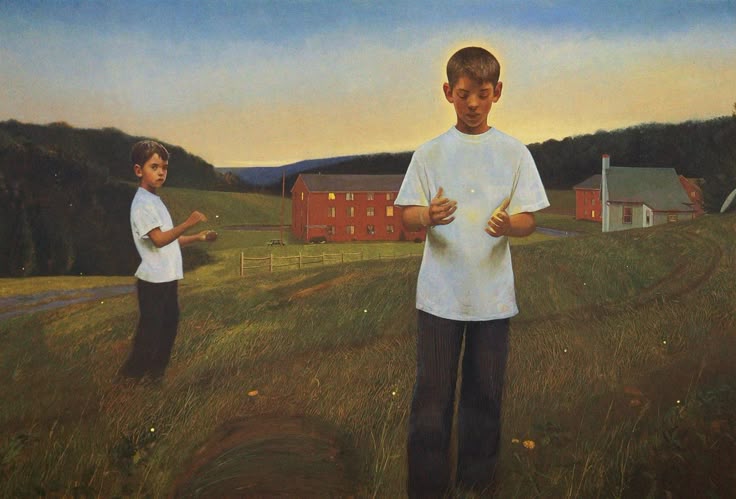
Firefly (1993) by Bo Barlett
“That Go-Liar was over nine foot tall!” Lester proclaimed to the men’s Sunday school group.
His twin, Lawrence, chimed in, “Nine feet, nine inches, over three of them cu-bits.” This made Goliath close to as tall as Lawrence and Lester put together, with Lawrence standing on Lester’s head.
Lawrence and Lester (no one ever said “Lester and Lawrence”) were stocky, well-muscled farm owners, my mom’s first cousins. Not ready to give up on Goliath yet, Lawrence added, “That gentleman could hold a bale a hay in each hand and tho it up to the barn loft from the ground. We could use him ‘bout now!”
Mt. Zion was a one-room church, so the four Sunday school groups (kids, older kids, men, and women) each had a circle. I was ten (and with the kids) and sitting back-to-back with Lester. While the men were glorying in the battle between David and Goliath, we were stuck with a watered-down version of The Sermon on the Mount, which still seemed generally way over our heads (“Blessed be he who gets to skip Sunday church to stay home to watch his great-grandmother, which happened to me every third Sunday—we talked about things like her two great fears, snakes and Communists, and how she remembered the “brushwhackers” from right after the Civil War). “,. . . And that David warn’t no more than fifteen er sixteen . . . imagine Jimmy Ben over thar fightin’ Goliar . . . be a purty short bout.”
“They say David searched and searched ‘til he found the perfect smooth stone for his ‘sling.’”
“’Smooth stone’—I like that—good luck findin’ one ‘round our ponds! That Roosevelt built purt near ever pond ‘round here. Them steam shovels dint leave no smooth stones.”
“’Smooth stone,’ my bo-hiney, ‘cuse my French. I’d take my shotgun an’ give ‘em a coupla shots a ought eight in tha face, then whomp ‘em in this big Phil-is-tine pecker!”
An impressive silence crashed down within the church at the word “pecker,” and the men, dressed in their starched Big Smith overalls and white dress shirts, acted dumbfounded to awake and find themselves in the company of foul-mouthed Buddy Poole.
I spent eight summers of Sundays in this church. My parents worked twelve hours a day, six days a week running their dry-cleaning shop (and my dad spent half of Sunday fixing the dry-cleaning equipment). They thought it would be “good for me” to ship me by bus the eight hundred miles from Hobbs, New Mexico, up to Spring Valley, Arkansas, to stay with my grandparents on their farm. And it was good for me, although my days were tinged with almost Old Testament type of violence. I learned pretty quickly that there wasn’t much for a young “city boy” to do on a farm in the summer except farm work, hunting, and trailing around with his grandmother talking to her—I quickly chose hunting and talking to my grandmother (my grandmother loved this since she was very isolated on that farm and my grandad was more of a worker than a talker), and, every night I played Chinese Checkers and dominoes with my grandmother (who, for some reason, called the dominoes “dominakers”).
All the farm people absolutely loved the idea of a city boy who was obsessed with hunting, so I was pretty much set (although, subsequently, I learned that an eight-year-old doesn’t especially have a good sense for what’s best to sustain nature’s natural order). As a hunter, basically left on my own, I shot pretty much every wild thing that moved (birds, frogs, rabbits, snakes—including poisonous water moccasins—if you scared them from the grassy bank into the pond, they had to swim slowly across the pond with their heads sticking about three inches out of the water—a perfect target). Year by year, my hunting arsenal expanded, from my Daisy BB rifle (which held 500 BBs and was made in a factory in nearby Rogers), to my Benjamin pump pellet gun (pump it six times and it was almost as strong as a .22 rifle), to my grandad’s bolt-action .22 Winchester rifle, to my grandad’s 20-gauge Remington shotgun (a nickel a shell, for me). At age eleven, I became ashamed of this mismatch of a battle and abruptly stopped hunting. It was like Daivd, armed with a Gatling gun, facing Goliath in battle. Unfortunately, I found myself much more often hoeing Johnson grass out of the cornfields and hefting huge shovelfuls of hard-kernelled corn into the feed grinder at the Co-op.
My parents and I weren’t church-going people. I’d like to say that attending Mt. Zion was spiritually enlightening for me, but it didn’t seem like it was, at least in the traditional sense. Instead, it was like a short visit to an alien planet once a week. I think it was like that for the good farm people of the Burk Shed community, too (I don’t know if Burk’s shed turned into this church). Everybody in a two-to-three-mile radius came to this church. And the minute they walked through the door it became possible for Noah to load two of every kind of animal in the world into a huge wooden boat he built by himself, although all the men knew how close to impossible it was to load one feisty heifer into a trailer to take to auction. Likewise, they took other biblical things right in stride, like Lot’s wife being turned into a pillar of salt for her momentary lapse of faith, when in their everyday lives they had to tiptoe around their own wives’ whims and idiosyncrasies all the time.
Johnny Poole was the only boy my age in the congregation. Every Sunday he came dressed in clean jeans, cowboy boots, and a long-sleeved “cowboy shirt,” with pearlescent snap buttons. In about eight years, he’d be killed in Quang Tri Province in Vietnam. Every Sunday I’d show up in clean jeans and a short-sleeved red, blue, or green Ban Lon shirt. Synthetic materials like Ban Lon were such a novelty in Spring Valley then that this served as a “dress shirt” and provided a flashy glimpse of the culture of the outside industrialized world.
Getting ready for church got incomparably easier when my grandparents got indoor plumbing my fourth summer there. No more baths in the metal wash tub in my bedroom. And going to the bathroom in the middle of the night got much easier, too, no more long treks to the outhouse in the copperhead-friendly dark. No more peeing against the green-painted concrete foundation of the house around the back side of the screened-in back porch. In the Old Testament I read about the Israelites slaying all those “who pisseth against the wall” in one of the many villages they conquered. Despite our nocturnal urinary activity, no one seemed intent on slaying my grandad and me.
Mt. Zion had a striking diversity of preachers rotating every week in a three-week cycle. One was a professional, but he also preached at Pilgrim’s Rest, a church on the highway to Springdale, three miles to the east (not on a dirt country road, like Mt. Zion). The rest were lay preachers, former preachers, visiting preachers, aspiring preachers, and one ultra-enthusiastic Sunday school teacher.
These preachers had very distinct rhetorical and delivery styles. One punctuated every four words or so with the shouted exclamation “Hah!” “If you believe, Hah! . . . in the sacred word, Hah! . . . of almighty Gawd, Hah! . . . repent, Hah! . . . repent, my brothers, Hah! . . . repent, my glorious sisters, Hah!” One cried the entire hour he preached, with crying being his way of breathing while talking passionately for an entire hour without pausing at the end of a sentence (I kept waiting for a break in the crying, but it never came, Hah!). One whispered, barely audibly. Everyone leaned toward him. The Holy Ghost was obviously whispering the message of God in his ear, and it seemed to come to us fairly directly, if very faintly (almost out of reach, but just barely in reach if you really put all your effort into grasping the words).
Up front, on a special display board to the right of the pulpit (they could slide out the old numbers, and slide in the new ones), they showed the weekly attendance (say, 68), the number of Bible chapters read by the congregants, 141, for example—I was always the champ here, with 39 one week), and the money given in the offering ($132.25 this week—my grandad always gave a five-dollar bill—thirty dollars now—befitting his position on deacons’ row). For my chapters I read the Old Testament almost exclusively. The New Testament seemed too tame and reasonable and loving to be much fun. I respected the words of Jesus, printed in red in this edition of the King James Bible, but I didn’t read many of them. “Yea, verily, I say unto you . . . .”
Not too far into the Bible, in Exodus, Moses asks God to “show him His glory.” God ends up showing Moses his “hindermost parts,” since showing him His face would have killed Moses. I pondered over this remarkable compromise for quite a while, never really getting a clear, realistic image. And I got it that Job didn’t create the leviathan and that God did. And I got it that Job was a righteous man and worked so hard to please God, but I had trouble seeing God’s problem with Job. I asked my grandmother about this, and she said, “You’re thinkin’ about it way too hard . . . you’re just supposed to read the chapters!”
My grandmother called lunch after church “Sunday dinner,” and she made the same kind of potato salad every Sunday. It was made mainly of tons of shredded boiled potatoes, with a yellow mustardy potato salad sauce. I liked it OK, but it wasn’t my favorite. She never cooked three-course meals, but twelve-course meals, with big bowls of mashed potatoes or pan-fried potatoes, fried okra, green beans, pinto beans, black-eyed peas, carrots, turnips, boiled “greens” in vinegar, etc., etc., and a big platter of friend chicken, and small bowls slaw, picked beets, and sliced cucumbers and onions in vinegar, with biscuits or cornbread (sometimes both). The star of the table was a big full plate of thickly sliced tomatoes from her garden. (Yes, there were only three of us, and one of us was ten and my grandmother never actually sat down to eat she was so busy serving the meal). My grandad seemed to eat a plate full of each thing (while continuing to be rail thin), then topped it off with a half a cup of hard homemade butter swimming in a plateful of molasses, which he’d eat with biscuits and/or store-bought bread.
After this meal fit for Goliath and his twin brother, he’d lie down on the white-rose-patterned linoleum (shoes and all) in the living room by the heater and go to sleep, as ordained by God (Sunday was a “day of rest”). No work whatsoever (except, of course, for my grandmother), no hunting, no shooting, no fireworks, no croquet, no talking about politics. So my grandmother and I played “hanged man” on the chalkboard by the refrigerator in the kitchen, and I drank tons of sweet iced tea. My whole life then could be measured in tall glasses of iced tea. I had no concept of caffeine, but I kept it coursing steadily through my veins.
The choir and the singing was always joyous, loud, and fun, and filled the church to the brim (and probably drifted quite a ways beyond to the fields of oats, alfalfa, and corn surrounding the church). My grandmother sang in the choir enthusiastically, but my grandad and I just listened (and I read along in the hymnal). The song that struck me the most was “Uncloudy Day.” In the sweet by-and-by, during that perfect time we longed for, would come the long-awaited uncloudy day, peace on earth, heaven, eternal bliss. As I got older, I thought about this objectively. In Spring Valley in July, ninety-six degrees, with enough humidity to float a boat, what you really wanted was a cloudy day, and I bet that’s what they wanted in Palestine, too.
Mabel played the piano for the singing. She played it loud (the chords strongly and continually pulsing in your body), her son Jimmy sitting close to her on stage for comfort. Mabel had a huge limp and a huge jaw on the right side of her face. Jimmy got the jaw but not the limp, and he couldn’t talk. He was twenty-two but looked twelve. He seemed rapt and peaceful sitting by his mom, bathed in the warm and refreshing music of salvation. Later, I would think Jerry Lee Lewis played just like Mabel. Like Jimmy, during the hymns, I felt buoyed and uplifted (held close and saved), with all the rough things in life smoothed out. We were happy and totally alive, sailing on a sea of faith, rejoicing together like self-righteous honky tonkers intoxicated by the music.
Easily the most dramatic feature of every Sunday service was “testifying.” Three or four self-selected members of the congregation would stand up and testify about their recent interactions with the living God. Velma, for example, would say, “We thank ya, Gawd . . . and Jesus . . . for all the wonders you shown us in our lives . . . Esther Lea finally got taken by the cancer—blessed, blessed Jesus! And Wanda Mae’s Elmer may lose that hand where the bull kicked him—dear Jesus! . . . and Billy Dean got the polio—hear me, Lord! . . . and my Thelma Lou, God have mercy! may lose her foot to the diabetes . . . .” The cumulative message of all the testifying, to me, was that these good people have suffered mightily and steadily and taken it all in stride, day by day and week by week, but “Please, Lord, don’t hurt us no more—we’ve had enough for now . . . !”
I guess I did learn something about spirituality those summer Sundays. If God was anywhere, He was waiting just above those varnished hardwood oak pews between ten and noon each Sunday. Unique in my experience, every person there had a good opinion of me, wished me well, and expected great things from me (except for maybe Johnny Poole—I could never get a good read on him). I was Hettie and Berry’s grandson, Erma Jane’s boy, from “out West.” I was polite, respectful, loved to hunt, and they were lucky to have me there for the summer. I wasn’t overly proud of my Ban Lon shirts or my “city” way of life, and I clearly loved their way of life.
Ideally, God manifests Himself in the everyday attitudes and actions of His people. Somehow, in that place and time, they had gotten the Word, and it showed. The power of God is absolute, if whimsically applied, and His grace clearly shone on Mt. Zion Church and me those Sundays. 
***
W.D. Blackmon served as Department Head of the English Department at Missouri State University for twenty-two years. He won a Book-of-the-Month Club Fellowship Award for his fiction writing (with Saul Bellow and Ralph Ellison as the judges), a Woodrow Wilson Fellowship (for future university teachers), and a Special Fellowship in the Humanities for Creative Writing at the University of Utah. His short stories have appeared in such publications as the Associated Writing Programs' Intro series (with R.V. Cassill as editor), The Kansas Quarterly, The Mississippi Review, Short Story, The Carolina Quarterly, and the Western Humanities Review, and his critical work in The Denver Quarterly. His book, Blood and Milk: A Novel in Stories, was published by Et Alia Press in Little Rock, and Inside Syria: A Physician’s Memoir (co-authored with Tarif Bakdash) was published by Cune Press.
|
***