CO-NAVIGATION* By John Lee Clark *** The Montréal Review, June 2026 |
|||
I. In 1996, my father—Lee Clark, a DeafBlind community leader and educator based in Minnesota—and a hearing-sighted colleague of his, Linda Hanke, were invited to present at a conference in Vancouver, British Columbia. Dad decided to take all of us there and make a little vacation out of the trip. I was in high school and it was my first international flight. The majority of the attendees were dewy-eyed college students studying to be “Intervenors.” The Canadian presenters spoke incessantly of the value of “intervention,” a word that baffled me. When it came up for what seemed the thousandth time, I nudged Linda and asked what it meant. Her explanation stunned me. “Intervention,” she said, crinkling her nose at the term, “is where you interrupt, step in, take over. In order to fix something or prevent a bad thing from happening.” “Do you mean,” I asked in mock wonderment, “we DeafBlind are the bad thing that’s going to happen?” “That’s the idea,” she said. We both laughed. We were assured that we had it much better in the United States, where, instead of Intervenors, we had Support Service Providers. I remember sitting back with a sense of satisfaction. Our feeling of superiority, however, was not at all warranted. Yet the concept of “intervention”—the sighted leading the blind—did and does deserve our scorn. At the time of the conference, the most recent published definition, from the Fall 1995 issue of Deaf-Blind Perspectives, alarmingly read: An intervener is specially trained to provide clear and consistent sensory information to an individual who is deaf-blind, compensating for both vision and hearing loss in such a way as to facilitate and enhance learning and interaction with the physical environment and with society. An intervener acts as the eyes and ears of the individual who is deaf-blind, making him or her aware of what is occurring and attaching language and meaning to all experiences. An intervener intercedes between the individual who is deaf-blind and the environment in such a way so as to minimize the effects of multisensory deprivation, and to empower the individual to have control over his or her life. This and virtually all other explanations of variously named “sighted guide” or “guide slash interpreter slash teacher” roles make obligatory reference to empowering DeafBlind individuals—it is always “individuals.” The conference’s keynote speaker, a jovial leader in the Canadian National Society of the Deaf-Blind named Kerry Wadman, stopped joking long enough to remind his audience that “we have dreams and desires, too,” and that “Intervention, as we want it, is the provision of an interpretation of what is going on and leaves the final decision up to us.” All I remember of Kerry at the conference was how fast he spoke ASL, how often the audience laughed, and how disappointed I was when, that evening at the banquet, Mom advised against my approaching Kerry, who was by then roaring drunk. I am thankful that a record of the conference proceedings survives, because Kerry’s address, titled simply “Intervention,” is a fascinating study in missed opportunities. There are openings in the discourse Kerry had offered for our simply seizing the world, but he, like the rest of us, had ceded the world to a sighted person, whose job it was to tell us about it and hand over whatever “final decisions” we made. Though an ardent advocate of intervention, Kerry was aware of how the ASL word “intervention” is identical to “interruption.” He called a part of his speech “Great Interruptions.” This section was devoted to hilarious misadventures with Intervenors, and he dexterously used these anecdotes to disrupt his own speech. “So sorry, folks!” he had said, interrupting himself. “There is this thing called intervention.” Cue in audience laughter. One story he shared was about the time he was at the subway station. Someone tapped his hand and he reached out, only to have his face slapped. His hand had landed on a lady’s bosom. Cue in more audience laughter. Kerry continued with his story. Tucking in his hands, he waited for his Intervenor to arrive. When she finally showed up, they left the station and began walking. And they kept walking, until Kerry stopped in his tracks and exclaimed, “Where the hell are we going?” “Following you, Chief!” was the Intervenor’s prompt reply. As I write this, I can feel Kerry throwing up his hands here for comic effect. Little did he suspect that what he went on to say had stopped short of a very real possibility, something that has now come to pass. But we can honor him for having come so close, and we can understand the shying away that ensued, because we all stopped short for so long. Laughing at his own story, he quipped, “Since when do the blind lead the sighted? I knew of the blind leading the blind, but this was ridiculous!”
II.
For about thirty years now, the DeafBlind community in the United States has held two seemingly contradictory positions. One is that access to paid sighted guides—called Support Service Providers, or SSPs for short—is the top issue in our advocacy efforts. Currently, about half the states have an SSP program of some kind. In the states boasting the most developed and well-funded programs, each enrolled DeafBlind person can use fifteen, thirty, or as many as forty-five hours of SSP services per month, which enable us to go shopping, run errands, go through our mail, pursue recreational activities, attend events, and travel. In other cases, we must make do with ten or fewer hours a month. Where there are no SSP programs, we are forced to rely on family, friends, and volunteers, which frequently renders it impossible to do or ask what we desire. There is no national SSP program. The situation varies from state to state, and many DeafBlind people migrate for the express purpose of living in a state with more SSP services. Wherever there is no such program, we and our friends have lobbied long and hard for this essential resource to be established. It’s an arduous process because hearing-sighted policymakers would rather grant us almost anything else. They have directed millions upon millions of dollars into technology, medical research in the never-ending search for cures, education, pretenses at employment, and even the training of dog guides to the tune of more than fifty thousand dollars per canine. People who sit in cubicles are eager to thrust upon us solutions other than what feels natural and vigorously pragmatic: working with fellow human beings. The other thing that’s just as enduring as our demand for SSP services is our loathing for the term “Support Service Provider.” In some countries, more benign or less heavy-handed titles are used, such as “Communicator Guides” in the United Kingdom, “Communication Guides” in Australia, and “Interpreter Guides” in Brazil, though Brazil also has the more problematic “Instructor Mediator” title. But Canada takes the prize for having the most transparent title of all: “Intervenor.” The past thirty years has seen a steady stream of proposals in the United States for a new name, including “Access Assistant,” “Environmental Information Specialist,” “Driver-Guide,” and “DeafBlind Services Provider.” We all agreed the old name had to go, but we couldn’t agree on a replacement. Was a change in terminology all that we wanted, or were we vaguely aware of a deeper problem with the concept of a guide? When Protactile slid under our arms and tugged, one of the many things that startled us was how inappropriate the theory and practice of guides suddenly seemed to us. Implicit in the act of sighted guiding is the idea that there is one world and one truth, the guide’s. Indeed, we had routinely explained to policymakers that SSPs were our eyes. How could we go out there without eyes? The SSP’s job was to tell us about the world while steering us away from interfering with it. Grasping our guide’s elbow, we glided around like a dream, never making contact with anything or anyone to awaken us. Sometime around 2010, Terra Edwards, a long-time volunteer SSP and at that time a graduate student, and Jelica Nuccio, her DeafBlind companion for that evening, went to a community event in Seattle. Typically, Terra would have launched into an explanation of what was going on in the room, telling Jelica who was there. On this night, however, Terra asked Jelica to tell her about the environment. Jelica paused, for this was an unusual request. Asking a DeafBlind person for information was something sighted people rarely ever did. As Jelica proceeded to enumerate what she smelled and felt, Terra was, as she later told me, “surprised by how much she had to share with me and then a feeling of sadness followed.” The surface of distantism had been pulled back when Jelica revealed another realm. Terra experienced regret because she had, as a well-schooled sighted associate of our community, worked so eagerly to keep distantism intact. “Now,” with the advent of Protactile spaces, she noted, “it is a tactile surface that is broken when distantism breaks through and the feeling is more one of annoyance.” It was Terra who coined one of the most important new habits for sighted people making the shift away from intervention: not-acting. That is to say, to stay chill. If they see a DeafBlind person heading toward a wall, for example, their old impulse is to rush forward and prevent an imagined collision from happening. The reality is that we seek out walls all the time, we bump into things all the time, and we are forever and fluently fumbling. As I repeatedly point out to sighted students of co-navigation, “We go about our business every day, twenty-four hours a day, so why should it suddenly be different because you’re there?” There are two keys to sighted co-navigation, whether one is working as an SSP or moving in another capacity, as a friend, colleague, family member, or partner: not-acting and joining-in instead of intervening. Suppose we enter a room and, while taking off our coat, drop our keys. In the past, a sighted person always pounced to pick up our keys. So consistent was this behavior that if we knew there were sighted people around, we wouldn’t bother reaching down to start looking for our keys. Now, with the Protactile shift, the expectation is that sighted people not-act. They are to continue doing whatever they were doing. We will reach down and start searching for our keys and we will soon find them. In fact, whenever we did go ahead and look for the keys at the same time a sighted person tried to help, either we found them first or the help delayed the retrieval of our keys. We could have been on the verge of grabbing our keys, our fingers a centimeter away, when a sighted person seized our hand, telling us they’ll get them for us. It never made any difference to them whether we were seemingly going way off or just about to recover our keys. They insisted on taking care of it for us. Why? Because, for them, anything we did in our way, the way we did things in private, was the wrong way. If it happens that we are already with a sighted person, chatting with them, when we drop our keys, our new model of co-navigation dictates that the sighted person do one of the following things: One is to do nothing except maintain co-presence, such as keeping their hand on our back or their leg against our side, as they check their phone or take a sip from their thermos while we fumble for our keys. Or, two, they can signal on our back, to suggest that we fumble toward the left, a little farther up there, bingo! Sometimes this additional information is redundant; sometimes it’s helpful. Either way, it is a contribution to, and not a replacement of, our process. Or, three, we can both reach down, our hands together, and when they touch the keys, we also touch them. They are never the one to take up our keys “for us.” At the heart of not-acting and joining-in is the recognition that our way is legitimate. Co-navigation embraces an ecology in which DeafBlind people are a force that shapes the world. The term “co-navigator” points to the fact that there is another navigator, someone else who is also navigating: us. For this reason, much of sighted co-navigation involves doing “nothing.” No need to jump up, no need to freak out, no need to swoop down. But it doesn’t mean leaving us alone. Quite the opposite: Our process is not exclusive of sighted people. They can join us. They can learn how to fumble along with us. We often want to fumble together. A mixture of not-acting and joining-in also results in the reversal of who does the most moving around. Sighted people who intervene to help or guide lunge forward, wave at others to get out of the way, call to people from across the room, and fetch things or speak up or take an item off a shelf or open a package or fill a cup or press buttons or carry a tray or throw items into trash cans for, for, for, for, for, for, for, for us. To facilitate the sheer amount of movement they wish to do on our behalf, we were asked to stay and wait. Co-navigation is the opposite. We do most of the moving, routinely leaving sighted co-navigators behind. Because we hated being told to wait, we don’t degrade them by parking them. Instead, we talk about when and where we’ll rendezvous. “Okay, I’ll find you there in about fifteen minutes!”
III.
It’s no wonder that the grating moniker “Support Service Provider” did not budge until it became much more than a matter of vocabulary. Protactile showed us that something beyond notions of mere access was at stake. People in the movement were busy creating new resonances in our lives when, on June 11, 2018, Jason “Jace” Judy of Ohio sent a message to the DeafBlind Studies listserv. It bore the subject line “Do we need to change the SSP term?” Something on Facebook had caught his attention, a proposal to replace the hated term with “Access Provider,” and he asked our opinion. We promptly nixed “Access Provider” and began tossing around alternatives. Some became running jokes, such as the one about our being superheroes with sidekicks. My literary turn of mind found me, on June 21, conjuring up the likes of “Valet,” “Chauffeur,” “Amanuensis,” and “Lieutenant.” Somewhat incongruously for this cast of characters, I added “Co-Navigator.” I was thinking of the role of ships’ navigators in relation to their captains. Upon landing on “Navigator,” however, some intuition, a collective filter, nudged me to resist and move beyond the master–servant or executive–assistant symbiosis we had been riffing off of. Indeed, such relationships are apt to flip sides. It must have been the subtlest of impulsions that planted the “Co-” prefix, but once lodged, it was obvious where it had come from. “Co-presence” was already a central concept in our discourse. “Co-creating meaning” had come up a few times, as had “co-conspirator.” And we were always talking about navigation. As I pressed Alt-S and this list of terms slipped into DBS members’ inboxes, I decided not to overtly push for “Co-Navigator.” As it happened, I didn’t need to. Lisa van der Mark from the Netherlands was the first to second it, or not quite second it, for it hadn’t been specifically proposed, but she did lift it out of the tangle of ideas to declare how much she liked it. Tashi Bradford, who was then studying in the United Kingdom, said she still preferred “sidekick.” Then a shout came from Ottawa, Ontario, Canada: “Co-Navigator!!!” This was Robert Sirvage, who launched into a discussion of how the term could more deeply inform our movement. Among other things, it was an answer to problematic practices in the field of Orientation and Mobility. Robert recalled for us a conversation he had with a hearing-sighted instructor who specialized in teaching DeafBlind people how to travel with a white cane. He had asked the instructor if he taught DeafBlind folks how to walk together with another DeafBlind person. The instructor was dumbfounded. When Robert asked the instructor how he conducted his lessons, the specialist explained that he would go to a location in advance, such as to a subway station, and map out a route, converting his visual observations of the space into tactile landmarks he then gave his student to follow. After receiving this explanation, Robert inquired of the instructor, “Why not just walk together with your DeafBlind student to check out new places together, and use both of your experiences as a starting point for discussion? So that both of you can build toward an understanding based on what is actually within a DeafBlind person’s sensory grasp?” Once more the specialist was flabbergasted, and the only response he could muster was: “But it would be so unsafe!” After recounting this exchange, Robert again shouted, “Co-Navigator! Love it! This paradigm shift will pave the road for Orientation and Mobility to hire DeafBlind instructors because only we know how to co-navigate. Don’t let the guy who uses safety as the reason for everything fool you.” Robert was referring to the Protactile movement’s number-one precept when he said “only we know how to co-navigate.” If a model requires sight or hearing, it isn’t the right model. If it’s something that we can do ourselves, then it may be the right way to go. Sighted co-navigation is based on the co-navigating DeafBlind people do together. A sighted person adds an inflection to the process. The way two DeafBlind people co-navigate isn’t the same as a sighted person and a DeafBlind person co-navigating, but the point is that the model itself does not require sight or hearing to work. Almost immediately, we were blessed with the perfect opportunity to test a complete overhaul of “provider” language and thinking. Seven of us Protactile educators gathered in Monmouth, Oregon, during the week of August 6 to 11, 2018, to immerse thirty-six interpreters in our world. We were already going to teach them a very different way of doing “guiding,” but now we had a new name. And it was so self-explanatory and suggestive of rich strata of meaning that, as we proceeded, we went deeper than we would have without such a designation. One of the educators, Oscar Chacon, wrote to the DeafBlind Studies listserv about his experiences during that whirlwind week. In the beginning, he had felt tense, at odds with the location. But by week’s end, he told us, “with the interpreter-trainees becoming our co-navigators, the environments and I were already good friends because I had partners to complement their receptions of environmental stimuli with my own, which I shared as well.” He felt like he and the universe had finally clicked. “The astonishing multiplying power of Protactile!” “Great post!” jumped in H. L. Pavey from Texas. “I had to do a fist-bump in the air and internally say ’YES!’ when I saw the word ’co-navigators.’ That’s a term I want to experience a lot more!” She then noted how society does love acronyms and jokingly wondered if it is to be “CONG.” “I’m a little bit silly here, excuse me!” The settled acronym proved to be the much duller “CN,” but it quickly gained wide circulation. During the ensuing year, a comprehensive theoretical exploration of co-navigation anchored the discourse within the Protactile movement. On July 28, 2019, Victoria Magliocchino, president of the Florida DeafBlind Association, asked the DeafBlind Studies community for input. The board of directors had brought up the need to get rid of the “SSP” term for a program they ran. Vicky had suggested replacing it with “CN,” and reported that, “The board seems to like the term ’co-navigator,’ but they want to make sure the term is appropriate. I explained my reason: A DeafBlind person co-navigates with a sighted person and they work together to gain access.” On August 12, 2019, the earth shook with the news that our new term had been formally adopted by an organization for the first time. In her celebratory message, Vicky wrote: I am very excited to announce we the Florida DeafBlind Association (FDBA) Board has agreed to change the term Support Service Provider (SSP) to CoNavigator (CN). The new term shows that the CN works WITH the DeafBlind individual, making her or him autonomous. FSSP is now FCN—Florida CoNavigators. No hyphen, just like “DeafBlind.”
IV.
The emergence of Protactile is such an epoch-maker that there is a Before and an After. We who are in the After regard Before with disbelief, laughter, and outrage. What went on Before is the stuff of slapstick comedy or historical trauma or, not infrequently, both. When we bring up something from Before, those of us who were there will say, “Whatever were they thinking? Why didn’t we know?” Those who only know the After are incredulous: “How is it possible anyone thought that was a good idea?” As it happens, what SSPs did—and continue to do, if they haven’t changed or been fired—provokes the most gasps of both mock and genuine horror: “No way! Really? Impossible!” Before, each time an SSP came to pick us up, they stepped out of their car, walked up to our door or the entrance to our building, tapped our shoulder, and, after a greeting, gave us their elbow. We took it and followed them to the passenger side of their car, whereupon they opened the door for us, often holding our head down like a police officer does on television. In the worst cases, we were expected not to close the door but to let the SSP close it. This was low-grade torture, because our natural inclination was to reach out to make sure the door was closed but at the moment we reached out to find out what was going on with the door or why it was taking longer for the SSP to close it than we anticipated it would take, the door sometimes slammed on our inquiring hand. There were also horror stories—considered as such even back then—where an SSP put on our seat belt for us. After, when a CN picks us up, we typically have them wait inside their car as we go out to meet their car. We feel our way to the passenger side door, open it, and reach in to make sure it’s them. The CN says “Hey you!” or gives a thumbs up, and we slide into our seat. We may greet them first before closing the passenger side door, or we may close the door first before turning to greet them. We put on our seat belt ourselves. Before, while holding on to an SSP’s elbow as we walked along sidewalks, they occasionally stooped to indicate that we should stoop behind them, or else they tried to pull us down. This was for us to avoid hitting our head against a low tree limb hanging over our path. The awkward procedure rarely worked. For example, the SSP often stood up once they were safely beyond the tree limb’s leafy reach, only to have us stand up at the same time, knocking our head on it anyway. After, with a CN walking side by side with us, our hands together, always communicating, they mention that there’s a tree. We both reach up to touch the tree’s shivering lushness. It is the simplest thing in the world to pass under the tree limb while or just after touching it. Before, during more than a million combined trips to grocery stores over forty years of the Support Service Provider era, the SSP routinely took the front end of a shopping cart to pull it while we held on to the handle behind the cart. Thus we followed the cart on its hypnotizing wending way through the store. It stopped now and then for the SSP, consulting our shopping list, to put items in our cart or to ask us a question. “For Rice Chex, do you want family size or regular size?” A troubling trend was how the SSP treated our shopping list as a source of authority greater than we ourselves were. When we changed our mind, such as dropping red plums in favor of fresher black plums, they told us, “No, your list says red plums!” After, with CNs, we both walk behind the shopping cart together, always communicating. When we stop, we both reach for an item, and it is we who take it down from its shelf and place it in the cart. We roam around with our hands regularly as our CN adds information about what we are touching. Many times we feel for something without the CN knowing, or needing to know, what we are looking for. We ourselves may not always know and may be curious, or we do know, we know what the item feels like among its counterparts. Before, an SSP always freaked out when there was a slip or an accident, such as our colliding with a pole after they had looked away. “Oh, I’m so sorry! I wasn’t paying attention! It’s my fault!” Operating as “providers” as they did, they wielded a great deal of control, but it also came with an awful, self-absorbed sense of responsibility. Actually, they apologized so ardently it’s a wonder “SSP” didn’t stand for “Sorry Sighted Person.” After, when we’re walking with a CN and a pole hits our shoulder, they pause. If we shrug it off and continue, we continue. They don’t say anything about it. They don’t freak out. This is because our bumping into things is the norm, and they recognize that. We are still responsible, we still do our own navigating. Just because we are with a CN doesn’t mean we stop navigating, stop using our cane, stop attending to the fact we are two people journeying together, covering for ourselves and each other. If we get hurt, the CN asks, “Are you all right? Where does it hurt? Oh no! Do you want ice for that?” This is the concern and care of a fellow traveler. Before, an SSP asked us what we wanted from the bank teller, and, upon learning the transactions we wished to be made, they proceeded to engage with the bank teller. The SSP told the teller to make this deposit or that withdrawal. From time to time, the SSP asked us for our identification card or relayed to us a question the teller had that the SSP didn’t know the answer to. If a silence stretched on for too long and we asked what was going on, they often said, “Wait, I’m talking to the teller” or “Explain later.” Also, it was always to the SSP that the teller said “Good morning” or “Have a nice day.” The SSP always responded in kind, sometimes letting us know what the teller had said too late for us to say “You have a nice day, too.” After, our CN does not ask us in advance what we want to accomplish at the bank. When we approach a teller, the CN gives us a quick sketch of who the teller is—their appearance, race, gender, approximate age, general disposition, the name on their tag—and what they’re doing. “Now she’s looking up at us, smiling. Says, How can I help you today?” We may, for example, reach over to take the teller’s hand and gesture with it to request paper and a pen. Our CN says, “She understands. Now looking for a piece of paper. Found one, handing it over—toward me.” The CN does not take the piece of paper, but merely reports the fact that the teller had handed it over to them. We take the piece of paper, to establish and continue a direct link with the teller. Our taking initiative for every stage of every interaction leads to the building of relationships, such as with a bank teller whose name we remember the next time, and “Good morning” evolves into “How are your kids doing” and “Shh, here, I got this chocolate bar for you. When I saw it, I thought of you!” Before, it was always smooth sailing with an SSP, every task and every interaction successful. But successful for whom? After, with a CN, as well as without one, we experience failures sometimes. Co-navigation brings us into contact with wonderful people as well as people who are rude, inflexible, and unwilling to engage. Such ruptures mean we are in thrilling commerce with reality. And it means we take matters into our own hands, deciding whether we want to walk out, demand to talk with the manager, fight it out with the rude person. Before, in fast-food or buffet-style establishments or the like, often an SSP stood up and said, “I’m going to refill my cup. Want me to refill your cup, too? Can I get you anything else?” After, in the same sorts of places, we often stand up and say to our seated CN, “I’m going to refill my cup. Want me to refill your cup, too? Can I get you anything else?” Or, as a matter of common courtesy, a CN may do the same for us. When we stress in our teaching that sighted co-navigators shouldn’t do things “for” us, one frequent response from novices is, “But I’m a very polite person. I do those things for anyone, not just for a DeafBlind person! It’s not helping, it’s being nice!” To which we reply, “Yes, but is your relationship with the DeafBlind people reciprocal in that we can also extend such kindnesses to you in return?” For the sighted-guide model is nothing if not designed to ensure that we never gain enough purchase on the environment to harvest it for ourselves and be generous to others. Co-navigation involves both of us touching the environment, including the soda fountain, or else our proceeding to explore on our own.
V.
In 1928, a British–Irish DeafBlind writer and her friends founded the National Deaf-Blind Helpers’ League, the world’s first formal human-guide service for DeafBlind people. It was a successful undertaking—the organization eventually became Deafblind UK, the country’s largest and most comprehensive provider of services, training, and housing—but it wasn’t without causes for concern. The writer, Frieda Le Pla, later published an autobiographical and sociological study called Glimpses Into a Hidden World. One of the things that worried her was “de-personalization.” Frieda let a correspondent of hers, “Mavis,” sum it up for her readers. Mavis had written: Since deafness added itself to blindness I have often had occasion to feel as if I had ceased to be a real human being, a person, and had become instead just a physical body that needs only to be fed now and then, and kept housed and warm, and could then be ignored as a ghost or shadow, with no right to be consulted about anything, and no intellect or soul to be taken into account. And Kerry Wadman, in the middle of his adulatory account of intervention during the 1996 conference that I attended, inserted a remark reinforcing Mavis’s incisive thought. He said that DeafBlind people often felt sorry for hearing and sighted people, especially Intervenors. “People who can see and hear,” he explained, “tend to concentrate on communicating to, directing, guiding, helping, and teaching us . . . to the point where our humanity gets lost.” My friend Erin Manning, an artist and philosopher, once observed with me that what happens when someone thinks someone else needs “help” is that “the world is reduced, it becomes less.” Everyone is supposed to be affected by every interaction we have, to change another and be changed by them as well as to change the environment around us and be changed by it. But intervention, as a process in “subtraction” of the world, requires that sighted guides become hardened and finds us becoming hard, too. Nowhere is this truth more chillingly—if unconsciously—stated than the section heading in the latest published definition of SSP services, from June 2021, that reads: “SSP Philosophy: Professional Distance, Objectivity, Respect.” In the United States the harm went farther when our traditional helpers were split into two classes: interpreters and SSPs. In many parts of the world, while “interpreting” and “guiding” are recognized as different tasks, both are performed by the same person. What caused this intuitive organization of human resources to be torn asunder? When the American Association of the DeafBlind began hosting annual national conventions in 1975, the organization recruited many volunteers to support an awkward approach by which they followed sighted conferencing norms as much as possible. To make this work, most of the volunteers were called upon to do interpreting during presentations and meetings. Meanwhile, interpreters for sighted Deaf people were agitating to get their work recognized as a profession, complete with formal training and certification. Certified interpreters enlisted to support AADB conventions felt they should be distinguished from volunteers who were not trained or certified interpreters. In 1980, AADB president Roderick Macdonald came up with “Support Service Provider” as a label for any convention helper who wasn’t an “Interpreter.” Thus was the Great Split born. At first, the “Support Service Provider” tag was attached to anyone who supported the conventions: those who loaded luggage onto buses, those who served food in the cafeteria, those who worked the registration tables, those who set up or cleared off chairs, as well as those who worked more closely with the DeafBlind delegates. Over time and beyond the conventions, as more and more interpreters said it wasn’t their job to drive us or guide us or describe the environment, “Support Service Provider” came to mean a lower-level professional or volunteer who did many things but not interpreting. There’s a moment in Joanne Greenberg’s highly ethnographic 1988 novel Of Such Small Differences that captures a classic example of the Great Split at work. Joanne is a trained anthropologist, and to create her main DeafBlind character, John, along with other people in his world, she interviewed many delegates, volunteers, and interpreters at the 1986 AADB convention. John has the following exchange with an interpreter when they step outside after an appointment. Finding that it’s raining hard, with some walking, a bus ride, and more walking to reach home ahead of him, John turns to the interpreter and asks: “Can you give me a ride home?” There was a pause and then her wet hands answered, “I’m not local here; I’m from California.” “Are you leaving for there now?” “No, I meant something else. I meant I’m a professional. We’re trying to establish interpreting as a profession. You wouldn’t expect your doctor or lawyer to provide transportation.” “I’m not asking you to provide transportation, I’m asking for a ride. Is it out of your way?” “Even if it wasn’t, that’s not the point. The point is professionalism. Professionalism and insurance.” She left him. Interpreters ceasing to drive us to and from appointments, meetings, classes, and events, as well as the people we do carpool with ceasing to be interpreters, has cost us untold opportunities, educations, careers, and lives. Throughout my many failed attempts to gain a university education, for example, interpreters were always waiting there in the classroom, ready to work. But I could never attend class regularly, because bus drivers routinely failed to stop for me or forgot to tell me when we arrived at my desired bus stop, or because paratransit arrived late to pick me up or had many other stops before dropping me off. Even when I started receiving SSP services, which involved an SSP picking me up for us to run errands around town, it did not offer a solution for my schooling. “The policy,” the SSP program director told me, “is that you cannot use an SSP just for a ride. If you go to a class, there is nothing for the SSP to do there, and that is not the purpose of the service. If you go to a grocery store, that’s fine, because the SSP will be guiding you in the store. Is that clear?” More serious is our common and deep reluctance to seek medical care because it’s so hard and rarely works out to arrange for an appointment, arrange for an interpreter to be there, and arrange for a ride, this last crucial link frequently the definition of “fail”—such as the medical van driver yelling at us and then leaving because we didn’t respond. My dearest childhood role model besides my father, Leslie Peterson, died at age sixty-six. He had put off seeing a doctor until it was too late. By then, the cancer was too advanced. Some years before, he had told me that he thought he had lived through a heart attack. When the chest squeeze came and he started to sweat profusely, he went to his recliner and commended himself to God. He joked that he had been disappointed he hadn’t died then. The professionalization of interpreters was a powerful process that benefited sighted Deaf people, resulting in interpreting services and access to distance telecommunications being guaranteed by such legislation as 1990’s landmark Americans with Disabilities Act. “Guiding services” were never included, nor was tactile access to telecommunications. We were left out, and could only use what is designed for and guaranteed to sighted Deaf people. While the co-navigational framework is for everyone, so far the title of “CoNavigator” has been mainly used to replace “Support Service Provider.” This leaves the Great Split intact. But should it? Shouldn’t we extend the framework to include those formerly contained in the role of interpreters, thus sewing back together what, as we turn it over, had been cut in two? It was my left eyelid that gave me my first taste of a world where I had a CoNavigator rather than an SSP and, separately, an interpreter. A bump in my lower eyelid was bothering me. It turned out to be a sty, a mundane affliction I’d never experienced before. It wasn’t painful enough for the emergency room but was becoming annoying enough to contemplate the hassle of making an appointment with my doctor. The appointment was set for two days later, but the irritation soon became unbearable. I emailed Ico, who’s one of my regular CNs, paid for by a consumer-directed program. I’d converted Ico into a CN. They were available that evening, and I emailed the interpreting services coordinator at my clinic to say I wanted to do a walk-in during Urgent Care hours. And, I told the coordinator, I knew an interpreter who was available. Ico happens to be a certified interpreter as well, which most SSPs are not. The clinic would pay for Ico the interpreter and the consumer-directed fund under my control would pay Ico for the time before and after the visit at the clinic, but in my mind, I had an experiment. What if clinics, universities, agencies, and other places offered CNs so we could navigate their systems as a whole? I opened the passenger-side door. “You got it!” Ico said. I jumped in, and we zipped through light traffic. The receptionist at the clinic on Wabasha Street was sheepish. “So sorry, it’ll take maybe two hours, maybe longer.” Ico told me there were eight people in the waiting room. “Do you know,” I wondered, bidding Ico to interpret, “if the wait is shorter at another clinic?” The receptionist smiled. “I’ll make some calls and see what I can do.” A minute later, she said, “The Como Park location has a fifteen-minute wait.” “Thanks a million!” I directed at her and, privately to Ico, said, “Let’s go.” Como Park was a fifteen-minute drive, and the wait was ten minutes, and I only had a sty. “Nothing to be done,” the doctor chuckled. “Just an opiate eye drop. Over the counter. It’ll heal in six weeks.” He laughed again when I gripped his leg in response to “six weeks.” The pain had disappeared by then—whether due to the relief of knowing what it was or due to the ease of the whole experience I don’t know. We stopped at a random pharmacy and I grabbed the box of eye drops. Because I was out instead of cooking supper for my family, I decided to do a drive-through at Culver’s and bring home burgers and fries for everyone. On the way home, with the smell of supper wafting into my nostrils and my left lower eyelid blinking more comfortably, I said to Ico, “You know, those people in the waiting room back there at the Wabasha clinic . . . They all probably have a car, right? So why are they waiting there for hours when they can go to Como Park or wherever?” “Yeah!” Ico laughed. “But, to be honest with you, it’d have never occurred to me to do that. Thanks to you I know what to do next time that happens to me.”
|

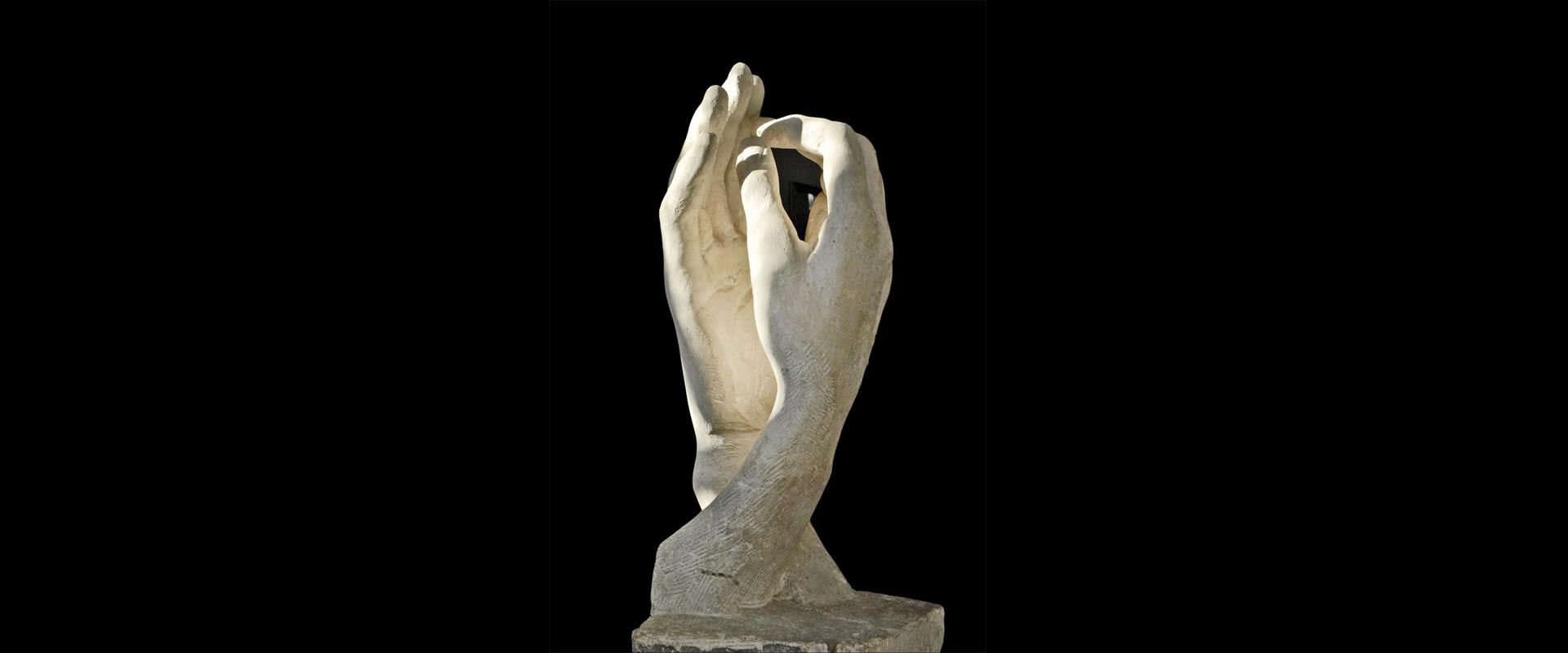
Art Note: The Cathedral (1908) by Auguste Rodin. Two right hands, from two different figures, held a fraction of an inch apart — neither grasping nor guiding, just meeting. © Musée Rodin, Paris. Collection page. Public-domain sculpture (1908)

